



By BONIFACE KASSAM
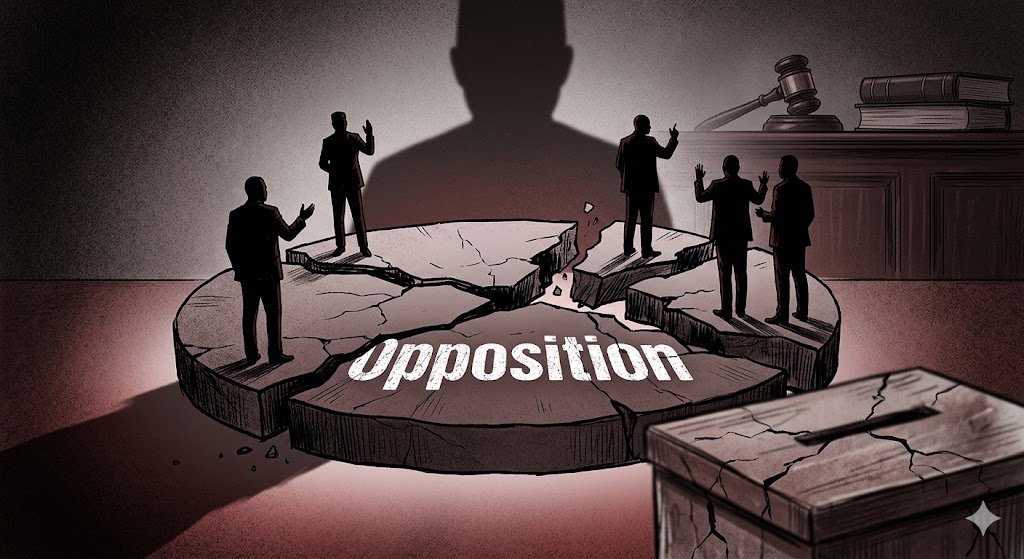
As preparations gather momentum across Nigeria’s registered political parties ahead of the 2027 general elections, internal crises have simultaneously taken centre stage.
Several parties are currently entangled in disputes, with multiple litigations still pending in court.
Among the hardest hit are the Peoples Democratic Party (PDP) and, more recently, the African Democratic Congress (ADC).
Unsurprisingly, accusing fingers are being pointed at the ruling All Progressives Congress (APC), with critics alleging that the crises are being fuelled through the subtle machinations of the Presidency.
While these claims remain largely speculative, the perception of external interference continues to shape public discourse around the instability within opposition ranks.
Defections, a fragile political advantage
One immediate consequence of these internal wranglings is a wave of defections sweeping across party lines, with the ruling APC emerging as the primary beneficiary.
However, political analysts warn that this apparent advantage may be short-lived. The convergence of diverse political interests—particularly the struggle for dominance between long-standing party loyalists and new entrants—poses a significant risk.
Many observers describe the situation as a “keg of gunpowder,” capable of igniting deeper conflicts within the ruling party itself.
Coalitions, uncertainty, emerging tensions
Adding another layer of complexity is the defection of key political figures such as Peter Obi, former presidential candidate of the Labour Party, and Rabiu Musa Kwankwaso, leader of the NNPP, to the Nigerian Democratic Congress (NDC), a coalition platform led by the former Governor of Bayelsa State, Serieke Dickson.
This move, however, is already facing setbacks due to alleged internal disagreements.
Political watchers suspect that unseen political forces may once again be influencing developments behind the scenes.
Meanwhile, in line with guidelines issued by the Independent National Electoral Commission (INEC), the process for the purchase of Expression of Interest and Nomination forms has commenced across parties, with aspirants positioning themselves for various elective offices.
The APC has recently extended its deadlines, while some opposition parties are yet to fully kick off their processes, still grappling with internal restructuring and ongoing membership drives.
A test of unity ahead 2027
Against this backdrop, a critical question remains: will any opposition party emerge sufficiently united and legally unencumbered to mount a credible challenge against the ruling APC in 2027?
At present, legal battles appear to be the most significant constraint facing opposition parties.
Whether these challenges are self-inflicted or the result of calculated political manoeuvring remains a matter of debate.
What is clear, however, is that unless these issues are resolved promptly, they could significantly weaken the opposition’s chances—raising concerns about the competitiveness and balance of Nigeria’s democratic process in the forthcoming elections.
Kassam, former Editor of SATURDAY STANDARD, writes from Jos