



In Plateau State, where tensions can escalate quickly and trust is often fragile, the work of journalists is increasingly shaped not just by events on the ground but by what circulates online. Against this backdrop, CHRISTIANA LOT, SEKYEN WALSHAK & NANCY MAJEKODUNMI examine how artificial intelligence, AI, social media and misinformation are transforming conflict reporting, peacebuilding and public perception across the state
A video showing burning houses landed in a journalist’s WhatsApp inbox. Within minutes, the footage spread across Facebook pages and X timelines, accompanied by alarming claims of another violent attack in Plateau State.
Fear, as always, moves faster than facts.
Angry reactions quickly followed. Communities began accusing one another, while some users openly called for retaliation. The video was forwarded repeatedly across groups and timelines as tension quietly built.
Hours later, fact-checkers discovered the footage was not from Plateau State—or even Nigeria. But by then, the damage had already been done.
In communities already weighed down by mistrust and recurring tensions, misinformation can deepen divisions long before the truth catches up.
Plateau State has repeatedly witnessed the spread of false online claims during periods of crisis. Recycled videos, misleading images and unverified casualty figures often made the rounds on WhatsApp, Facebook and X.
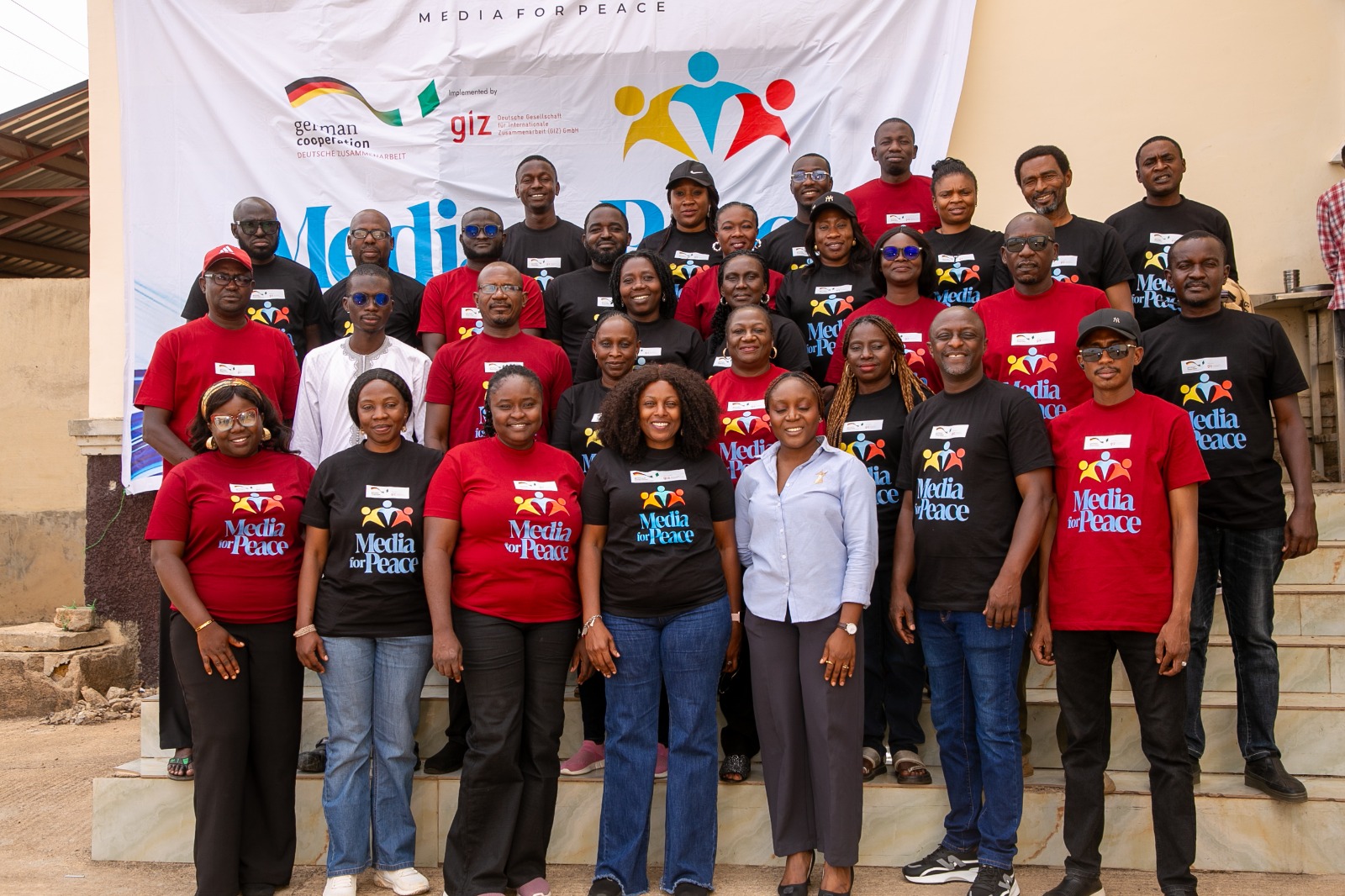
In several cases, journalists and fact-checkers have had to debunk claims capable of escalating panic and worsening already fragile situations. This growing digital challenge became one of the major concerns during a three-day Media for Peace training organised by the German Agency for International Cooperation (GIZ) in partnership with the Plateau State Peace Building Agency under the PEACECORE Programme in Jos.
Held at Crispan Suites and Event Centre, the workshop brought together journalists from various media organisations across Plateau State to examine how digital media, artificial intelligence, misinformation and online narratives were reshaping conflict reporting, peacebuilding and public trust.
Inside the training room: Journalism in the digital age
Inside the conference hall, journalists listened closely as facilitators projected manipulated images, misleading social media posts and AI-generated content onto large screens. The demonstrations showed just how easily false narratives could spread online and trigger emotional reactions before proper verification took place.
Although the training broadly focused on conflict-sensitive reporting, communication development and peacebuilding, much of the discussion centred on the rapidly evolving digital media landscape and the risks emerging from the misuse of technology.
From deepfakes and manipulated videos to online hate narratives and emotionally charged misinformation, facilitators warned that journalists were now operating in an information ecosystem far more complex and volatile than ever before.
Researcher and reporter, Abdullahi Murtala, explained that digital media had transformed nearly every aspect of journalism and public communication.
According to him, social media was no longer just a platform for interaction. It now shaped narratives, drives political conversations, influences emotions and affected how communities perceived one another.
He noted that many people had become deeply attached to social media platforms, relying on them not only for information but also for validation, identity, work and social engagement.
“False information does not only spread pictures or videos, it spreads emotions,” he said.
“When people see certain posts online, they react with fear, anger, panic, or hatred. Some narratives are deliberately framed to create division through religion, ethnicity, or politics. That is why journalists must prioritise verification and accuracy over speed, because vitality does not equal truth.”
Murtala warned that digital platforms could easily inflame tensions in fragile societies like Plateau State, where longstanding ethnic and religious divisions had already left communities vulnerable to inflammatory narratives.
According to him, online actors often exploited emotional language, sensational framing, and “us versus them” narratives to provoke outrage and deepen polarization.
For journalists working in conflict-prone areas, a single misleading post could trigger panic far beyond the reach of traditional rumours.
The digital battlefield
The workshop also explored how journalism itself was rapidly evolving in the digital era. Murtala explained that many newsrooms were adapting their storytelling for online audiences through multimedia reporting, visual journalism, podcasts, TikTok explainers, interactive graphics and social media-first reporting.
“Media organisations are investing heavily in digital platforms because that is where audiences are now,” he said.
He added: “You can write a long article and still produce a TikTok explainer, a Facebook post, or a short Instagram video version for different audiences.”
He added that digital tools were improving journalism in several ways. As a result, community members could now send videos directly from locations journalists may struggle to access, while satellite imagery, mapping tools and geolocation techniques help reporters investigate incidents and verify locations more effectively.
At the same time, however, those same technologies were increasingly being used to manipulate information.
AI, the new information disorder
Facilitator, Lois Ugbede, of the Centre for Journalism Innovation and Development and Dubawa described artificial intelligence as one of the biggest forces currently reshaping the information ecosystem.
According to her, the traditional era of information gatekeeping had changed dramatically.
“Before now, if people wanted information, they relied more on radio, television, and newspapers where there was more control over what got published,” she said.
“But today, anybody with internet access can sit in their room and publish anything online,” she added.
She explained that AI had made the challenge even more complicated because technology could now manipulate audio, images and videos in highly convincing ways.
“Artificial intelligence can make people appear somewhere they have never been or say things they never said,” she noted.
Ugbede explained that misinformation, disinformation and malinformation continued to distort public understanding and weaken social cohesion online, especially when amplified by sensational headlines and algorithm-driven engagement systems.
According to her, many online campaigns were now strategically coordinated, with some accounts creating narratives while others amplified them through reposts, engagement and repeated circulation.
She added that social media algorithms often favoured emotional and divisive content because such posts generated stronger engagement, allowing misleading claims to spread faster than verified information.
This, she explained, created echo chambers where users were repeatedly exposed to information that reinforced their existing beliefs.
Language, ethics, the responsibility of journalism
Beyond technology and digital trends, facilitators repeatedly stressed the responsibility journalists carry in shaping public perception during periods of conflict.
Speaking on communication development and peacebuilding, Lady Irene David, Senior Communications Executive and Founder of LIDA Network, emphasised that every action—or inaction—by journalists carried consequences, especially in fragile communities where reports could either promote peace or fuel tensions.
According to her, hate speech, sensational reporting and biased narratives remained among the major factors undermining peace and social cohesion.
She urged journalists to intentionally promote balanced, accurate and conflict-sensitive reporting capable of encouraging dialogue, understanding and unity.
“Ethical journalism remains essential to peacebuilding, conflict prevention, and fostering trust within communities,” she said.
David also challenged journalists to uphold professionalism and responsibility in their reporting, noting that the pressure to break news quickly should never override accuracy and ethical standards.