



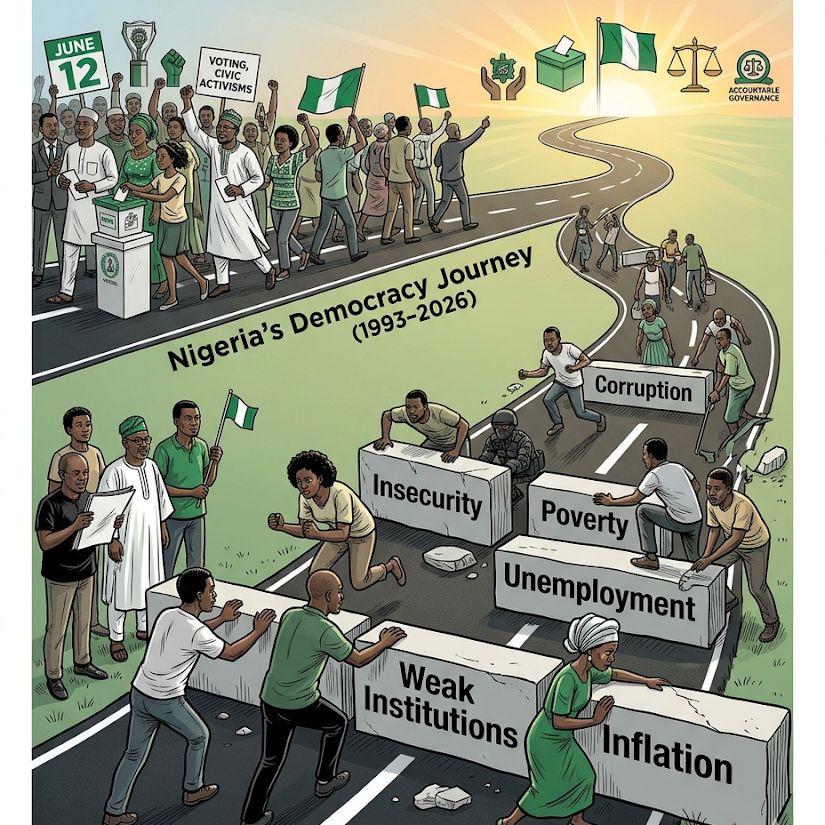
As Nigerians mark another Democracy Day, the occasion presents an opportunity not only to celebrate the restoration of civil rule but also to examine the state of the nation’s democratic experiment. In this insightful reflection, DAN MANJANG traces the historical significance of June 12, reviews the gains made since the return to democratic governance, and highlights the persistent challenges of poor leadership, insecurity, corruption, weak institutions and economic hardship. He argues that while democracy has endured, its true success will ultimately be measured by its ability to improve the lives of ordinary Nigerians
Every year on June 12, Nigerians commemorate Democracy Day, a day set aside to celebrate the nation’s democratic journey and honour the sacrifices of those who fought for civil rule. Democracy Day is not merely a public holiday. It is a solemn reminder of the struggles, aspirations, victories and disappointments that have characterised Nigeria’s democratic experience.
It is a day for reflection on how far the country has come and how far it still has to go in achieving the ideals of freedom, justice, equality and good governance.
The history of Democracy Day in Nigeria is deeply rooted in the events of June 12, 1993, when Nigerians participated in what is widely regarded as the freest and fairest election in the country’s history. The election was won by Chief Moshood Kashimawo Olawale (M.K.O.) Abiola, a businessman and philanthropist whose victory transcended ethnic, religious and regional divisions.
However, the military government of General Ibrahim Babangida annulled the election, plunging the country into political turmoil and widespread protests. The annulment remains one of the darkest chapters in Nigeria’s political history.
The struggle that followed the annulment led to years of political instability, repression and human rights abuses. Pro-democracy activists, journalists, labour leaders, students and ordinary citizens risked their lives in demanding the restoration of democratic governance. Many were imprisoned, tortured, forced into exile or even killed. M.K.O. Abiola himself was detained after declaring himself the rightful president and eventually died in custody in 1998 under controversial circumstances.
Following the death of General Sani Abacha and the transition programme initiated by General Abdulsalami Abubakar, Nigeria returned to civilian rule on May 29, 1999, with the inauguration of President Olusegun Obasanjo. For many years, May 29 was celebrated as Democracy Day. However, in 2018, President Muhammadu Buhari officially recognised June 12 as Democracy Day in honour of the sacrifices associated with the annulled election and the democratic struggle that followed. The move was widely welcomed as a symbolic act of historical justice.
Since the return to democratic rule in 1999, Nigeria has experienced uninterrupted civilian governance, making it the longest democratic period in the country’s history. Several elections have been conducted, governments have changed through the ballot box, and democratic institutions have continued to evolve. This continuity is, in itself, a significant achievement considering Nigeria’s history of military coups and political instability.
Democracy’s gains, unfulfilled promises
However, despite these gains, many Nigerians question whether democracy has delivered on its promises. One of the greatest challenges confronting the nation is poor governance. Democratic government is expected to improve the welfare of citizens, provide security, create jobs and ensure equitable development.
Yet millions of Nigerians continue to grapple with poverty, unemployment, inflation and inadequate social services. The gap between the political elite and ordinary citizens appears wider than ever.
Corruption remains another major obstacle. Successive administrations have pledged to fight corruption, but the problem persists across different levels of government. Public resources that should be used for infrastructure, healthcare, education and economic development are often diverted for private gain.
As a result, many citizens have become cynical about politics and governance, viewing public office as a pathway to personal enrichment rather than public service.
Electoral integrity also continues to raise concerns. While technological innovations such as electronic accreditation and result transmission have improved aspects of the electoral process, allegations of vote-buying, electoral violence, manipulation and judicial interference still undermine public confidence.
Many Nigerians feel that elections often fail to reflect the genuine will of the people, thereby weakening democratic legitimacy.
Security challenges have equally tested the nation’s democracy. Insurgency in the North-East, banditry in the North-West, farmer-herder conflicts in the Middle Belt, separatist agitations in the South-East and widespread kidnapping across the country have created an atmosphere of uncertainty. Citizens cannot fully enjoy democratic freedoms where insecurity threatens lives and livelihoods on a daily basis.
Furthermore, the quality of leadership remains a recurring concern. Democracy thrives when leaders are accountable, visionary and responsive to the needs of the people. Unfortunately, political patronage, godfatherism, ethnicity and religious considerations often overshadow competence and merit in leadership selection. Consequently, many elected officials fail to meet public expectations.
Why many Nigerians remain sceptical
Against this backdrop, one may ask: Is there light at the end of the tunnel? The answer is difficult and perhaps doubtful. While there are reasons for cautious optimism, the pace of progress has been disappointingly slow. More than two decades after the return to civilian rule, many of the structural problems that democracy was expected to solve remain unresolved.
One reason for scepticism is the apparent weakness of institutions. Strong democracies depend on independent institutions capable of enforcing laws and holding leaders accountable.
In Nigeria, institutions are often influenced by political interests, making accountability difficult. Until institutions become stronger than individuals, democratic consolidation will remain elusive.
Another reason for doubt is the growing disillusionment among young people. Many youths feel excluded from governance despite constituting the majority of the population.
High unemployment, economic hardship and limited opportunities have created frustration and weakened faith in the democratic process. A democracy that fails to inspire its youth risks losing its future.
Grounds for hope, way forward
Nevertheless, all hope is not lost. The increasing political awareness among citizens, the vibrancy of civil society organisations, the resilience of the media and the active engagement of young Nigerians in governance issues offer grounds for hope. Social media and digital technology have empowered citizens to demand accountability and participate more actively in public discourse than ever before.
Ultimately, Democracy Day should not merely be a celebration but an occasion for honest reflection. Democracy is not a destination but a continuous journey requiring vigilance, sacrifice and commitment from both leaders and citizens.
Nigeria’s democratic project remains a work in progress. The dream of a prosperous, secure and just society is still alive, but achieving it will require courageous leadership, institutional reforms, electoral integrity, economic inclusion and an unwavering commitment to the rule of law.
As Nigerians mark another Democracy Day, the question remains whether the nation will finally translate democratic ideals into tangible benefits for its people. The answer lies not in speeches or ceremonies but in deliberate actions that place the welfare of citizens above personal and political interests
Until then, while there may be a faint light at the end of the tunnel, many Nigerians will continue to view it with understandable caution and doubt.
Manjang, mnipr, M.Div, former Plateau State Commissioner of Information and Communication, writes via dmanjang@gmail.com