



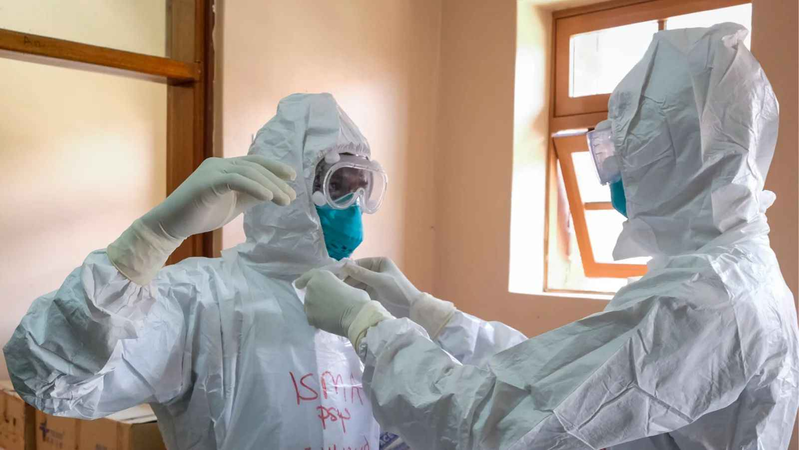
HOSEA NYAMLONG revisits one of the defining moments in Nigeria’s modern public health history — the 2014 Ebola outbreak that threatened to overwhelm Africa’s most populous nation. He examines how decisive leadership, courageous healthcare professionals, rigorous contact tracing and public cooperation transformed a looming catastrophe into a globally celebrated success story, while reminding Nigerians that the lessons of Ebola remain vital in an era of recurring health emergencies
Exactly twelve years ago, Nigeria faced one of the most serious public health emergencies in its history when the Ebola Virus Disease (EVD) threatened to spread across the country.
Through decisive government action, the extraordinary commitment of healthcare workers, aggressive contact tracing and widespread public cooperation, Nigeria successfully contained the outbreak and earned global recognition as a model for epidemic response.
The outbreak that threatened a nation
The crisis began on July 20, 2014, when a Liberian-American diplomat infected with Ebola arrived at the Murtala Muhammed International Airport in Lagos.
He collapsed shortly after arrival and was taken to First Consultant Medical Centre in Obalende, Lagos, where he was later diagnosed with the virus.
His arrival marked the beginning of Nigeria’s battle against one of the world’s deadliest infectious diseases.
One of the most unforgettable moments of the outbreak came on August 8, 2014 — a day many Nigerians still remember as “Salt Day”.
Fuelled by viral misinformation on social media, millions believed that drinking or bathing with warm salt water could prevent or cure Ebola. The rumour spread rapidly through Facebook posts, WhatsApp messages and text alerts, triggering nationwide panic.
Families consumed dangerous amounts of salt water, while others sprinkled salt around their homes, convinced it would ward off the virus. Provision stores sold out of salt within hours.
The false cure had tragic consequences. Several people died from excessive salt consumption, while many others were hospitalised with severe dehydration, hypertension, kidney failure and electrolyte imbalance, particularly those with underlying health conditions.
Health authorities and medical experts quickly debunked the claim, stressing that there was no scientific evidence to support it.
They urged Nigerians to rely only on verified information from the Federal Ministry of Health and the World Health Organization (WHO).
‘Salt Day’ remains one of the clearest examples of how misinformation during a health emergency can be as deadly as the disease itself.
Ebola was first identified in 1976 during two simultaneous outbreaks in Central Africa — one near the Ebola River in what was then Zaire, now the Democratic Republic of Congo, and the other in Sudan. Since then, the virus has resurfaced across Africa with devastating fatality rates.
But Nigeria’s story took a different turn. Instead of an uncontrolled spread in Africa’s most populous nation, health authorities launched an aggressive response.
Thousands of contacts were traced and monitored, infected persons were isolated, and massive public awareness campaigns educated citizens on symptoms, prevention and the need to report suspected cases promptly.
The courage that changed the course of history
At the heart of that success was Dr Ameyo Adadevoh, Lead Consultant Physician and Endocrinologist at First Consultant Medical Centre, Obalende.
Despite pressure to discharge the index patient, Dr Adadevoh insisted that he remain in isolation — a decision that likely averted a national catastrophe. She contracted the virus while treating patients and died on August 19, 2014.
Her courage and professionalism are widely credited with saving countless lives. She remains one of Nigeria’s greatest public health heroes.
On October 20, 2014, the World Health Organization officially declared Nigeria Ebola-free after the country completed 42 days without a new confirmed case following the discharge of the last patient.
Announcing the milestone in Abuja, WHO Country Representative, Dr Rui Vaz, described Nigeria’s achievement as proof that Ebola could be contained through coordinated action. He cautioned, however, that the global fight would continue until all affected countries had eliminated the virus.
Nigeria’s response became a global case study, demonstrating that a well-coordinated public health system, supported by leadership, transparent communication, rapid surveillance and community participation, can defeat even the deadliest outbreaks.
The lessons Nigeria must never forget
Twelve years later, Ebola remains a threat in parts of Africa. The Democratic Republic of Congo is currently battling another outbreak caused by the rare Bundibugyo strain, with thousands of cases and significant loss of life.
The resurgence underscores that Ebola remains a serious regional and global concern.
In Nigeria, health authorities say there are currently no confirmed cases. Nevertheless, the Federal Government has strengthened surveillance at border points, intensified preparedness measures and announced emergency interventions, including a Presidential Task Force and dedicated funding.
Citizens are urged to maintain good hygiene, report suspected symptoms promptly and avoid sharing unverified information that could trigger unnecessary panic.
The 2014 outbreak taught Nigeria hard but invaluable lessons: invest in laboratories, surveillance systems, emergency response infrastructure and the healthcare workforce; communicate clearly and transparently; fight misinformation aggressively; and recognise that public cooperation is the foundation of every successful response.
As Nigeria marks this important milestone, it is fitting to honour those who lost their lives, celebrate the bravery of frontline workers and acknowledge the resilience of ordinary Nigerians who followed public health directives.
Their sacrifice helped build a stronger public health system and demonstrated that protecting the nation from infectious diseases is a shared responsibility requiring vigilance, unity, science and unwavering commitment from government, healthcare professionals, the media and every citizen.
Ebola tested Nigeria. Nigeria passed.
The challenge now is to ensure that the lessons of that triumph are never forgotten.