



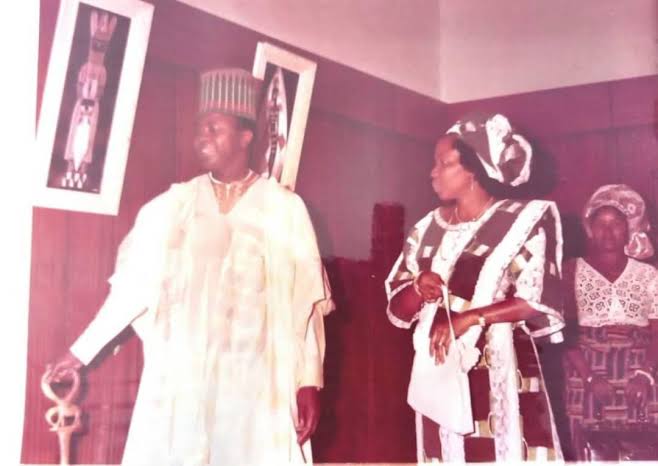
The proposed Solomon and Mary Lar Institute for Leadership Studies offers more than an opportunity to preserve the memory of two distinguished Nigerians. For JONATHAN ISHAKU, it presents a chance to recover the ideas, values and philosophy of service that shaped their lives, particularly Solomon Lar’s doctrine of Emancipation, and transform that legacy into a living institution capable of preparing a new generation of leaders
I received with great pleasure the news that plans are afoot to establish the Solomon and Mary Lar Institute for Leadership Studies. For me, the proposal is significant not merely because it seeks to preserve the memory of two distinguished Nigerians, but because it offers an opportunity to recover, institutionalise and transmit a philosophy of leadership that our society increasingly needs.
In several of my writings over the years, I have expressed profound respect for the late Chief Solomon Daushep Lar, former Governor of Plateau State and one of the most consequential political leaders produced by Nigeria’s Middle Belt.
At the same time, I have repeatedly regretted that much of the intellectual and developmental content of his political legacy, particularly the philosophy he called Emancipation, has not been sufficiently preserved, studied or transmitted to succeeding generations.
That is why the proposed Institute strikes me as both timely and important. A legacy as consequential as Lar’s should not survive merely in anniversaries, memorial lectures, political reminiscences or the fading memories of those who witnessed his era. It should become a body of knowledge: interrogated, documented, taught and applied to the continuing problems of leadership, governance and human development.
My admiration for Chief Solomon Lar has never rested merely on the offices he occupied. Nigeria has produced countless office-holders like him. Far fewer, like him, however, have succeeded in converting political office into an instrument for transforming the lives of ordinary people.
Chief Solomon Lar, as Governor of the old Plateau State, which included the present Nasarawa State and parts of the FCT, Abuja, during the Second Republic, governed for only a comparatively brief period of four years and three months before another military intervention terminated the democratic rule of the Second Republic.
Yet within that short period, his administration pursued a focused programme of human, institutional, social and infrastructural development which, measured against the disappointingly modest expectations of governance these days, appears almost extraordinary.
At the heart of that administration was one word that became inseparable from the Lar political philosophy: Emancipation.
But Emancipation was never intended merely as a campaign slogan. It was a philosophy of governance and a conception of society. It meant freeing people from poverty, ignorance, political exclusion and the structures that condemned communities to the margins of development. It sought to make government not an institution standing above the people, but an instrument through which ordinary citizens could enlarge their opportunities and take greater control of their own destinies.
Education, therefore, became one of its most important instruments. The Lar administration established 117 new secondary schools, three new teachers’ colleges and two tertiary educational institutions; built and stocked five divisional libraries, as they were then known; and established, for the first time, the Teachers’ Service Commission to strengthen the quality, welfare and administration of the educational sector. Think about it: all these in four years!
But Emancipation extended beyond the classroom. It meant creating economic opportunities and productive institutions. The administration established the large-scale mechanised BARC Farms at Zalaki, covering some 5,000 hectares, and commissioned Jos International Breweries (JIB), which became not only an important industrial enterprise but, together with BARC, a significant source of employment in the state.
I could go on and on, for the other sectors.
The more important point, however, is that Emancipation sought to give ordinary people confidence that government could become an instrument of their advancement and liberation rather than another structure of domination — the kind their communities had experienced under colonialism, feudalism and political marginalisation.
Therein lies an important lesson for this generation. And therein, too, lies the deeper justification for establishing an Institute bearing the names of Solomon and Mary Lar: not merely to memorialise two remarkable lives, but to recover the ideas behind them and put those ideas to work in the formation of new generations of leaders.
When the Middle Belt meant something
The Middle Belt idea of the generation that begat the Lars was embedded in a much deeper political philosophy of liberation. It arose from historical experiences of marginalisation and from the determination of its peoples to secure political recognition, educational advancement, economic opportunity and equality within the Nigerian federation.
For leaders such as Solomon Lar, therefore, the Middle Belt was not simply a geographical expression or an electoral catchphrase.
It represented a cause. It represented the demand that communities historically pushed to the margins should become full participants in determining their political, economic and social destinies.
Unfortunately, much of that intellectual content has gradually disappeared from contemporary political discourse. Today, the Middle Belt is increasingly mouthed as a sterile slogan of political opportunism — sometimes invoked only when elections approach and conveniently forgotten when the harder struggle for genuine human development begins.
The distinction is fundamental. Solomon Lar’s impact derived partly from a deep understanding of power and what political power ought to accomplish. He understood that political emancipation without economic emancipation is incomplete.
That political representation without education is fragile. That identity without development can become an empty slogan. And that leadership without service eventually degenerates into the mere occupation of office.
The challenge before the present generation, therefore, is not simply to repeat the political vocabulary of leaders such as Solomon Lar. It is to rediscover the ideas behind that vocabulary and determine how those ideas can speak to the very different Nigeria of today.
That is precisely where an Institute devoted to leadership training can become important. Chief Lar’s public career extended far beyond his governorship.
He spent much of his adult life in public service and politics, repeatedly using the opportunities available to him to contribute to Plateau State, the Middle Belt and Nigeria.
Whether as legislator, federal minister, governor, opposition figure or national party leader, his politics was characterised by a remarkable combination of conviction, resilience, bridge-building and commitment to democratic participation.
But beneath those different roles was a relatively simple proposition: politics should ultimately be about people. The enduring test of leadership lies in the people whose opportunities were enlarged, the institutions that were strengthened and the communities left better than they were found.
This is why the proposed Solomon and Mary Lar Institute for Leadership Studies deserves support far beyond the Lar family or the Foundation bearing their names. It offers an opportunity to convert memory into institution and legacy into curriculum.
The significance of the proposed Institute also lies in the fact that the legacy it seeks to preserve is not Solomon Lar’s alone. Beside his remarkable political career stood Professor Mary Lar, an accomplished educator whose life demonstrated that leadership is not confined to elective politics or Government House.
If Chief Lar pursued emancipation predominantly through politics, government and democratic mobilisation, Professor Mary Lar pursued another dimension of emancipation through education. Her involvement in expanding educational opportunities for nomadic communities in Nigeria addressed a fundamental question: How does a nation ensure that children beyond the reach of conventional schooling are not abandoned?
Her pioneering work demonstrated the patient intellectual and institutional leadership required to translate social policy into opportunities for marginalised people. She subsequently extended her public service into diplomacy, representing Nigeria abroad.
Thus, Solomon and Mary Lar represent two complementary traditions of leadership: one through politics, government and democratic mobilisation; the other through education, scholarship, social inclusion and public service.
Their paths differed, but the principle was the same: Leadership exists to enlarge human possibilities.
From legacy to institution
That principle should lie at the heart of the proposed Solomon and Mary Lar Institute for Leadership Studies. The Institute must not become merely another memorial institution bearing the names of distinguished Nigerians. Nigeria already has roads, monuments, buildings and institutions named after departed leaders. Names by themselves do not transmit values.
The Institute will justify the names it bears only if it succeeds in transforming their values and experiences into knowledge capable of shaping another generation.
It should become a living laboratory of leadership where politicians learn that public office is responsibility rather than entitlement; civil servants encounter integrity and accountability; community leaders study conflict management and peaceful coexistence; and young people learn that leadership begins long before appointment or election.
It should equally provide serious programmes for women, business executives, civil-society actors, educators and professionals, while serving as an intellectual centre for research into leadership, governance, development and nation-building.
In short, it should not simply preserve the past. It should prepare leaders for the future. The timing could hardly be more appropriate.
Nigeria possesses enormous human and material resources, yet continues to struggle with poverty, insecurity, weak institutions, corruption, unemployment, social fragmentation and underdevelopment. Running through virtually all these problems is the question of leadership.
Resources require leadership. Institutions require leadership. Security, economic development, national cohesion and democracy all require leadership.
Leadership education must therefore move beyond motivational speeches and abstract theories. Nigeria needs leaders of character, competence and service. Character without competence can produce well-intentioned failure.
Competence without character can produce sophisticated corruption. Power without service produces arrogance. Vision without execution produces promises.
Leadership requires the integration of character, knowledge, competence, responsibility and service. I am particularly attracted by the Institute’s proposed philosophy of Absolute Leadership:
Integrity, service, competence, vision, courage, accountability, inclusiveness, excellence, innovation and legacy should not merely decorate the Institute’s walls. They should constitute its curriculum.
Students should confront real leadership problems through case studies of Nigerian and African experiences, examining ethical dilemmas, public finance, institution-building, conflict resolution, constitutional government, development and the management of diversity.
The Lar experience itself should become material for critical study rather than uncritical celebration: What worked? What did not? Why? What lessons remain relevant to contemporary Nigeria?
That is how the Institute can transform legacy into knowledge. The proposed progression from leadership skills and certificate programmes to diploma courses, executive education, research, consultancy and eventually postgraduate studies is commendable.
But expansion must never come at the expense of standards. The Institute should aspire to produce certificates respected because its training is rigorous, research influential because it is credible, and graduates recognised by the quality of leadership they provide.
Its true products should, therefore, be people and ideas, not certificates. Partnerships with universities, professional bodies and reputable national and international institutions can strengthen its reach. A research and documentation centre could also preserve important materials on the Lars and the wider history of political thought, leadership, democratic struggle and social transformation in Plateau State, the Middle Belt and Nigeria.
Conclusion
Chief Solomon Lar’s Emancipation philosophy was ultimately about freeing people to fulfil their potential. Professor Mary Lar’s educational work similarly extended opportunity to people whom circumstances might otherwise have excluded.
The two traditions therefore converge around one enduring proposition: Leadership should enlarge human possibilities.
Nigeria needs better leadership. But better leadership will not emerge merely because we complain about bad leadership. It must be deliberately cultivated, intellectually grounded, ethically formed, practically tested and transmitted from one generation to another.
That should be the historic assignment of the Solomon and Mary Lar Institute for Leadership Studies. Properly conceived, professionally managed and protected from partisan politics and personality worship, it can become more than a memorial.
It can become a school of ideas, a nursery of leaders and a centre for the recovery of the true meaning of public service — a bridge between the Emancipation philosophy of one remarkable generation and the leadership responsibilities of generations yet unborn.
That would be Emancipation renewed. And that would be a legacy worthy of Solomon and Mary Lar.
Nde Ishaku, a journalist, essayist, author and lecturer, writes via bishilee2017@gmail.com