



From SAMUEL MATHIAS, Minna
For families who watched their loved ones leave home in search of a livelihood, the return was not by the road they expected, but through a morgue.
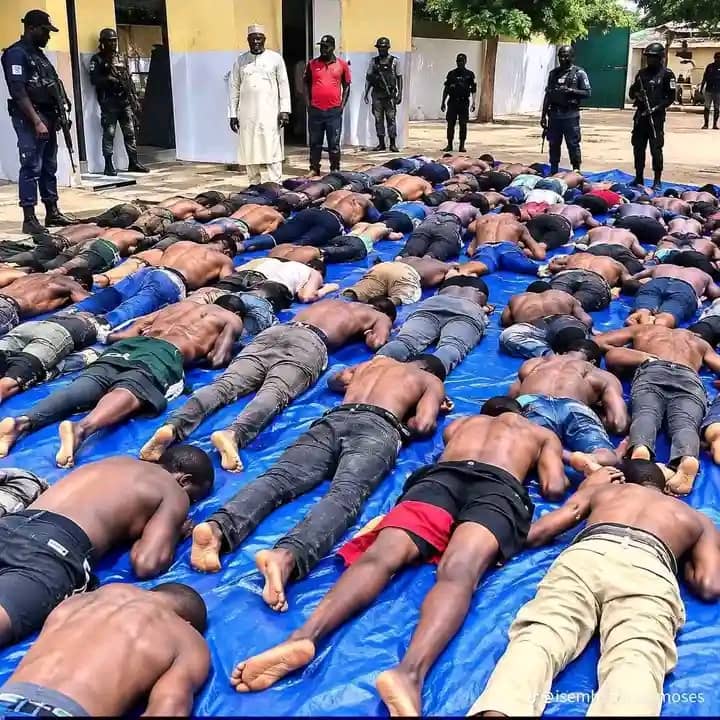
In the space of two days, an operation against suspected illegal mining in Minna turned into a tragedy that left dozens dead in custody, with survivors recounting suffocating heat, overcrowding, pleas for water and an alleged unexplained substance sprayed inside their cell.
It will be recalled that the Nigeria Security and Civil Defence Corps (NSCDC), on September 15 and 16, conducted an operation at an illegal mining site in the M.I. Wushishi/Lakpma area of Minna, Niger State.
The operation, initially described as successful, ended in tragedy.
About 37 artisanal miners, including teenagers aged between 14 and 17, reportedly died while in NSCDC custody.
What should have been a routine enforcement operation has now raised questions about the treatment of the detainees, the conditions under which they were held and whether constitutional limits governing detention were observed.
Questions over detention
Upon news of the deaths on Thursday morning, September 17, residents took to the streets in protest.
The demonstration led to a breakdown of law and order, with public infrastructure vandalised, government commercial buses destroyed and private property worth millions of naira attacked. A fresh death was also recorded during the unrest.
To restore calm, the state government imposed a three-day curfew in Minna.
The protesters demanded a clear explanation of how 37 people died while in detention.
In a statement issued to journalists in Minna on Thursday, September 17, the Command’s Public Relations Officer said the operations on Tuesday and Wednesday targeted suspected illegal miners, leading to the arrest of scores of suspects, with various exhibits recovered.
The Command confirmed that detainees died in the early hours of Thursday following a suspected outbreak of disease.
“The corpses of the deceased suspects have since been deposited at the General Hospital, Minna, for further medical examination to establish the actual cause of death,” the statement explained.
However, the NSCDC did not give a figure for the number of deaths, while protesters’ claims of between 34 and 37 deaths could not be independently verified at the time.
The Command appealed for calm as investigations continued.
Reacting on Thursday, Niger State Governor, Mohammed Bago, disclosed that preliminary accounts from survivors pointed to poor ventilation and excessive heat in the overcrowded cell.
“According to some of the survivors, the cell they were kept in was too small to accommodate their population, so as a result, their colleagues died on the basis of poor ventilation and heat,” Bago said.
He added that symptoms observed on some bodies suggested that the deceased might have also inhaled a toxic substance suspected to be carbon monoxide at the illegal mining site.
The governor said experts would be invited from Abuja to examine the mining site and soil samples to determine what happened.
He announced that the Department of State Services (DSS), NSCDC and other security agencies had constituted a 10-man investigative committee, chaired by Deputy Governor Yakubu Garba, with the Commissioner for Homeland Security, Maurice Magaji, as secretary.
Forensic audits and autopsies, he said, would be conducted.
“Life is life. Government will not tolerate any form of injustice. We will make sure we probe the matter to the letter,” he declared.
Bago also ordered the closure of illegal mining sites around M.I. Wushishi and other locations, warning that violators would be prosecuted.
Federal Government intervenes
The Minister of Interior, Olubunmi Tunji-Ojo, on Friday led a Federal Government delegation on a condolence visit to Minna and announced the suspension of the State Commandant, Suberu Siyaka Aniviye.
“It is an unfortunate incident. However, a full investigation will be conducted while the Commandant under whose watch this happened remains suspended. We run a government whose ultimate priority is the security of lives,” Tunji-Ojo said.
On Saturday, September 19, the Ministry announced the suspension of 21 operatives linked to the operation to allow for an independent investigation.
Those suspended included the Niger State Commandant, Suberu Siyaka Aniviye; O/C Station Guard, SC Usman Isah Ndamaka; Station Guard, ASC I Hassan Mohammed; Station Guard, CCA Bala Mohammed; Arresting Officer/O/C Investigation, CSC Oluwadare Sunday; Arresting Officer, DCC Obafemi Elvis; Arresting Officer, CSC Annas Shitto Lamino; HOD INT/INV, DCC Philip Ajayi; O/C Legal, ACC Barr. Stephen Tsado; Night Duty Officer, ASC I Alhassan Mohammed; and 11 Guard Duty Officers: IC Abdullahi Sale, IC Mohammed Sonfada, CAI Liman Abubakar, CAI Bala Usman, IC Mohammed Jiya, DSC Isah Suleiman, CAI Ahmed Wushishi, IC Sale Adamu, IC Haruna Mohammed, ASC I Aliyu Sallah and CAI Isah Sanusi.
A new commander has since been deployed to take over the Command.
In a statement by the Command’s spokesperson, DSC Abubakar Muti, the new Commandant explained: “At a moment like this, beyond arrests, investigations, enforcement and the fight against illegal mining, we must remember one fundamental truth: every human life matters. The loss of any human life is painful, and our thoughts and prayers are with the families who are mourning.”
Survivors’ testimonies
For those who survived the ordeal, the explanation of a disease outbreak does not answer what they say they experienced inside the cell.
Survivors who spoke to Governor Bago and Minister Tunji-Ojo gave disturbing accounts.
“As they were about to lock the room, they sprayed something that looked like perfume, and the smell started disturbing everyone in the room,” one survivor said.
Another survivor said 17 people were initially detained in a small room before more detainees were brought in on September 16 from the site around Lt. Gen. M.I. Wushishi Estate.
“They locked us in a very small room. We were 17 in number, then they added more people, and we started complaining that the room was small,” he explained.
He narrated how people began to collapse as the room became extremely hot. Pleas for water were allegedly ignored.
“We pleaded with them to give us water, but they said no one would open the door for us. We were screaming for help and told them people are dying one after the other. They did not believe us,” he moaned.
According to another survivor, who asked not to be named, he survived because he was close to the entrance, where he could breathe better.
Dauda Shehu from Allawa, Shiroro Local Government Area, gave this account: “We were not beaten or tortured but the cell they kept us in was too small and tight. We were stuffed in a room where we struggled to breathe… We banged the door, we begged several times… Even when we raised the alarm that some people were already dying, nobody answered us. Some of us even urinated on our bodies.”
He claimed that 65 people were arrested, but only six were taken to the General Hospital for tests.
“Where are the remaining 26 people if truly they claim that only 33 died? We were 65 people that they arrested,” he insisted.
“We are residents of Allawa community… We were chased by bandits and kidnappers, so we came here to find a means of survival… We are not bandits, we do not carry arms. We are only searching for survival.”
Another survivor claimed: “Some people died last night and many died this morning.”
An eyewitness, Yazid Aliyu, who monitored the operation, challenged the NSCDC account.
“Our parents are poor, we have to support ourselves to pay tuition fees. We are not illegal miners, we are mining legally. The land we are mining on was legally given to us by the owner. Civil Defence does not have the right to be shooting gold miners. They said heat killed gold miners; heat cannot kill a gold miner,” he said.
For some families, the reality of the tragedy hit them only when they arrived at the detention facility and saw the bodies of those they had spent days trying to reach.
Mallam Abdullahi, a local guard (mai-gadi, in Hausa), said his son, Salim Abdullahi, the family’s sole provider, died in detention.
“My son left the house three days ago for mining and didn’t return… For three days we have been coming and appealing for their release but Civil Defence told us they cannot release them,” he lamented.
“It was upon our arrival this morning as usual to give them food, I noticed that my son was dead among many others,” he said in tears.
“They should tell us what truly killed our children. Is it that they poisoned them or tear-gassed them? Because as at yesterday when we visited them, they were in good condition.”
Another relative, Mallam Babao Tudun Natsira, said his 17-year-old brother, Saleem, was among the dead.
“What kind of disease outbreak can kill many people and won’t affect the officers guarding them? They are lying,” he said.
The conflicting accounts have left families demanding answers not only about the cause of death, but also about how many people were actually detained, how many survived and what happened during the final hours of those who died.
Legal questions
Residents are now asking fundamental questions about the legality of the detention.
What law permits the NSCDC to detain suspects for over 48 hours?
Under Section 35(4) and (5) of the 1999 Constitution, as amended in 2011, any person arrested must be brought before a competent court within a reasonable time of 24 hours, or 48 hours where there is no court within a 40-kilometre radius.
While the NSCDC Act 2003, as amended in 2007, empowers the Corps to arrest persons for offences against critical infrastructure, oil bunkering, vandalism and illegal mining, it does not grant them the power to detain beyond 48 hours.
Where an investigation will take longer, the Command must apply to a Magistrate Court for a remand order under Section 293 of the Administration of Criminal Justice Act (ACJA). Any detention beyond that without bail or court approval is unlawful and actionable as a violation of fundamental rights.
Thirty-seven lives were lost, not in the mining pit, but in the custody of those paid to protect them.
Until an independent autopsy establishes the true cause of death, accounts for all detainees and determines responsibility, the assurance that “every human life matters” will remain mere words on paper.