



BOOK REVIEW
By JEFF DOKI
Let me begin with the obvious, though relevant, observation that Nigeria is a country with huge ethnic and cultural diversity. It is a nation where the three dominant ethnic groups — namely Hausa, Yoruba and Igbo — struggle on a daily basis, though with little success, to put the minor ones under their suzerainty, as a way of reducing this diversity.
But the good news is that, in spite of all these attempts, we still revel in our diversity as Nigerians because it is our diversity that constitutes our strength as a nation. For example, in Plateau State alone, we can identify about fifty-six or more ethnic groups. Piapung, which is the subject of this essay, is just one of such ethnicities.
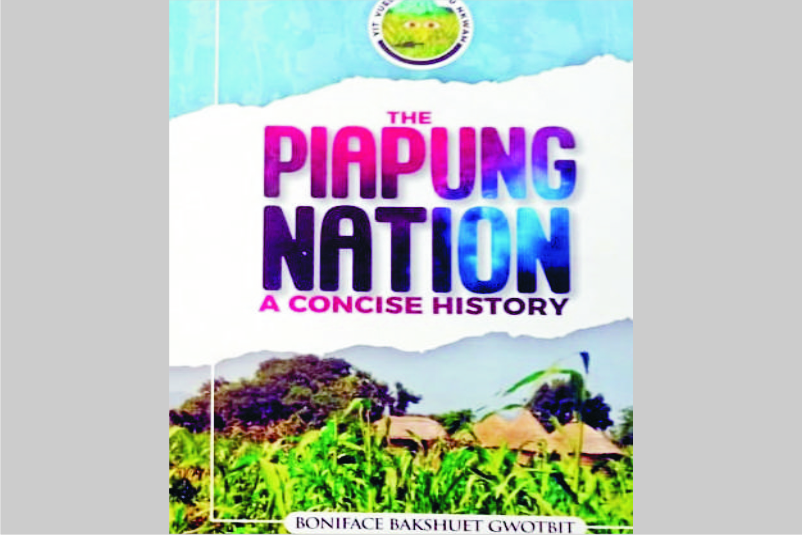
In his book The Piapung Nation: A Concise History, it is clear that Boniface Bakshuet Gwotbit, himself a Piapung son, understands this diversity, and one could not have asked for a more qualified author to explore the various complexities of the Piapung people. Made up of thirteen chapters, Gwotbit’s book is a profound statement about cultural renaissance, a theme that looks back to the very beginning of African writing.
When African writing began, virtually all writers were concerned with affirming the worth of African civilizations. As a matter of fact, cultural nationalism was part of the anti-colonial campaign. At the very beginning, therefore, African writing became a forum for dismantling myths and distortions about Africa by the outside world. It was a forum for the assertion of cultural affirmations and reaffirmations; a forum for encouraging Africans to regain belief in their cultures.
It could be perceived that Gwotbit’s book merely extends this line of cultural literature already drawn by literary giants like Chinua Achebe and Wole Soyinka.
History, religion, Piapung society
Chapter One of this 211-page book is concerned with the history, religion and inter-group relations of the Piapung people, who could be found in Piapung Chiefdom in Mikang Local Government Area of Plateau State. The name Piapung, which means “pure white,” emerged during the colonial period as a result of the encounter between the colonizer and Piapung’s ancestor, Kungsa. The obvious implication is that the Piapung people represent purity in Plateau State.
From the very beginning, we follow the author on a journey into the Piapung worldview and its various peculiarities, as well as the contradictions that abound in Piapung society. Unlike other religions, namely Islam and Christianity, African religion is not a religion of the book, and Gwotbit knows this for a fact. African religion has no sacred scriptures regarded as repertoires of authentic beliefs and practices. However, Piapung people are deeply religious, and religion permeates every aspect of their life. The evidence is there in Gwotbit’s book.
Before the advent of the art of writing, non-literate societies like Piapung had devised some means of preserving and transmitting their norms, values, beliefs and traditions. One such way was the oral tradition. The oral tradition refers to myths (or sacred tales), proverbs, folktales, oral poetry, etc. Another way of propagating values was through daily speech, prayers and invocations. As abundantly demonstrated by Gwotbit, all these had been age-old practices in the Piapung community.
The obvious implication is that in Piapung nation, myths were indispensable in conserving and transmitting the people’s religious beliefs. Of course, myths certainly tell us a lot about a people’s worldview, including their religion, understanding of their environment, geography, social organization and religious beliefs.
Economic, socio-cultural life
From Chapter Three up to Chapter Nine, Gwotbit holds the reader firmly by the hand as he winds his way through various inter-group relations, which were very prominent during bereavement; the various economic activities of the Piapung people, who were dominantly farmers and itinerants migrating in search of fertile land for farming; and, most importantly, the socio-cultural activities of the people exemplified by the celebration of the coming of Naan, the supreme god of the Piapung people, and other mythological and spiritual deities like Kom Toeng.
It could be perceived from Gwotbit’s narration that the oral tradition was of vital importance in pre-literate Piapung society. Furthermore, prayers were also an important aspect of Piapung life because of the belief that prayers are an exposition and explanation of their religion, in this case, traditional religion. In Piapung society, prayers are everything. Prayers are offered for children, health, wealth, rain, good harvests and success in trade or hunting.
Is it any surprise that the white colonizer relied on the efficacy of prayers to subjugate the Piapung nation in the later part of the 19th century? Among the Piapung people, prayers usually consist of an invocation or an appeal to a god or deities to grant protection, good fortune or ward off an impending misfortune. Besides, a prayer in Piapung nation may express dependence on God or a deity and confidence that such a god or deity would bend to meet human needs. Again, Boniface Gwotbit has demonstrated that this belief was sacred and pervasive in Piapung society.
Furthermore, the strength of Gwotbit’s book lies in the fact that, for the first time in recorded literature, an author has weighed the meaning of oral traditions, festivals, customs, ethos and values together with the Piapung worldview, seeking at the same time to answer fundamental questions about the place and relationship of man with the universe. Gwotbit has a telling way of presenting the complexity of his people’s beliefs and attitudes concerning their origin, nature, marriages, deaths, structures, organization and interaction of beings in the universe with particular reference to man.
The other thing that can hardly be missed by even the most casual reader is the fact that Piapung worldview is ordered in such a way that all beings belong to two worlds: the visible and invisible world. The visible world is populated by men and all material surroundings familiar to man. In Piapung nation, the visible world consists of the sky, earth, rivers, forests, mountains, etc. The invisible world (Boem), on the other hand, consists of the heavenly realm, which is considered the home of the Creators and deities.
All this is the burden of Chapter Three, Chapter Four and, most importantly, Chapter Eight. Other concepts like So’ot (witchcraft), Pa’a Goen Kos (inquest), etc., also find memorable expression in Chapter Eight.
Chapter Seven dwells largely on traditional institutions. Among many others are three prominent ones: Long Piapung, Longgang and Long-Gotlong.
Chapter Nine takes up the issue of naming and initiation ceremonies among the Piapung people. Here, attention is drawn to naming and its significance, especially Hemyei (male) and Matyei (female), as a child a mother gives birth to in an unusual place. Chapter Ten provides the reader with the mouth-watering delicacies and recipes of the Piapung nation. We have dishes like Mbwarara, Ngwoinaan, Nguk, Shikum, etc.
Chapter Eleven dwells on traditional education in Piapung society, which involves activities like agriculture, carving, weaving, blacksmithing and other entrepreneurial activities. In Chapter Twelve, the colonizer arrives with the Bible in his hand, and as the reader gets to Chapter Thirteen, “Things Have Completely Fallen Apart,” to use Chinua Achebe’s apt phraseology.
Postcolonial perspective, cultural reclamation
This well-researched, meticulously documented and instructive book has the capacity to hold the reader in thrall as he/she is swept up by the events it so ably describes. Gwotbit’s book brings back sobering and fleeting memories, and yet at the same time a tinge of something sweet but gone, perhaps forever.
Most importantly, the book could be read from the lens of postcolonial theory as a way of reclaiming the past. In this regard, the first step for colonized people in finding a voice and an identity is to reclaim their own past. We may need to recall that for many centuries, the European colonizer devalued our past, considering and seeing our precolonial history as a pre-civilized limbo or even a historical void. The colonizer maintained that African cultures were barbaric, satanic and works of the devil.
If the first step toward a postcolonial perspective is to reclaim one’s own past, then the second step is to begin to erode the colonialist ideology by which that past has been devalued. Again, this is the point where Boniface Gwotbit’s book, published by Kwasisco Production Logistics, becomes influential.
We may concede that as a writer, Gwotbit has a purpose, implicit or explicit: it is to correct the distortion of the Piapung, and by extension African, culture; to recreate the past in the present in order to educate the Piapung nation and the general reader; give them confidence in their cultural heritage; and enlighten foreign readers, helping them dispel false impressions about Piapung culture acquired from centuries of misrepresentation.
Gwotbit seems to agree completely with Chinua Achebe’s view that African peoples did not hear of culture for the first time from Europeans. Their societies were not mindless but frequently had a philosophy of great depth, value and beauty. They had poetry and, above all, they had dignity. It is this dignity that many African peoples almost lost during the colonial period, and it is this dignity that they must now regain. The worst thing that can happen to any people is the loss of their dignity and self-respect. The writer’s duty is to help them regain it by showing them, in human terms, what happened to them and what they lost.
Finally, despite the passage of years, Piapung culture still retains its freshness and relevance, its ability to pierce the heart of human situations in matters of love, marriage, religion, death, governance or social behaviour. Practical and perceptive, the values and norms of the Piapung nation still challenge the modern mind, leading us to contemplate anew the joys and ecstasies still binding us to the wisdom and humanity of a people long gone.
By representing the past so clearly, Gwotbit desires that present-day readers could learn how to reanimate the virtues of the past. More than that, Gwotbit presents the past so passionately in the devout hope that its virtues can at least have a moral effect on the present. From an academic point of view, the past or antiquity could mean something ancient which could be studied in the same way anthropologists study ancient cultures today.
The past could also give a gloss of respectability to contemporary institutions like education and commerce or it could mean a pattern of moral excellence that might be revived by imitation and influence the conduct of the reader. Whichever way we look at it, Gwotbit is drawing from the past to reanimate the present.
It is left to be said that Gwotbit’s book differs from many other African writers on this subject only in the sense that most early African writers aimed to educate readers to regain belief and confidence in their norms and values. This they achieved by revealing the foolishness of the Christian religion. Gwotbit, on the other hand, has embraced Christianity like a bride. Apart from being a Knight of the Order of St Murumba (KSM), there is evidence in Chapter Twelve that Gwotbit is one of the translators of the Piapung Bible.
Lastly, The Piapung Nation: A Concise History is a very significant book, and its unique value may be expressed in at least three ways: One, it marks the beginning of Piapung cultural renaissance. Two, it will serve as an authoritative encouragement for the Piapung nation for many years to come. Three, it represents the temper, aims, norms and values of the Piapung nation generally.
Doki, Ph.D., is a Professor of Comparative Literature with the University of Jos