



In this analysis, HENRY DIYO examines the deepening crisis within the African Democratic Congress (ADC), highlighting how factional leadership battles, court interventions and regulatory actions by the Independent National Electoral Commission (INEC) have plunged the party into uncertainty ahead of the 2027 general elections
Barely nine months before the 2027 general elections, the African Democratic Congress (ADC), once touted as a viable “third force” in Nigeria’s opposition politics, is imploding under the weight of a multi-factional leadership crisis that has left the party effectively leaderless at the national level and crippled at the grassroots.
What began as an ambitious opposition coalition takeover in July 2025 has metamorphosed into open warfare, a court-ordered stalemate and a nationwide suspension of state congresses, raising fresh doubts about the party’s ability to mount any credible challenge to the ruling All Progressives Congress (APC).
National leadership crisis
The crisis can be traced back to July 2025, when a coalition of prominent opposition figures, including former Senate President, Senator David Mark, and former Osun State Governor, Rauf Aregbesola, assumed control of the ADC following the resignation of the previous National Working Committee (NWC) led by Chief Ralph Nwosu.
Mark emerged as National Chairman, with Aregbesola as National Secretary, in what the coalition described as a strategic realignment to build a formidable platform ahead of 2027.Almost immediately, Nafiu Bala Gombe (also referred to as Nafiu Bala or Rafiu Bala), who had served as Deputy National Chairman under the old leadership, rejected the development.
He accused the coalition of an illegal takeover, insisting that he never resigned and remained the rightful successor.Gombe approached the courts in September 2025, triggering a prolonged legal battle that culminated in a Court of Appeal ruling on March 12, 2026, directing all parties to maintain the status quo pending the substantive suit at the Federal High Court, Abuja.
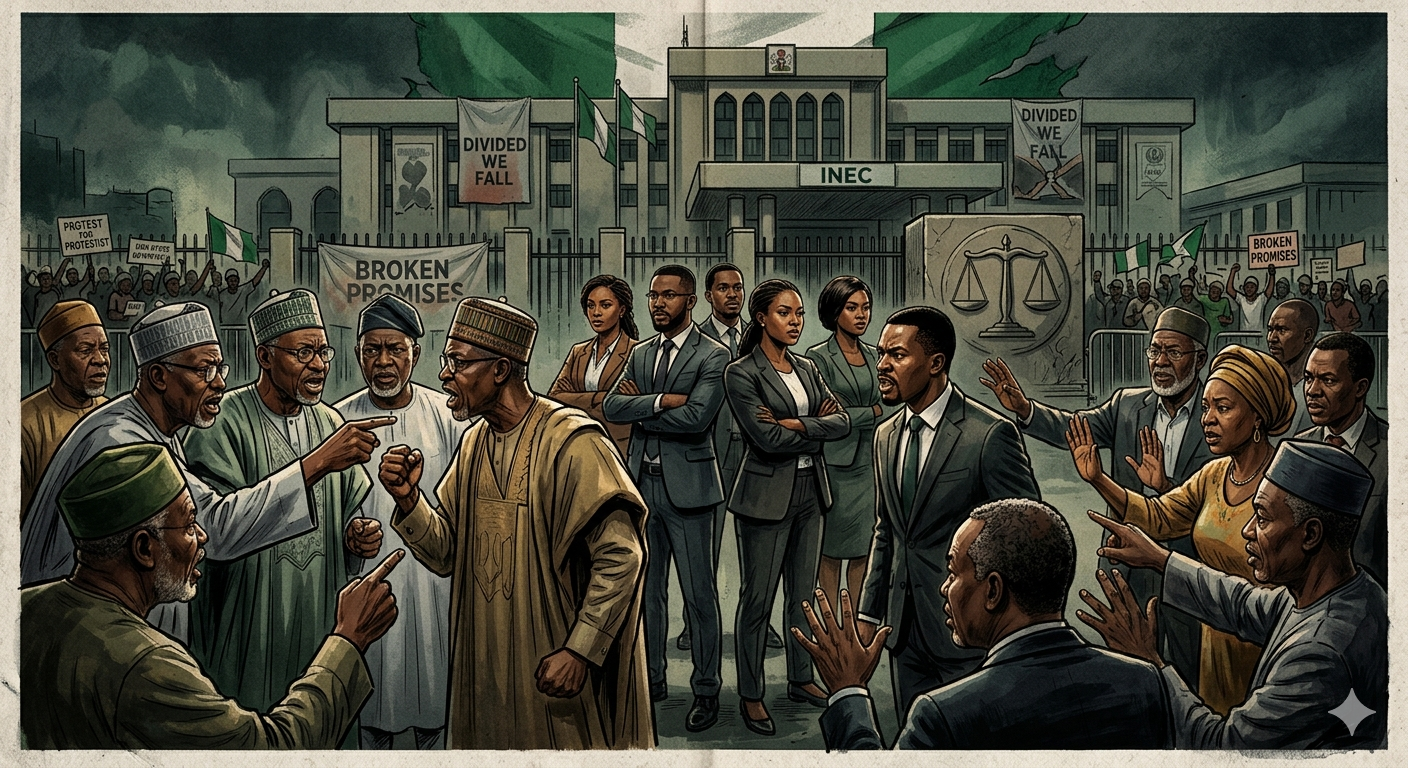
In compliance, the Independent National Electoral Commission (INEC) delisted the Mark-led NWC from its official portal around April 1–2, 2026, and declared that it would recognise neither faction until the courts resolve the matter.This move effectively created a leadership vacuum at the federal level and sparked rival protests at INEC headquarters.
Mark’s camp, joined by opposition figures including Atiku Abubakar and Peter Obi, staged a demonstration demanding restoration of their recognition.Gombe’s supporters, however, countered with their own rally, urging INEC to recognise him as the authentic chairman.
A third faction has further complicated the situation.On April 7, 2026, the State Chairmen Forum, comprising chairmen from about 25 states and backed by the party’s 2023 presidential candidate Dumebi Kachikwu, rejected both the Mark-led coalition and the Gombe group, describing them as “hijackers.”
Speaking in Abuja, the Abia State Chairman, Don Norman Obinna, declared: “We disassociate the ADC from David Mark, Rauf Aregbesola, Bolaji Abdullahi, Prof Osunbor and all members of the so-called coalition… all actions taken by them in the name of the ADC are not binding… Nafiu Gombe has never held the position of deputy chairman of the ADC.”
The forum subsequently announced its own interim National Working Committee, naming Ogga Temitope Kingsley (Kogi) as acting National Chairman, Muhammad Khala Jidda (Borno) as Deputy Chairman, Odion Kennedy (Edo) as Secretary, and Obinna as National Publicity Secretary, among others.They pledged to organise a proper national convention and “rescue the party from impostors.”
State chapters in disarray
The crisis at the national level has had a ripple effect across state chapters, throwing party structures into confusion.Ward, local government and state congresses—critical for building structures ahead of party primaries and the May deadline for membership register submission—have been suspended or disrupted in most states.In Ondo State, the party explicitly cited INEC’s directive and the national crisis in halting all congresses.
Anambra State suspended activities indefinitely, with Chairman Patrick Obianyo insisting that current executives remain in office.Niger State followed suit across all 25 local government areas.In Adamawa State, a Yola High Court injunction halted proceedings until April 15.
Kaduna State witnessed rival groups issuing conflicting postponements, while Oyo State shelved its activities to avoid litigation.Even in states attempting to proceed, such as Plateau and Jigawa, factional tensions have emerged, with threats of parallel structures.
In Abia State, where the third faction’s chairman originates, a caucus has distanced itself from Obinna, citing court injunctions and disciplinary issues.Similar parallel claims have also emerged in Osun and Edo states.The result is a party unable to speak with one voice, conduct internal democratic processes or present a unified front to voters.
Uncertain future, political implications
Critics within the party attribute the crisis to broken power-sharing agreements, personal ambitions and internal distrust.Former National Chairman, Ralph Nwosu, has dismissed some of the claims, insisting that Gombe and other stakeholders were present and supportive during the July 2025 handover at the Yar’Adua Centre.
“They were all there clapping,” he said.Some party members have also alleged external interference, accusing the APC of sponsoring protests and legal actions to weaken the opposition.
Human rights lawyer Inibehe Effiong has criticised INEC’s handling of the situation, warning that it could undermine the credibility of the electoral process.
Analysts, however, describe the crisis as largely self-inflicted, noting that opposition parties in Nigeria often struggle with internal cohesion.With less than a year to the 2027 elections and primaries approaching, the ADC’s chances of recovery appear uncertain.
The ongoing legal battle at the Federal High Court may take months to resolve, while reconciliation among the factions remains unlikely in the short term.Although the third faction has proposed a national convention as a way forward, any outcome may lack legitimacy without INEC recognition.
For now, the ADC stands as a cautionary tale—a party with presidential ambitions but no recognised leadership, disorganised structures and a fractured base.
Whether the factions can reconcile before the electoral timeline closes remains a critical question for both the party and Nigeria’s multi-party democracy.