



By CLEM OLUWOLE
The epithet, ‘Home of Peace and Tourism‘, no longer seems to apply to Plateau State. This is largely due to the 2001 ethno-religious catastrophe that has snowballed into the pervasive insecurity currently witnessed almost everywhere.
Regarded as a mini Nigeria, Jos, the state capital, became a haven for those fleeing the Kafanchan/Kaduna crises of the late 1990s. When Zamfara adopted Sharia law as a way of life, those who felt uncomfortable fled to Jos, widely regarded as Paradise on the Plateau.
Consequently, the economy of the Tin City witnessed a huge boom. However, the escape turned out to be like jumping from a frying pan into the fire when violence of unprecedented dimension erupted in 2001, following the appointment of a so-called settler as chairman of the Jos North Poverty Alleviation Programme (PAP).
It was as though the escapees brought ill luck to the hitherto peaceful city. In the midst of the hostilities, the Dariye administration constituted a panel headed by Justice Niki Tobi. The panel sat and issued a White Paper, but the government lacked the political will to implement its recommendations.
The report has since gathered dust in government archives.
When peace collapsed
The massacre in Jos and its environs was so frightening that it became evident the city would never be the same again. The once bustling city was deserted, and all commercial and social activities came to a halt.
No curfew was required to keep people indoors.In the Jenta Adamu settlement neighbourhood, later renamed New Jerusalem, where I lived, hunger set in after about one week of inevitable lockdown.
This was not due to lack of money; rather, there were no foodstuffs available for purchase. The situation was the same everywhere.Soon, the neighbourhood, once filled with domestic animals, became empty. These animals were not driven away by fear of the crisis; rather, they were taken for food.
Owners often discovered that their goats, chickens and other livestock had disappeared—collateral damage of the crisis.
As the killings escalated and spread across the state, as though the combatants had sworn an oath of self-annihilation, the Obasanjo administration swiftly imposed emergency rule, overseen by the former Chief of Army Staff, General Chris Mohammed Alli (rtd).
The destruction might not have escalated so drastically if the crisis had remained confined to the struggle between natives and settlers over the leadership of the PAP. However, once religion was introduced, the situation spiralled out of control.
It became a case of “To your tent, O Israel.”Christians fled from Jerusalem to Jericho, Muslims from Mecca to Medina, while others ran in all directions. Everyone was on the move—men, women, children and the elderly.In many communities across the Tin City, vigilante groups emerged.
In New Jerusalem, over 100 residents across various areas had access to firearms such as double-barrelled guns, pump-action rifles and dane guns. Locally made weapons, including petrol bombs, also became common.
Individuals skilled in improvised explosive devices trained others. The backyard of my residence was filled with bottles half-filled with sand and petrol, each fitted with a wick. These were used as makeshift grenades.
Other weapons included bows and arrows, swords, machetes, spears and even slings—the weapon used by David against Goliath. Traditionalists relied on charms, while others turned to prayers and fasting.
These combined efforts made New Jerusalem nearly impregnable. This experience has continued to shape my advocacy for individual gun ownership in recent years.
Cycles of violence, failed responses
The Alli administration worked for six months to restore calm, achieving relative peace. The emergence of Da Jonah Jang as Dariye’s successor in 2007 brought a temporary truce. However, violence resurfaced following the controversial 2008 local council elections, particularly in Jos North.
For over seven months, the state remained on edge. It took more than two months for Jang to establish a Judicial Commission of Inquiry, chaired by Prince Bola Ajibola. Although a White Paper was produced, it suffered the same fate as that of Justice Niki Tobi—no meaningful implementation.
Persistent killings and destruction of livelihoods led to the establishment of the Joint Task Force (JTF), which later gave way to Operation Safe Haven (OSH) after failing to meet expectations. Yet, neither has successfully curtailed the activities of criminal elements.
The “Haven” has remained unsafe.Governor Simon Lalong managed to reduce the crisis and restore relative peace during his tenure, though occasional attacks persisted until May 29, 2023.
The current governor, Barrister Caleb Mutfwang, is nearing his third year in office, yet the situation remains largely unchanged. Communities continue to be attacked and displaced, resulting in significant loss of lives and property.
Rising threats, urgent solutions
The present situation in Plateau State has evolved beyond the triggers of the 2001 crisis. Banditry has become widespread, with attacks occurring frequently. Documenting these incidents would be akin to attempting to empty the River Niger with a teaspoon.
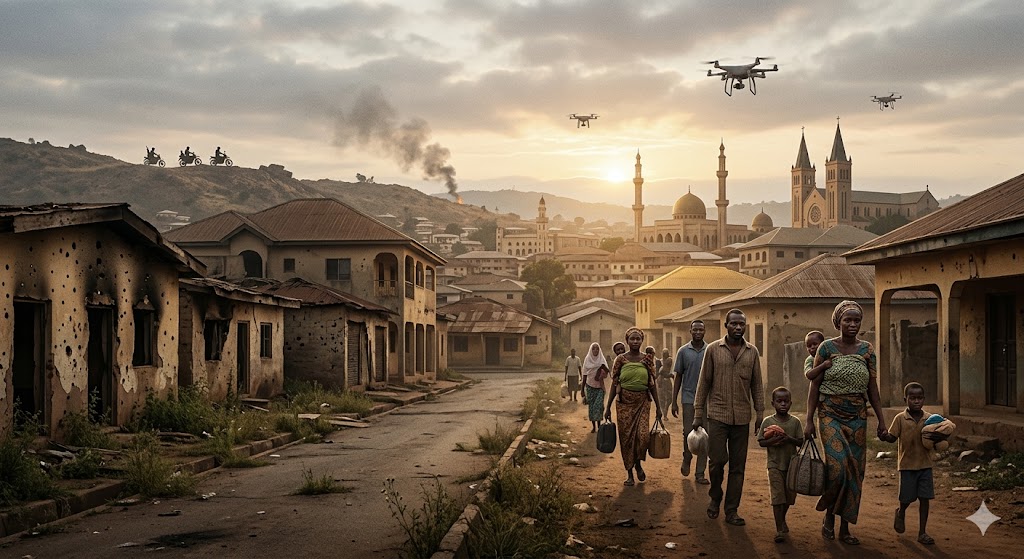
One of the most recent attacks occurred on Palm Sunday at Angwan Rukuba, where gunmen on motorbikes killed about 28 innocent people.
While not the deadliest attack in recent times, it generated widespread concern due to its timing, execution and the attackers’ ability to escape into surrounding hills.
This reflects a broader national crisis, particularly across Northern Nigeria, where insurgents and bandits operate with alarming boldness. They often issue advance warnings, demand protection fees, impose levies and attack defenceless communities.
Following operations involving United States forces, including Christmas Day Tomahawk strikes on terrorist locations in Sokoto State, there was hope for improvement.However, the situation suggests that either these efforts have provoked further aggression or that security forces are overwhelmed.
It is therefore encouraging that the administration of President Bola Ahmed Tinubu has proposed the deployment of AI-driven surveillance systems during his condolence visit to victims of the Angwan Rukuba attack.
This represents a step in the right direction, as modern security challenges require technological solutions. Expanding such initiatives nationwide could deter criminal activities.
In November last year, President Tinubu declared a state of emergency on insecurity, increasing security deployments and proposing the establishment of state police to tackle banditry, terrorism and the so-called farmer-herder conflicts.
Given the urgency of the situation, the establishment of state police should be expedited and treated as a standalone priority rather than being delayed alongside broader constitutional Towards restoring peace to Plateau’s Tin City.
The nation is racing against time, and decisive action is needed to halt the continued loss of lives.