



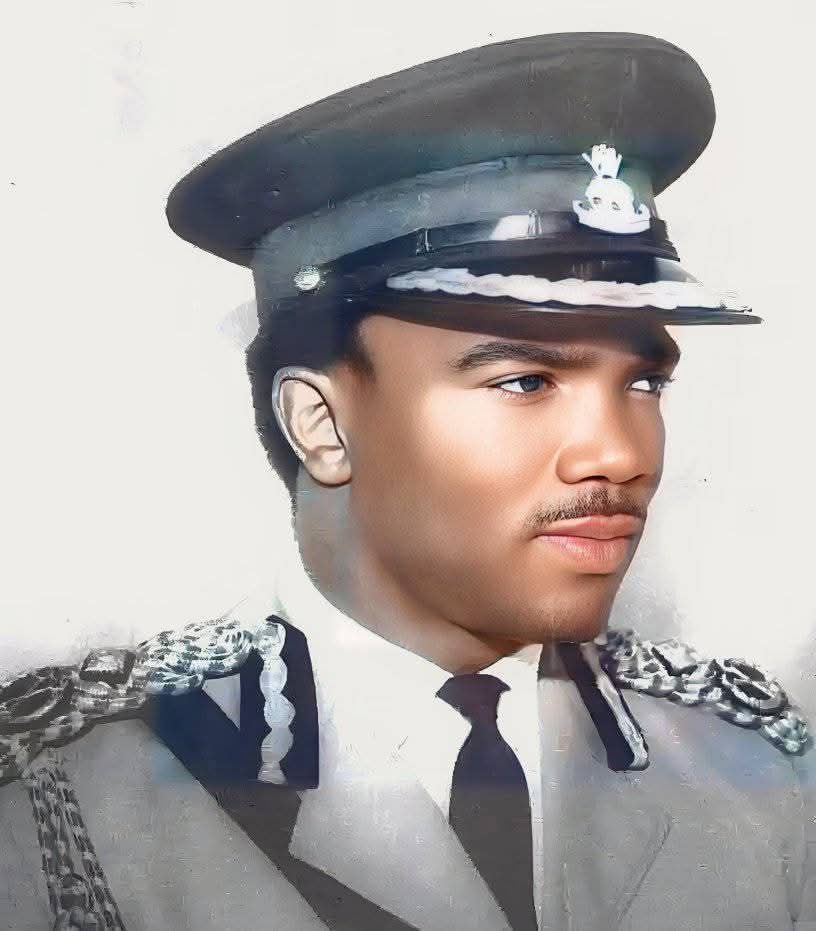
Fifty years after his death, the legacy of Joseph Dechi Gomwalk, former Military Governor of Benue-Plateau State, continues to resonate across generations, institutions and the socio-political landscape of Nigeria, as KATDAPBA GOBUM reflects on the enduring imprint of a leader whose life and times remain both influential and contested
Some thirty years ago, in 1996, at the Multipurpose Hall of the University of Jos—an institution he initiated during his forty years on earth—a book chronicling his life was launched.
The book, JD Gomwalk: A Man of Vision, written by Chief Anthony Goyol, stands as a signpost on the road to recovering the essence of a man whose true place in Nigerian history remains subject to partisan interpretations and conclusions.
That afternoon, when Joseph Dechi Gomwalk and others allegedly found guilty in the attempted February 13, 1976, overthrow of the Murtala Mohammed government climbed down from the Black Maria that conveyed them to the execution ground, it is doubtful that the authorities of the time imagined that his memory would remain alive, vibrant and incandescent so many decades later.
That a book recounting his life has travelled across the world, telling the story of the son of a District Scribe who rose to become a pathfinder for his people’s aspirations, is testimony that there was far more to the late Commissioner of Police and first Governor of Benue-Plateau State than the official narrative that sought to erase both his physical presence and his ideas from Nigeria’s collective consciousness, particularly within the Middle Belt.
Those committed to the upliftment of the Middle Belt owe Chief Goyol a debt of gratitude for his effort to set the record straight and firmly establish Gomwalk as a significant historical figure.
Understanding the historical context
To appreciate the persistence of the legacy of JD Gomwalk, even 50 years after his death, it is important to understand the historical forces that shaped his worldview within Northern Nigerian society and the broader Nigerian state.
Born in the early decades of the 20th century, he inherited a cultural environment shaped by the entrenched emirate system, where opportunities for advancement for a minority Ngas Christian were largely dependent on missionary-supported Western education. If today the Middle Belt continues to draw identity and political relevance from the creation of Nigeria’s six geo-political zones, it is because of a long history of perceived marginalisation and hegemonic control by the dominant Hausa-Fulani establishment, with whom they shared geography more than historical experience.
The often-told story of the establishment of THE NIGERIA STANDARD Newspaper vividly illustrates that little had changed between 1935 and 1972 in the fundamental power dynamics between dominant groups and minority communities in Northern Nigeria.
According to a statement contained in the programme booklet marking the newspaper’s 20th anniversary in 1992, Gomwalk recognised the critical role of the media in shaping a developing society. At the time, only a few newspapers existed in the North—most notably New Nigeria and its Hausa counterpart, Gaskiya Ta Fi Kwabo.
As part-owner of New Nigeria through the Interim Common Services Agency (ICSA), Gomwalk expected equitable coverage for all six northern states. However, his expectations were dashed during the visit of then Military Governor of Mid-West State, Colonel Samuel Ogbemudia, to Benue-Plateau State, which received inadequate coverage.
Deeply dissatisfied, Gomwalk conceived the idea of THE NIGERIA STANDARD. Without immediate printing facilities, he collaborated with the Nigerian Observer in Benin City, and by July 8, 1972, the first edition was published. Iliya Audu, drafted from the Ministry of Information, undertook the challenging task of coordinating printing and distribution between Jos and Benin City.
Institutional legacy, development vision
The same motivations that led to the establishment of THE NIGERIA STANDARD also informed Gomwalk’s creation of institutions tailored to the needs of the Middle Belt, which had previously been neglected within the broader Northern administrative framework. Under his leadership, Benue-Plateau State witnessed the establishment of a marketing board, transport services, a university campus, a lottery board, a television station and other pioneering institutions.
Notably, the Benue-Plateau Television (BPTV) broke the monopoly of television broadcasting in Northern Nigeria, previously dominated by Radio Television Kaduna (RTK), whose signals barely reached many Middle Belt communities. At the time, the state encompassed vast territories, including present-day Taraba, Nasarawa, Benue, parts of Kogi and sections of the Federal Capital Territory.
In 1975, BPTV achieved a historic milestone by becoming the first television station in Sub-Saharan Africa to transmit in colour—an accomplishment built on the foundations laid by Gomwalk’s administration.
Political turbulence, contested narratives
Despite his developmental strides, Gomwalk’s tenure was not without internal challenges. The Middle Belt itself was fraught with ethnic tensions and competing interests among its diverse groups. The creation of Benue State in 1976 by the Murtala Mohammed administration reflected underlying socio-political divisions and demands for greater representation.
Political controversies also trailed Gomwalk’s career. Allegations of corruption surfaced through affidavits sworn by Aper Aku in 1974, following earlier political tensions involving Joseph Tarka. These allegations were later utilised by military figures such as Joseph Garba, Shehu Yar’Adua and Abdullahi Mohammed to justify the July 29, 1975 overthrow of General Yakubu Gowon.
Chief Anthony Goyol’s biography stands out for its balanced approach, presenting both the accusations and Gomwalk’s defence, allowing readers to draw their own conclusions.
In retrospect, it is arguable that if internal contradictions within Benue-Plateau had not been amplified along ethnic lines, the course of events—and indeed history—might have unfolded differently. However, history is shaped by complex, interwoven forces that rarely allow for simple interpretations.
Joseph Dechi Gomwalk was undeniably a man of his time, reflecting the aspirations and struggles of his people. His enduring significance lies in his efforts to chart a new path for development, grounded in hard work, education, civility and self-reliance within the Nigerian federation.
He benefited from the support of Head of State, General Yakubu Gowon, and the collaboration of progressive contemporaries such as Paul Unongo, whose commitment to collective good transcended ethnic divisions. Gifted with charisma, energy and humility, Gomwalk possessed a remarkable ability to connect with people, mobilise support and execute transformative projects.
For the family he left behind—his children, spouses and mother—his life remains a powerful reminder that while endings may be tragic, history often delivers a more enduring and favourable verdict. It is, therefore, not surprising that successive leaders, including Chief Solomon Lar, Chief Joshua Dariye and Senator Jonah David Jang, have immortalised him through landmarks such as the State Secretariat Complex in Jos.
Today, his legacy lives on in subtle yet profound ways. From the thousands educated at the University of Jos, to the audiences entertained by NTA Jos, to civil servants working within the state secretariat, and to visitors enjoying the Jos Wildlife Park and Pandam Reserve—countless lives continue to be shaped by the vision he set in motion decades ago.
Gobum, former Managing Editor of THE NIGERIA STANDARD Newspaper, writes from Jos