


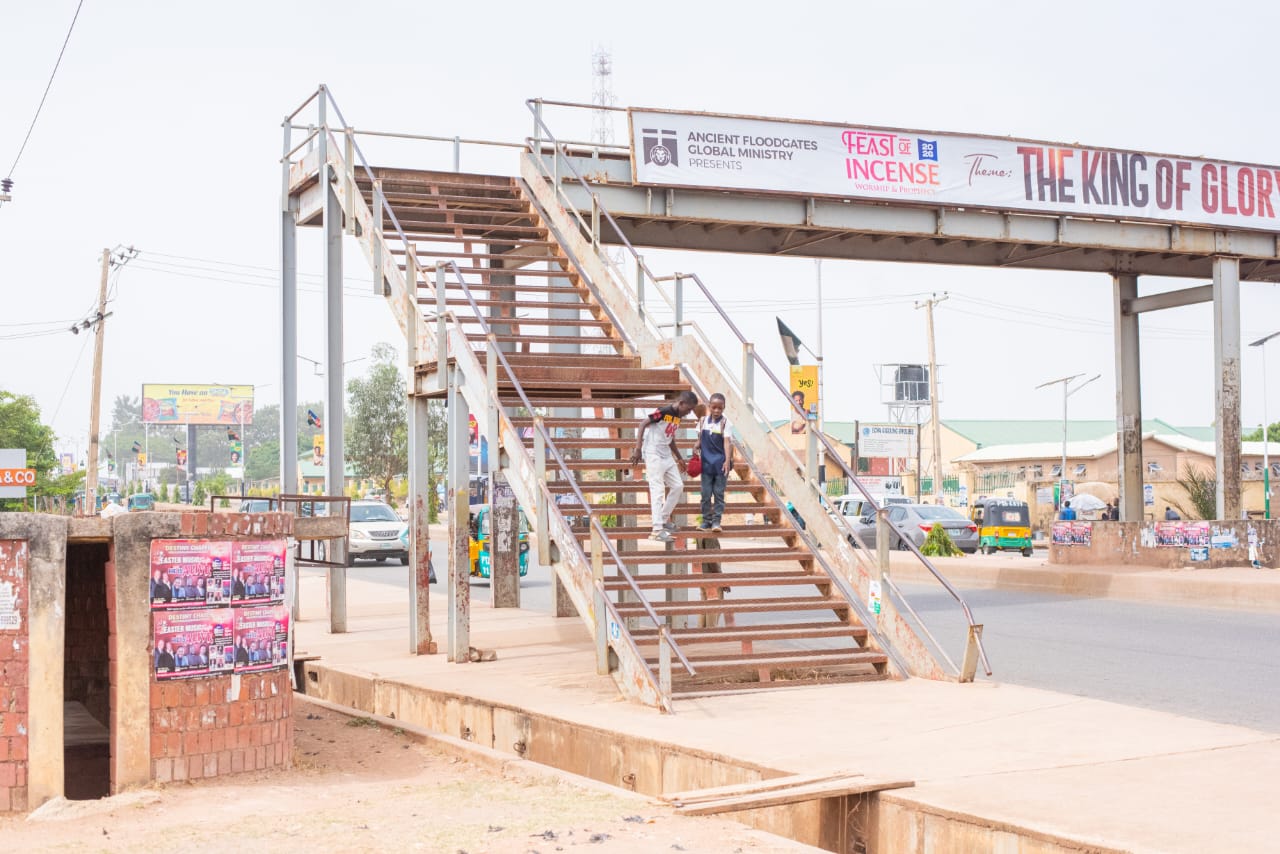

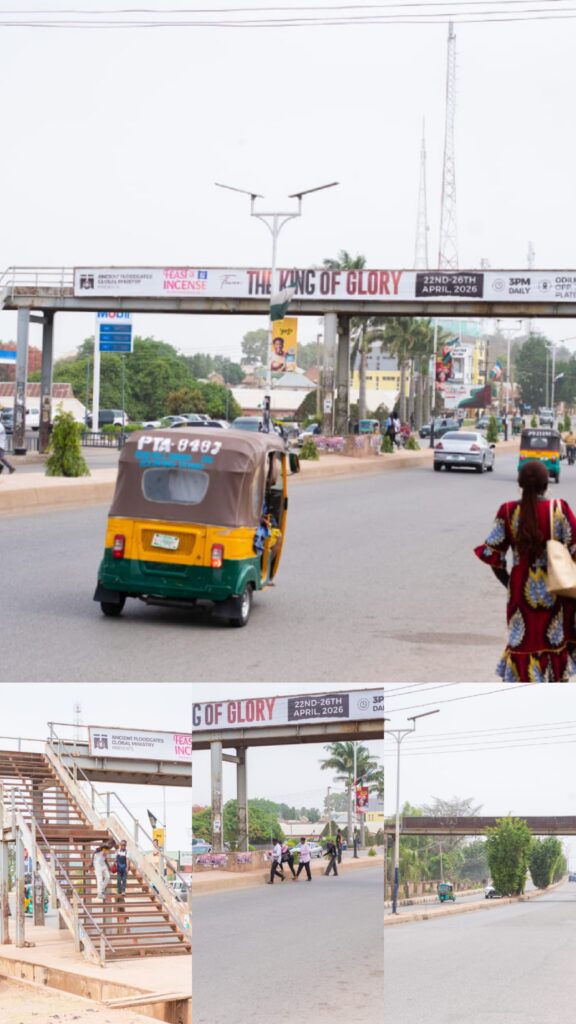
SHINPENAN DAKWAM examines the growing importance of pedestrian bridges in Jos, Plateau State, where increasing traffic congestion and risky road-crossing habits continue to endanger lives. The piece highlights how these structures serve as critical safety lifelines, the behavioural challenges limiting their use and the urgent need for better maintenance, planning and public awareness to improve urban safety
In the heart of Jos, Plateau State, daily life unfolds against a backdrop of constant traffic pressure. Along major routes such as Ahmadu Bello Way, Yakubu Gowon Way and the busy Secretariat Junction, the roads are filled with impatient horns, weaving motorcycles and fast-moving buses competing with time and space.
Yet, rising above this organised chaos are pedestrian bridges—silent structures designed for one critical purpose: saving lives.
These bridges are not mere architectural additions; they are essential safety corridors in a city where crossing the road has become increasingly risky.
A lifeline above the chaos
Pedestrian bridges serve as vital safety infrastructure, separating human movement from fast-moving vehicles. In densely populated urban areas like Jos, where traffic congestion is routine, they reduce the risk of accidents and create a controlled pathway for pedestrians.
For students, traders, workers and other daily commuters, these bridges offer a safer alternative to darting across busy highways. They are particularly important in high-risk zones where motorists often speed or disregard pedestrian safety.
Beyond their physical function, these structures carry human significance. A mother guiding her child across a bridge finds reassurance. A student heading to school gains a safer route. For the elderly, they provide a structured and less hazardous crossing point.
In essence, each bridge quietly supports countless lives and routines every day.

Between safety, neglect, public attitude
Despite their importance, pedestrian bridges in Jos are often underused due to behavioural and structural challenges. Observations show that many pedestrians still prefer to cross busy roads directly, ignoring the safer alternative above.
Umar Ibrahim, a shoe seller near the Paul Gindiri Overhead Bridge, pointed out that the structure was built to prevent avoidable accidents, yet compliance remains low.
He suggests stronger enforcement and public awareness campaigns to encourage usage.
Similarly, Stephanie Bitrus, a student at Plateau State Polytechnic, describes the road as dangerous despite the presence of the bridge, noting that some people still risk crossing below. Commercial driver, Edward John, adds that many pedestrians ignore safety advice simply because they are always in a rush.
However, concerns about infrastructure condition also influence behaviour. Nankwat Mangs points out that poor maintenance discourages use, especially at night when bridges lack lighting and feel unsafe. This highlights a critical gap between infrastructure provision and user experience.
Interestingly, some residents do use the bridges for more than safety. Moses Peter says he uses them for exercise, while Timnan Dashe notes that family guidance and habit make bridge use a regular part of his routine. These perspectives show that behavioural change is possible when safety culture is reinforced.
Location also plays a role in effectiveness. Some bridges, such as the one at Hill Station/Hill Crest School, remain underutilised, prompting calls for better planning. Residents argue that high-traffic danger zones like Old Airport Junction should have been prioritised instead.
Urban planning, traffic glow, need for smarter placement
Beyond pedestrian safety, these bridges contribute to smoother traffic flow by reducing random crossings that disrupt vehicular movement. In well-planned urban systems, they help regulate where people cross, easing congestion and improving efficiency for drivers while maintaining pedestrian safety. This balance is essential in modern city development, where infrastructure must serve both mobility and protection.
Ultimately, the effectiveness of these bridges depends not only on their construction but on consistent use, proper maintenance and sustained public awareness. Without these, even the best infrastructure risks becoming ineffective.
As Jos continues to expand, pedestrian bridges represent more than steel and concrete. They symbolise the responsibility of government and citizens alike to prioritise human life in urban development.
True progress is not only measured by roads built, but by how safely people can move across them.
Thank you for this! A better Nigeria starts with better enlightenment.