


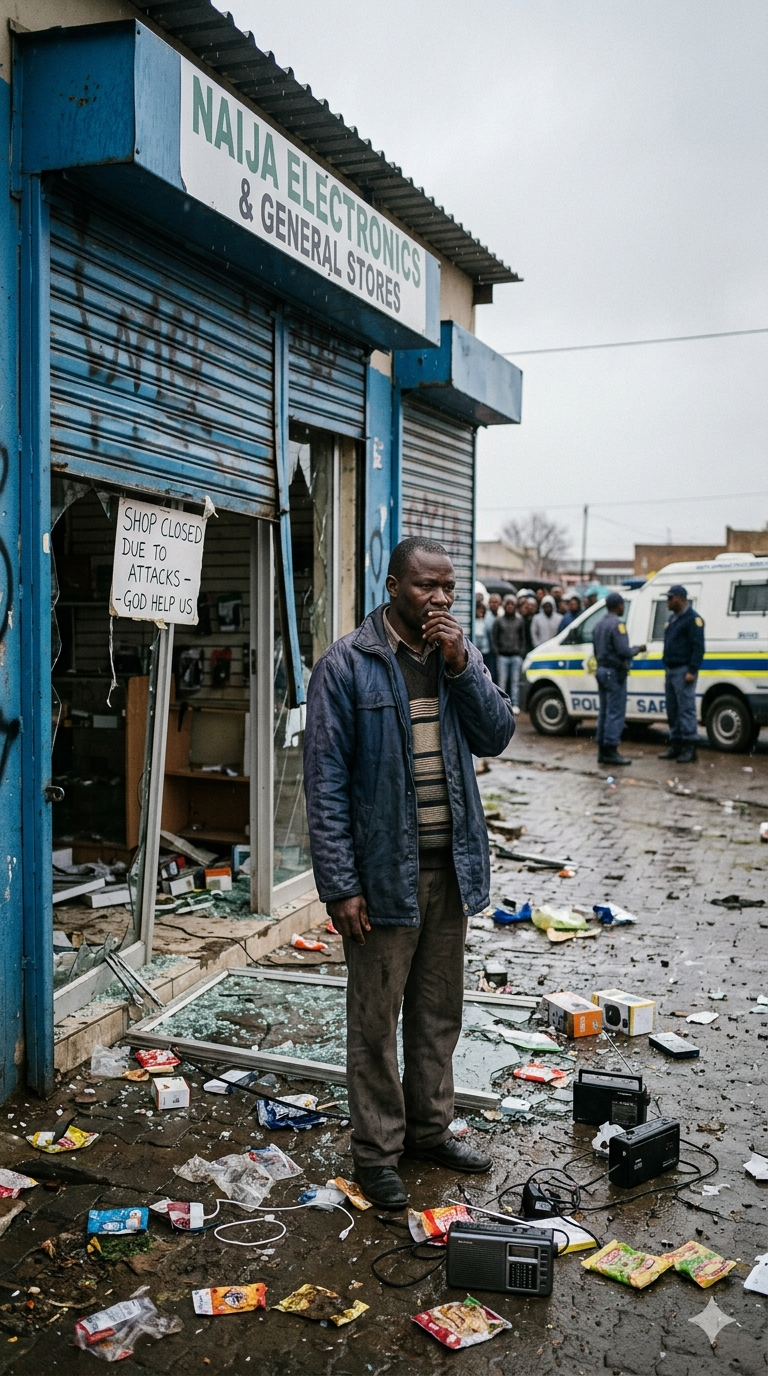

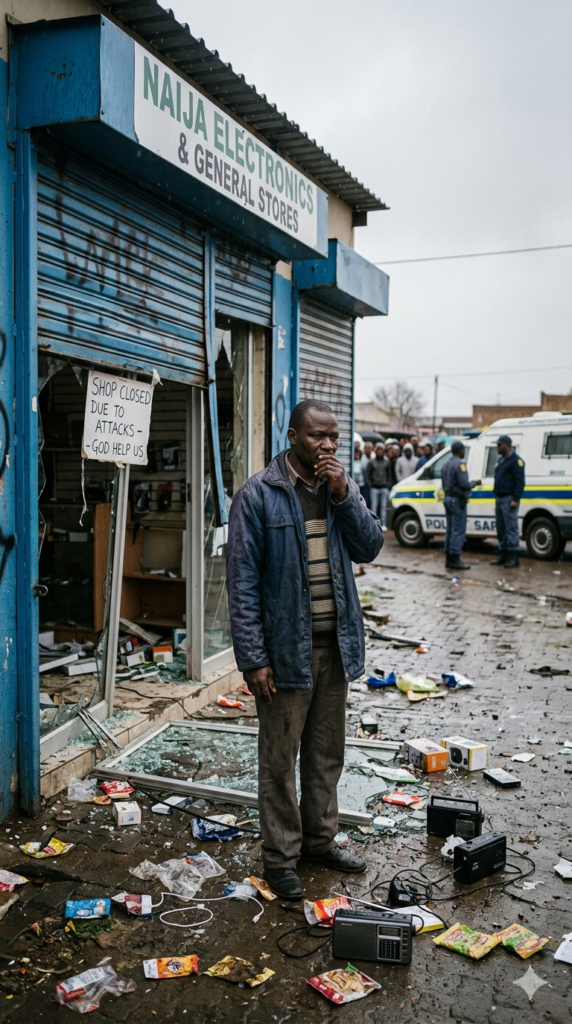
For thousands of Nigerians living in South Africa, survival has become a daily struggle marked by fear, uncertainty and repeated exposure to xenophobic attacks that have destroyed businesses, shattered families and weakened confidence in the promise of African unity. FELIX AMALE examines the painful experiences of affected Nigerians, the lingering silence surrounding many of the attacks and the growing calls for stronger diplomatic and institutional protection from the Nigerian government
For years, Nigerians living in South Africa have continued to endure recurring xenophobic attacks, economic hardship and psychological trauma amid growing concerns over what many describe as inadequate intervention from both the South African and Nigerian governments. Despite repeated outbreaks of violence and widespread reports of intimidation, many victims say they have been left to fend for themselves while waiting for meaningful protection and lasting solutions.
A pattern of violence, fear
Xenophobic violence in South Africa is not new. In 2008, 2015, and 2019, mobs targeted African migrants, looting shops and killing dozens of people. Nigerians, who are highly visible in retail businesses, auto parts trading and the informal economy, have often been singled out during such attacks.
While the official position of the South African government has consistently described the incidents as “criminal acts and not xenophobia,” victims on the ground insist that the reality is far different.
According to many affected migrants, attackers often chant, “Amakwerekwere must go,” a derogatory expression used against foreigners.
To further attest to the reality of the attacks, a Nigerian identified as Okafor recounted his painful experience.
“This is the third time my shop was burgled and all my goods carted away. And there is no insurance by the government to cover this loss,” he lamented.
The African Centre for Migration & Society at Wits University documented more than 200 xenophobic incidents between 2019 and 2024. However, experts believe the actual number may be far higher because many migrants avoid reporting cases to the police for fear of arrest, harassment or deportation.
“I reported when they broke my arm. The officer asked me for my papers first,” said Ada Nwosu, a salon owner in Durban.
“My case never went to court.”
Following each major outbreak of violence, the Nigerian Ministry of Foreign Affairs usually issues official statements condemning the attacks. Ambassadors are summoned, while diplomatic meetings, including sessions of the Bi-National Commission, are convened.
In 2019, the Nigerian government airlifted about 640 Nigerians who voluntarily chose to return home after widespread violence.
However, many Nigerians residing in South Africa argue that the government’s response has remained largely reactive and insufficient.
“There is no early warning system. No legal fund. No real engagement until bodies are on the floor,” said Chika Eze, President of the Nigerian Union South Africa (NUSA).
NUSA estimates that more than 800,000 Nigerians currently live in South Africa, although there is no official figure. Many of them are traders, students, artisans and skilled professionals whose remittances contribute significantly to Nigeria’s economy.
Despite this contribution, many migrants say they feel abandoned.
The Nigerian High Commission in Pretoria maintains that it regularly engages South African authorities and provides consular assistance to affected citizens. Nevertheless, migrants on the ground describe the mission as under-resourced, slow in responding to emergencies and unwilling to exert strong public pressure on the South African government.
“We don’t need a press release after the fact,” said Emeka Okonkwo, who runs an electronics shop in Mayfair. “We need someone to call the police commander before the mob forms.”
Economic, emotional toll deepens
Beyond the destruction of businesses and physical attacks, the crisis has continued to inflict severe economic and emotional damage on Nigerians living in South Africa.
Some parents reportedly withdraw their children from school after receiving threats, while business owners avoid expansion plans due to fears of future attacks. Skilled professionals are also reconsidering renewing their work permits because of growing insecurity and uncertainty.
Observers believe the situation also undermines the objectives of the African Continental Free Trade Area (AfCFTA), which Nigeria strongly championed.
Analysts argue that if Nigerians and other Africans cannot move, live and work safely within African countries, then the dream of a borderless Africa will remain difficult to achieve.
Although regional organisations have occasionally spoken against xenophobic violence, many critics insist that their interventions have yielded little practical impact.
In 2023, the Economic Community of West African States (ECOWAS) called for improved protection of migrants, while the African Union’s Agenda 2063 emphasises free movement across the continent. However, implementation and enforcement remain largely dependent on individual states.
Community leaders and advocacy groups have continued to demand concrete measures to protect Nigerians in South Africa.
Among the proposals put forward by NUSA and other stakeholders are the establishment of a 24-hour emergency hotline with legal support and rapid response mechanisms during attacks, as well as the creation of a diaspora protection desk within the Nigerian High Commission.
They also called for proper public documentation of xenophobic attacks to counter denial and support possible compensation claims for victims.
In addition, they urged the Nigerian government to apply stronger bilateral pressure by linking trade and diplomatic engagements with South Africa to measurable migrant safety commitments.
“We are not asking for special treatment,” Eze said. “Just for the Nigerian state to treat us like citizens, not liabilities.”
Waiting for meaningful action
Despite repeated promises and diplomatic engagements, many Nigerians in South Africa say they are still waiting for meaningful action capable of guaranteeing their safety and dignity.
Back in Mayfair, Okafor has reopened his shop. The metal shutters are now newer and stronger, while a baseball bat remains hidden behind the counter for protection.
“I love Nigeria,” he said quietly. “But right now, Nigeria doesn’t love me back.”
For many Nigerians living in South Africa, hope now rests on whether the Nigerian government can move beyond official statements and establish practical systems that genuinely protect its citizens abroad.