



By NANCY MAJEKODUNMI
There was a time, not too long ago, when Nigerians could move across regions with relative ease and little fear. Communities were bound by shared values and a strong sense of social trust helped maintain stability.
But today, that sense of security has significantly eroded. From homes and highways to schools and places of worship, violent attacks and abductions have created an atmosphere where safety is increasingly uncertain.
More than two decades into Nigeria’s struggle with insurgency and violent extremism, insecurity remains deeply entrenched. Across several states, including Plateau, communities continue to endure repeated attacks, displacement and loss of lives and property.
For many families, these are not distant headlines but painful realities that leave deep psychological and economic scars. Villages are attacked, homes are destroyed and livelihoods are disrupted, leaving survivors struggling to rebuild their lives.
Recent incidents further underscore the scale of the crisis, including travellers abducted along interstate roads, students taken from schools and subjected to trauma and recurring violence in communities such as Angwan Rukuba.
These events are not isolated; they reflect a broader pattern that has weakened economic activity, discouraged investment, and attracted international concern. Travel advisories issued by countries such as the United States warning against visits to parts of Nigeria highlight the gravity of the situation and its implications for national development.
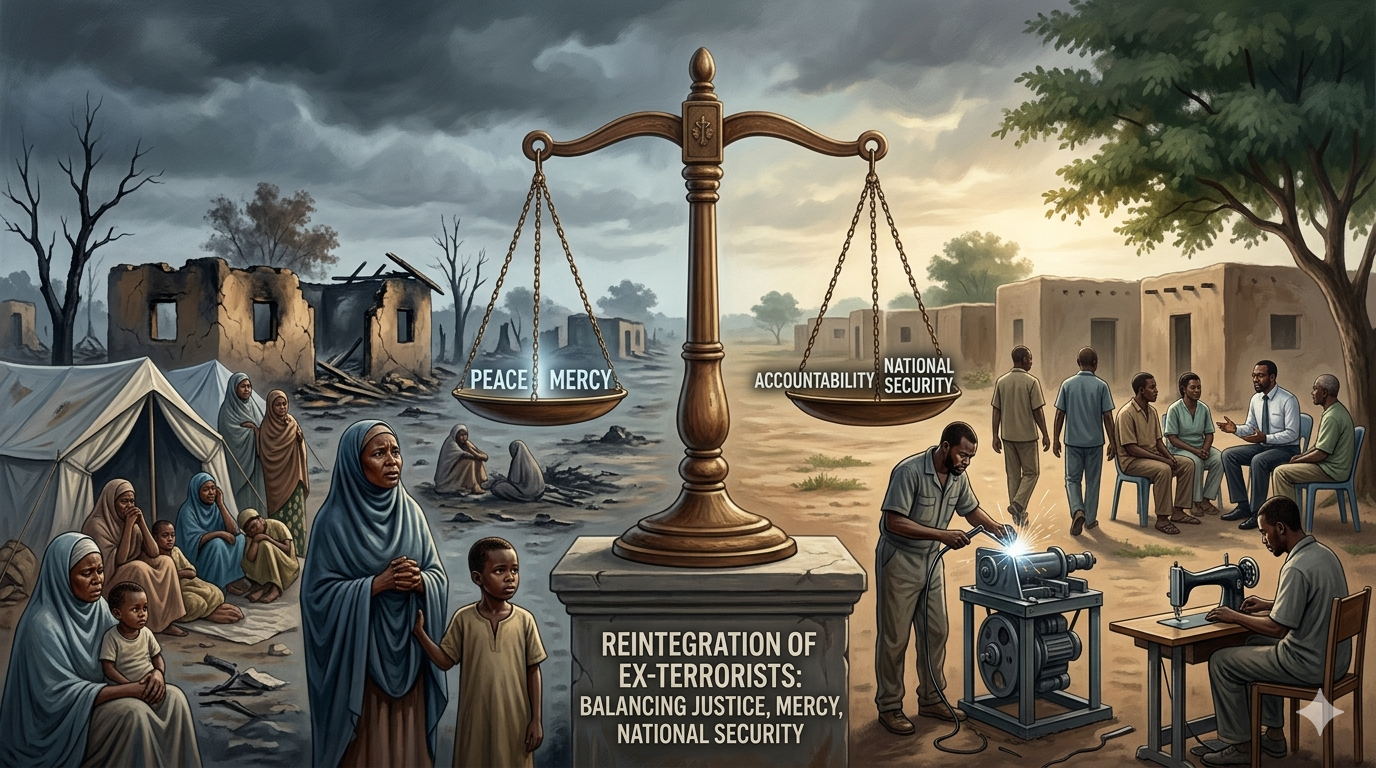
Against this backdrop, the Federal Government’s deradicalisation and reintegration initiative under the Operation Safe Corridor Programme has generated significant national debate. Established in 2016, the programme seeks to rehabilitate former insurgents through vocational training, psychological support and civic reorientation aimed at encouraging disengagement from violent extremism.
Reports indicate that over 2,000 individuals have passed through the initiative, with a recent batch of 744 completing the process and reportedly receiving financial support to assist their reintegration into society. In principle, deradicalisation is not without merit. Globally, it is recognised as part of non-kinetic approaches to addressing insurgency, focusing on counselling, education and structured behavioural change.
However, the Nigerian context raises difficult and sensitive questions around justice, timing and public perception. For many victims of terrorism, reintegration efforts appear to place greater emphasis on perpetrators than on those who have suffered immense losses. Families who have lost loved ones or livelihoods often continue to struggle without adequate institutional support.
Trauma remains largely unaddressed, and closure is often elusive. In this context, financial assistance to former fighters risks being interpreted by the public as reward rather than rehabilitation.
The core issue is not whether individuals can change, but whether accountability is being adequately addressed. In most justice systems, serious crimes—particularly those involving loss of life—carry proportionate consequences. Perceptions that offenders may escape such consequences risk undermining public confidence in the rule of law.
This also raises concerns about deterrence in a society already grappling with widespread violent crime and insecurity.There are equally important questions about the depth and sustainability of the rehabilitation process itself. Transforming deeply entrenched ideological beliefs is a complex process that often requires long-term engagement, not short-term intervention.
While a six-month programme may serve as an initial step, it may not be sufficient to guarantee lasting behavioural transformation. Without strong post-reintegration monitoring and community-based support structures, the risk of relapse into violence cannot be ignored.
Reintegration efforts must also consider the communities expected to receive former insurgents. Trust, once broken by violence, is not easily restored. Successful reintegration depends not only on the readiness of individuals but also on the willingness of communities to accept them.
This requires transparency, consultation and, most importantly, justice for victims whose lives have been permanently altered. A balanced approach is therefore necessary. Non-kinetic strategies such as deradicalisation should complement, not replace, accountability mechanisms. Victims must be supported through trauma care, compensation and structured rehabilitation programmes that acknowledge their suffering.
Public confidence in such policies will depend largely on their fairness, transparency and effectiveness. Without these, initiatives like Operation Safe Corridor risk being viewed with suspicion and could undermine their own objectives.
Ultimately, the challenge before policymakers is to strike a delicate balance—recognising the possibility of change while firmly upholding justice for victims and the rule of law.
The fight against terrorism is not only about ending violence but also about restoring trust, justice and social cohesion. Any sustainable strategy must, therefore, place victims at its centre, ensure accountability for wrongdoing and proceed cautiously in the reintegration of those once responsible for harm.
Very interesting and insightful piece; will explore the theme in a forthcoming gathering of the Africa Peace Fellows in Abuja in August, from a restorative justice mindset that’s victim centered. Peace.
This is a good read. I hope that one day policy makers and Nigerians will take a drastic measures and strategies to combat insecurity in our beloved country.