


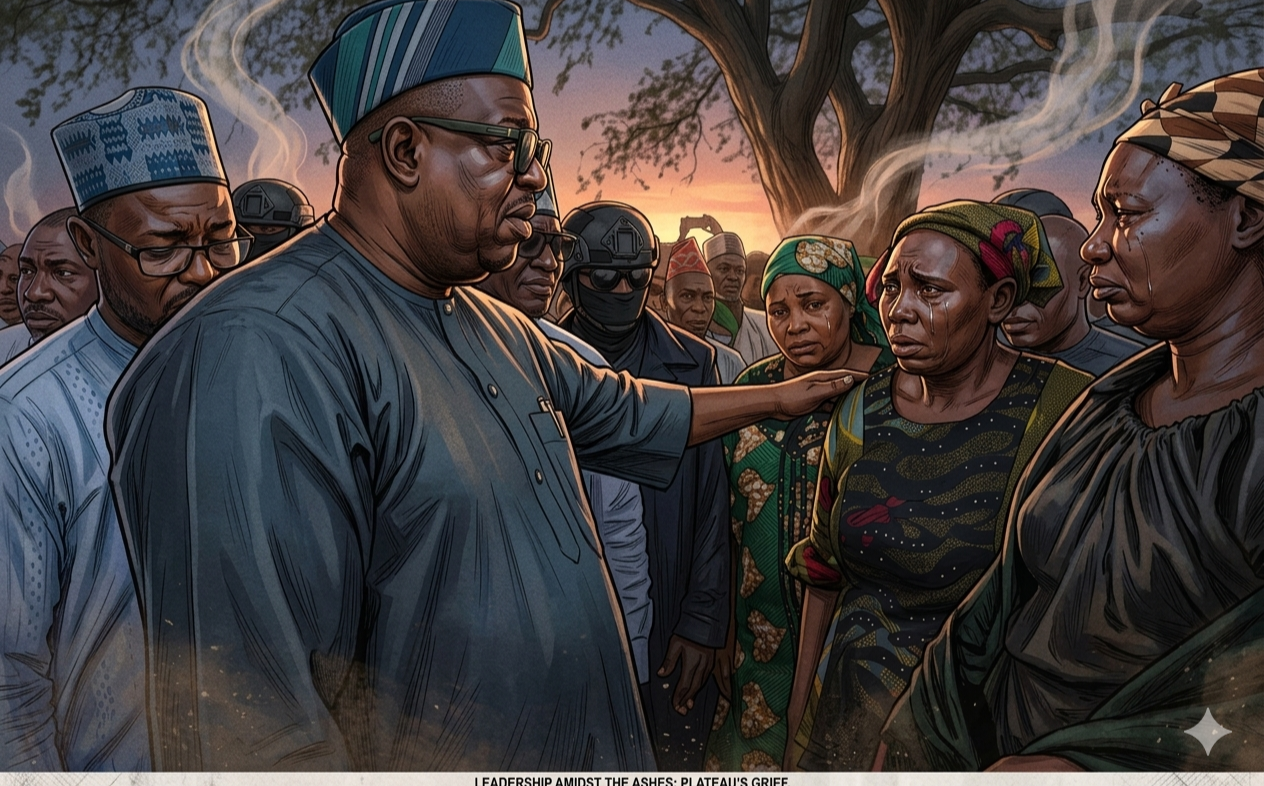

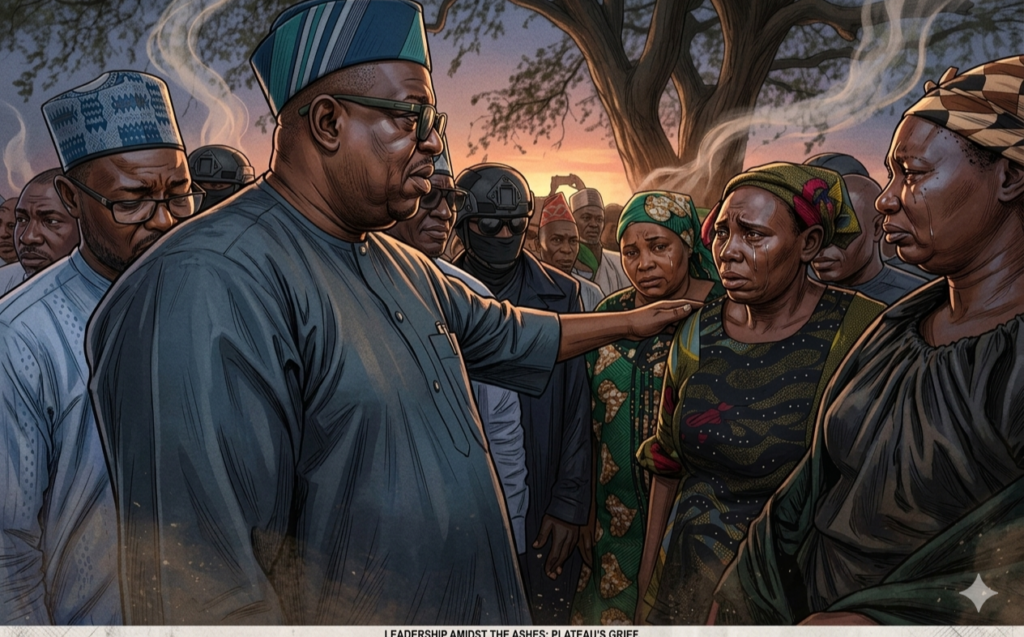
MONDAY’S visit of Plateau State Governor, Barr. Caleb Mutfwang, to the attacked communities in Barkin Ladi and Bassa local government areas once again presents a defining picture of responsive, responsible and compassionate leadership at a time when many communities are bleeding under the weight of repeated violent assaults. In a period when public trust is often eroded by distance and detachment between leaders and the led, the governor’s physical presence in Nding community, Nding Sesut village and Ngra Zongo village speaks volumes of a leadership style that does not govern from afar, but shares in the pain of its people.
DURING the visit, Governor Mutfwang did not merely offer routine condolences. He empathised deeply with widows, children, survivors and families who have endured unbearable loss, assuring them that the state government would not abandon them. His declaration that “Nding community will not go down” was not just political rhetoric, but a symbolic reassurance to traumatised citizens that they are not alone in their darkest moment. This is the true test of leadership — not in comfort zones, but in moments of crisis when leaders must stand physically, emotionally and institutionally with their people.
THIS approach is not new for the governor. We recall his prompt visit to Angwan Rukubu in the immediate aftermath of the bloody March 29 massacre, where at least 32 innocent lives were brutally cut short by terrorists. That swift intervention set a tone of empathy and urgency in governance, reinforcing the principle that leadership must respond not only with statements but with presence, compassion and action.
DURING the latest visit, Mutfwang went beyond sympathy to action. At a strategic security stakeholders’ meeting in Barkin Ladi, he reaffirmed that perpetrators of violence would not escape justice and announced far-reaching measures, including a ban on night mining, night grazing and grazing by underage children. He also directed that all mining activities must end by 5:00 p.m. daily. These decisions reflect a government that is not only mourning the dead but also attempting to confront the structural enablers of insecurity.
YET, beyond these immediate interventions lies a deeper and more enduring national conversation that these recurring killings continue to provoke. The renewed attacks in Barkin Ladi and Bassa once again bring to the fore a long-held argument that can no longer be postponed — the urgent need for the establishment of state police in Nigeria.
WHILE it is true that state policing may not completely eliminate the menace of violent attacks, it would significantly reduce their frequency and impact. Security personnel drawn from and stationed within local communities possess an intimate understanding of the terrain, culture and movement patterns of their environments. More importantly, they have stronger social ties and a direct stake in the safety of the very communities they are sworn to protect.
THE current centralised policing structure has often struggled with delayed response times, unfamiliarity with remote locations and overstretched manpower across vast and volatile territories. In contrast, decentralised policing at the state level would ensure quicker intelligence gathering, faster intervention and stronger community trust. All of these are critical ingredients in preventing and responding to attacks of this nature.
Certainly, the time for state policing in Nigeria is long overdue. The persistence of these tragic incidents, despite repeated condemnations and deployments, underscores the limitations of the existing security framework. If Nigeria is truly committed to safeguarding lives and property, then security must be brought closer to the people who need it most.
GOVERNOR Mutfwang’s visit, therefore, is not just a moment of sympathy; it is a reminder of what governance should look like in times of crisis — present, compassionate and decisive. But beyond commendation, it must also serve as a call to national action. Plateau State continues to grieve, and its people continue to ask for one simple thing: the right to live in peace and security.
AND until that is guaranteed through stronger localised security architecture and genuine political will, leaders will continue to make such painful journeys of condolence. And citizens will continue to ask when, finally, enough will be enough.