



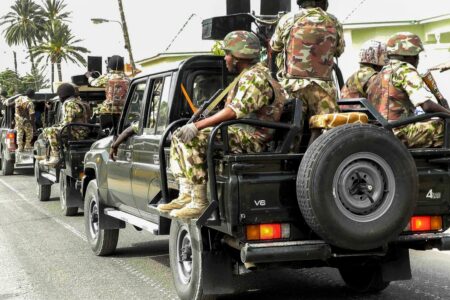
Recent military operations against terrorist groups in the North-East have once again brought national security concerns to the front burner, especially as communities across the country continue to grapple with kidnappings, killings and other violent attacks. In this article, NICK DAZANG stresses the need for Nigerian security forces to build on their recent operational successes by maintaining sustained pressure on terrorists while adopting more proactive and intelligence-driven strategies to end insecurity permanently
The recent gains recorded by the Nigerian Armed Forces in the war against terrorism have offered a ray of hope to citizens weary of years of bloodshed, kidnappings and insecurity across the country. Yet, despite these commendable victories, the wave of attacks and abductions still sweeping through several states underlines the urgent need for sustained and more strategic military offensives against terror groups and criminal gangs threatening national stability.
On Tuesday, May 19, 2026, the Defence Headquarters (DHQ), in a statement by its Director of Information, Major General Samaila Uba, said ongoing joint counter-terrorism operations by Nigerian troops and the United States Africa Command (US-AFRICOM) in the North-East had gathered significant traction. To justify this position, the DHQ reeled out a number of successful operations.
According to the DHQ, its assessment as of May 19 showed that 175 ISIS/ISWAP militants had been eliminated from the battlefield through sustained ground and air assaults. As a result of these assaults, several high-profile terrorist commanders were killed. They include Abd-al Wahhab, an ISWAP commander responsible for coordinating attacks and propaganda activities; Abu Musa al-Mangawi, a senior ISWAP member; and Abu al-Muthanna al Muhajir, a senior media production manager and close associate of Abu-Bilal Minuki.
Gains in
war against terror
The statement said the operations had led to the destruction of terrorist checkpoints, weapons caches, logistics hubs, military equipment and financial networks used to sustain insurgent activities. It is worthy of note that these assaults came shortly after the neutralisation of terror kingpin, Abu-Bilal Minuki, alongside several of his lieutenants ensconced in a compound in the Lake Chad Basin. The assaults also came after the killing of more than 20 ISIS/ISWAP fighters at Metele, Borno State.
Al-Minuki had been under U.S. sanctions since 2003 and was labelled a “global terrorist” in 2023. At the time of his death, he was the second-in-command of ISIS and a Sahel-based senior leader. In that vantage position, he was part of ISIL’s General Directorate of Provinces, which provides “operational guidance and funding around the world”. By every reckoning and benchmark, ISIL’s global operation was “greatly diminished” by al-Minuki’s death. Our Armed Forces deserve praise for neutralising him and his fellow travellers.
Yet, these accomplishments pale in comparison with the swathe of recent abductions and acts of terror that have taken place across the country. Consider the gory catalogue.
On Friday, May 15, 2026, armed bandits carried out coordinated attacks on Local Education Authority (LEA) Primary School, Ahoro-Esinele; Community High School, Ahoro-Esinele; and Baptist Nursery and Primary School, Yawota — all in Oriire Local Government Area of Oyo State. They abducted a high school principal, seven teachers and 30 learners and students. One of the teachers has since been killed by the bandits.
Worrying wave of attacks
On the same day, not fewer than 40 learners and students were abducted by suspected Boko Haram terrorists from Mussa Primary and Junior Secondary Schools in Askira-Uba Local Government Area of Borno State. Last week, suspected members of the Lakurawa terror group killed seven soldiers in an ambush at Runji village in Illela Local Government Area of Sokoto State.
Trigger-happy bandits, in broad daylight, attacked Guga Grains Market in Bakori Local Government Area of Katsina State. They shot indiscriminately and killed innocent people, including a pregnant woman. A delegation of intending pilgrims led by the District Head of Jangebe in Zamfara State was also attacked by armed bandits. They killed the district head on the spot and abducted the intending pilgrims alongside a councillor.
Last week, a former member of the House of Representatives from Jigawa State, Anas Abba Adamu, died in captivity after he was abducted on the Abuja-Kaduna Highway. His abduction, following several others on the same highway, has revived fears of the nightmare commuters endured in the hands of kidnappers on that road a few years ago. These fears are justified given the upsurge in kidnappings for ransom and wanton killings, particularly between the Jere-Bwari stretch that bypasses the Abuja-Kaduna Highway.
Also last week, Boko Haram militants killed 27 fishermen at Mafa and six loggers at Dikwa, both in Borno State.
Certainly, the recent assault on terrorists, which has been stridently canvassed by Nigerians, is commendable. This is even more so because these operations, unlike the recent air interdictions in Borno, Niger and Zamfara states, were precise. There was no collateral damage and the Armed Forces did not suffer casualties.
Why the offensive must continue
Commendable as these joint assaults by Nigerian and American troops were, our Armed Forces should not rest on their oars or be content with basking in the glow of these achievements. Instead, these successes should galvanise them to remain on the offensive. The attacks should be relentless and sustained until the greater mission of decimating the terrorists and attaining victory is accomplished.
Henceforth, and in tandem with these latest successes, our Armed Forces should act only when there is credible, precise and unimpeachable intelligence. This will ensure that air interdictions are not accompanied by collateral damage or the controversy and emotions generated by operational errors.
Additionally, at all times, our Armed Forces must be proactive and take the initiative. This gives them the advantage of surprise and ensures they remain ahead of the terrorists. A situation where they merely react to attacks unwittingly gives the terrorists the upper hand. This should not be so, given the professional capacity of our Armed Forces.
As our Armed Forces prosecute the war against terror, they must continually learn from and interrogate their shortcomings. Such evaluations should generate lessons and necessitate changes in strategy. Why, for instance, were military bases and commanders left vulnerable to attacks by terrorists?
In the aftermath of the abduction of 276 schoolchildren in Chibok on April 14, 2014, the Safe Schools Initiative, spearheaded by former U.K. Prime Minister Gordon Brown, was inaugurated. Not less than $30 million was contributed chiefly to construct safe classrooms, fences and provide guards for vulnerable schools in Borno, Adamawa and Yobe states.
What happened to the funds? How were the schools in Mussa left unprotected? What strategies are being fashioned out to secure schools, learners, students and teachers? To these, after all, belongs the future.
Dazang, OON, writes from Abuja