




In this report, PALANG KASMI examines the efforts of the International Federation of Women Lawyers (FIDA), alongside security agencies and other stakeholders in Plateau State, to strengthen coordinated responses to violence against women and girls (VAWG), as they highlight systemic gaps, cultural barriers and enforcement challenges undermining the effective implementation of gender-based violence laws
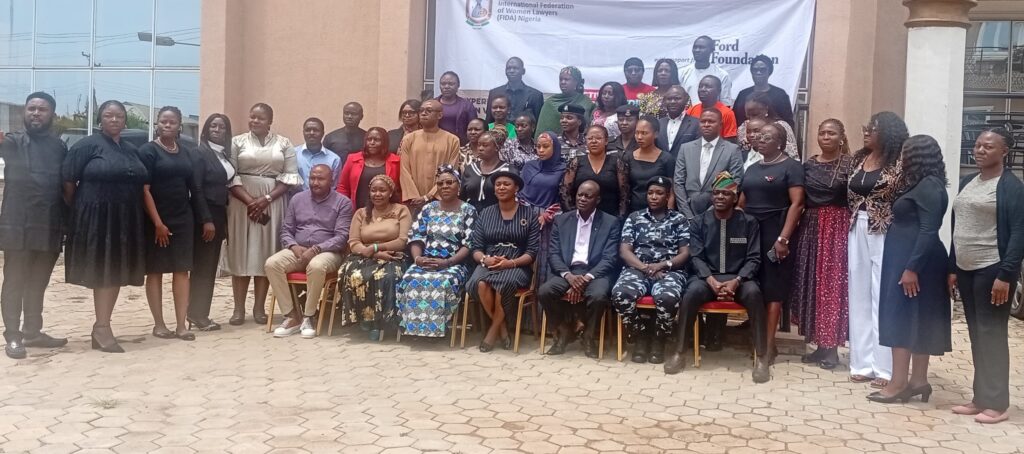
The International Federation of Women Lawyers (FIDA) has organised a forum tagged, ‘Experimental Learning Forum for Law Enforcement Agencies on Violence against Women and Girls (VAWG) Prevention’ to address the increasing menace of VAWG in Plateau State.
The one-day forum with the theme, ‘Promoting Gender Sensitive Cultures in Law Enforcement Agencies towards preventing Gender Based Violence’ took place on May 20, 2026 at the Emerald Resorts and Gardens, Rayfield, Zaramaganda Road, Jos, Plateau State.
Among participants were state and non-state actors, including representatives of NAPTIP, NAWOJ, NSCDC, Nigeria Police Force, National Human Rights Commission, Plateau State Gender and Equal Opportunities Commission, among others.
Parts of engagements included practical group discussions and experience-sharing sessions on challenges and barriers hindering the implementation of Gender Based Violence (GBV) laws and policies such as the Child Rights Law (CRL), Violence Against Persons Prohibition (VAPP) Act and the Administration of Criminal Justice Act (ACJA) by law enforcement agencies in relation to GBV offences.
Systemic gaps, weak prevention structures, institutional challenges
FIDA Nigeria Country Vice President/National President, Mrs. Eliana Martins, represented by the Plateau State Chapter FIDA Chairperson, Barr. Nankus Fyaktu, explained that the learning forum was necessitated by recent engagements with state and non-state actors which revealed that GBV persists not only because of gaps in response systems but also due to deep-rooted social norms, weak preventive frameworks, limited cross-sectoral learning and inadequate proactive engagement by frontline institutions, community and religious structures.
She noted that prior multi-stakeholder and experiential learning dialogues had gone beyond policy discussions into practical, experience-based learning platforms.
“This has led to stakeholders requiring opportunities to learn from real-life prevention models, to share field experiences, to analyse what works and to co-create context-specific prevention strategies.”
Martins explained that law enforcement officers are well positioned to contribute to VAWG prevention through early identification of risk, deterrence and engagement with other actors, but lamented that there remains limited structured space for them to reflect on experiences, learn from peers and strengthen prevention-oriented practices.
She expressed delight that the forum would serve as a practice-based platform bringing together law enforcement officers and key stakeholders for deeper understanding of what effective VAWG prevention looks like in real contexts and for strengthened coordinated prevention-focused action.
The FIDA Country Chair further stressed that achieving success in combating VAWG requires a shift from reactive enforcement to proactive prevention.
She said, “Policies and laws provide a foundation for addressing the menace, but prevention requires continuous learning, adaptation and cross-sector collaboration“.
Identifying existing gaps, Martins listed inadequate documentation and sharing of practical experiences in VAWG prevention among institutions, limited integration of prevention strategies into law enforcement practice especially at community level and persistent harmful social and cultural norms not adequately addressed through preventive systems.
“Therefore to maintain the momentum of project implementation and advocate for continued prioritisation of women’s rights and in extension gender justice towards curbing incidences of VAWG across focal states,” she said, adding that FIDA Nigeria plans to conduct experiential learning with and among law enforcement agencies on VAWG prevention in local communities.
According to her, the forum is a solution-oriented platform that shifts focus from theoretical discussions to real-life prevention practices and lessons learned directly from field experiences.
Martins was optimistic that the engagement would strengthen prevention-oriented thinking within institutions, especially among frontline actors, and promote collective ownership and accountability for VAWG prevention.
Cultural norms, enforcement gaps, security agency concerns
A gender expert and resource person at the forum, Dr. Gad Shamaki, who presented on ‘Forms of Gender Based Violence and Socio-Cultural Norms’, said many cultures and traditions in Plateau State and Nigeria continue to support GBV.
He said most people remain traditional in their thought processes and are slow to accept changes in ways of life, instead sticking to cultural practices.
Shamaki disclosed that most cultures have refused to adjust on issues of female inheritance.
“When it comes to inheritance, women are not considered worthy to own a land, or inherit anything from their father. And when it comes to her late husband, some men want to inherit his properties and even the wife and children he left behind.
“But all of these practices are not good for us, when a woman is raped, you hear people asking what kind of cloth was she wearing, what hour did she go out, why is she out of the house, and nobody is addressing the rapist and saying what he did is wrong”.
The gender expert recommended that society should address these issues holistically to ensure safety for everyone, protection of rights and rejection of second-class treatment of women, while also ensuring boys and girls are trained to respect each other.
He also called on security agencies to respond appropriately to victims of violence.
“Whenever a woman runs to any station and says she has been violated, assaulted or somebody is threatening her, let them not send her home, the fact that she came to the station shows she needs help, despite having her family or pastors around.”
“The security agents should protect her and ensure the perpetrator is invited, warned and in cases where he needs to be arraigned, he should be taken to court so that we do not have a situation where they ask her to go home and settle the case and the next thing she is killed,” Shamaki advised.
On the female inheritance bill being pushed in Plateau State, he described it as a friendly bill that supports women’s rights, urging the state to emulate Eastern Nigeria where women are recognised in inheritance matters.
He also made a passionate appeal for individuals to write wills and clearly state beneficiaries of their property to reduce GBV-related disputes.
In another presentation on ‘Intersection between the Administration of Criminal Justice Act, VAPP and Child Rights Act Towards Strengthening the Prevention of GBV and Protection of Women’s Rights’, Shamaki urged stakeholders to sensitise the public on GBV laws and where to seek help when violated.
He advised the Plateau State Government to provide shelters and meet policy requirements of GBV laws, while commending organisations such as FIDA, NAWOJ, NUJ, NAPTIP and others for their efforts in securing rights and justice for victims.
He further urged people from all walks of life to study GBV laws and understand their rights.
Traditional interference, rising cases, justice challenges
The Plateau State Commander of the National Agency for the Prohibition of Trafficking in Persons (NAPTIP), Mr. Alex Adole, said GBV cases in Plateau State are increasing.
“We have many cases, the cases we are getting from rural areas and even within the urban areas increasing, we have been protecting them, we have so many cases in the court,” he said.
According to him, NAPTIP recorded a life imprisonment conviction recently in the widely celebrated case of Mr. Richard Abe who had carnal knowledge of a girl of about 5 years, adding that many other cases are still pending in court.
On challenges affecting prosecution, Adole expressed concern over the role of some traditional rulers in settling GBV cases outside the justice system.
“Before we know it, they will go ahead and settle it, giving goats and money to the victim’s family. In one of the cases in Mangu LGA, before we could even effect the arrest, the traditional ruler had already settled the case and they gave money and other things to the father of the victim.
“We put pressure on them but they refused to come up and you know, you cannot take such a case to court because when a victim refuses to testify in the court, there is nothing you can do,” he lamented.
He said NAPTIP continues sensitisation exercises every Thursday in rural areas to educate communities on GBV prevention and reporting.
“We go about sensitising and telling them that immediately such an act is committed especially the sexual aspect, the victim has to be taken to the hospital immediately before taking a bath because if she does, the evidence will be washed away,” Adole said.
The forum identified cultural, religious and other biases, attempts at suppressing justice and manipulation of legal procedures by influential individuals as key barriers to successful prosecution of GBV cases.
Participants urged stakeholders to return to their workspaces, prioritise humanity and strengthen synergy among institutions to protect society from violence against women and girls in Plateau State.