



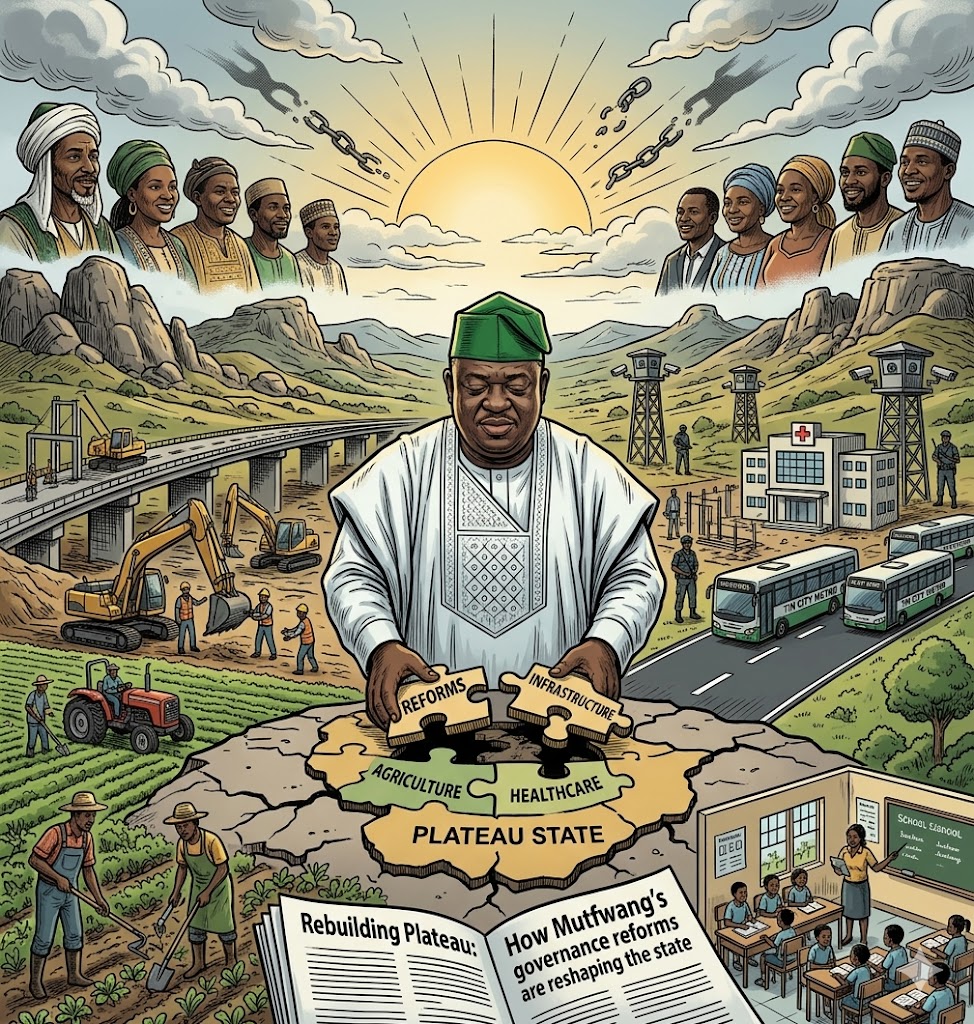
THREE years into the administration of Governor Caleb Mutfwang, Plateau State is increasingly presenting itself as a government in transition from instability and uncertainty to coordinated growth and institutional recovery. What is emerging is not merely a political narrative, but a broader attempt to reconstruct public confidence, revive critical sectors and restore Plateau’s standing as one of Nigeria’s historically strategic and culturally significant states.
SINCE assuming office, Governor Mutfwang has projected governance through the lens of responsibility, consensus-building and practical intervention rather than political theatrics. His administration inherited enormous expectations in a state grappling with security pressures, infrastructural decay, economic stagnation and declining public trust. Yet, rather than pursuing short-term populism, the government appears to have adopted a gradual but deliberate strategy aimed at rebuilding institutions and creating the conditions for long-term stability.
AT the centre of these efforts has been the issue of security, long regarded as Plateau’s most pressing challenge. Recognising that economic growth and social harmony cannot flourish in an atmosphere of fear, the administration prioritised measures designed to strengthen intelligence gathering and community-based protection mechanisms. Operation Rainbow was revived and repositioned to improve rapid response capabilities, while community policing structures were expanded through the mobilisation of more than 1,500 volunteers supporting local security operations.
THE deployment of drones and CCTV surveillance systems across strategic areas further signalled a move towards technology-driven security management, especially in vulnerable urban and rural communities. Complementing these measures is the Federal Government-approved recruitment of 1,000 Forest Guards, an initiative expected to reinforce territorial monitoring and help tackle criminal activities in forests and remote settlements that have often served as safe havens for armed groups.
EQUALLY notable has been the administration’s attention to the civil service and institutional functionality. For years, delayed salaries, unresolved pensions and poor working conditions weakened morale within the public sector. The Mutfwang administration sought to reverse that pattern through reforms aimed at restoring efficiency and confidence in government institutions. Regular salary payments, improved promotion structures and enhanced welfare packages have become key components of that intervention.
TRANSPORTATION reforms have similarly produced visible impact. The introduction of 30 Tin City Metro buses has eased urban mobility pressures while helping many residents cope with rising transportation costs. At a time when economic hardship continues to affect households nationwide, such interventions have provided practical relief to commuters and workers across the state capital and adjoining areas.
AGRICULTURE, which remains one of Plateau’s strongest economic pillars, has received substantial government attention. With over ₦20 billion reportedly committed to agricultural inputs and support programmes, the administration has attempted to stimulate both productivity and rural livelihoods. Farmers have benefited from improved seedlings and mechanisation support, including tractors acquired under the ACReSAL initiative, while displaced communities have seen efforts towards land reclamation and reintegration into farming activities.
INFRASTRUCTURE renewal has also become one of the most visible symbols of the administration’s agenda. Across the three senatorial zones, road construction and rehabilitation projects are gradually altering both urban and rural connectivity. From the ongoing urban renewal initiatives in Jos to road expansion projects in communities such as Shendam and Mangu, the government has focused on improving movement, opening economic corridors and reconnecting previously neglected areas.
THE education sector has equally witnessed renewed intervention. Hundreds of classrooms have either been constructed or rehabilitated, while learning facilities and instructional infrastructure continue to receive attention. Scholarship programmes, including international sponsorship opportunities, have expanded access for students who might otherwise struggle to pursue higher education.
HEALTHCARE reforms under the administration have followed a similar pattern of institutional rebuilding. Major hospitals have undergone upgrades, diagnostic equipment has been procured and medical personnel, including specialists, have been recruited to improve healthcare delivery. Primary healthcare centres across several communities have also received renovation and support.
THE establishment of the Plateau State Drug and Medical Commodity Agency represents another significant step towards improving the supply chain for essential medicines and medical materials. Combined with the expansion of state-supported health insurance coverage, these interventions are gradually improving access to healthcare services, especially for vulnerable and low-income populations.
TOURISM and culture, sectors historically tied to Plateau’s identity, are also witnessing renewed government focus. The rehabilitation of tourist attractions, improvement of hospitality infrastructure and revival of cultural festivals are helping to restore the state’s image as the “Home of Peace and Tourism.” Beyond symbolism, these efforts carry economic implications through the stimulation of hospitality, entertainment and creative industries capable of generating employment and attracting investment.
PERHAPS the most defining feature of the administration, however, lies not only in projects executed but in the governing philosophy behind them. Governor Mutfwang has consistently projected an approach centred on inclusion, consultation and collective ownership of governance. In a state often shaped by political, ethnic and communal divisions, this approach has contributed to reducing tensions and strengthening public participation in governance processes.
THIS growing acceptance was reflected during the recent APC gubernatorial primary election, where party members across the 17 local government areas overwhelmingly endorsed Governor Mutfwang as the party’s flag bearer for the 2027 governorship election. For many observers, the outcome represented more than a routine political exercise; it was interpreted as a referendum on the administration’s performance over the past three years.
SIGNIFICANTLY, the governor responded to the endorsement not with triumphalism, but with humility, describing the outcome as a renewed responsibility to serve the people more diligently. By acknowledging the contributions of party members, stakeholders and citizens, he reinforced the image of a leadership style rooted in shared responsibility rather than personal glorification.
CERTAINLY, Plateau State still faces considerable challenges. Security concerns have not completely disappeared, economic pressures remain severe and the demands of development continue to outpace available resources. Yet, the direction of governance over the last three years suggests that the state is gradually laying foundations capable of supporting sustainable peace, economic recovery and institutional stability.
WHAT the Mutfwang administration has arguably achieved most is the redefinition of governance expectations in Plateau State. Through investments in infrastructure, agriculture, healthcare, education, security and institutional reforms, it has attempted to demonstrate that governance can once again become responsive to public needs.
IF the current momentum is sustained with discipline, transparency and continuity, Plateau may indeed be entering a new phase in its political and developmental history — one driven not merely by promises, but by measurable efforts towards rebuilding a state long burdened by division and underdevelopment.
Great