



By JOHN OKWII
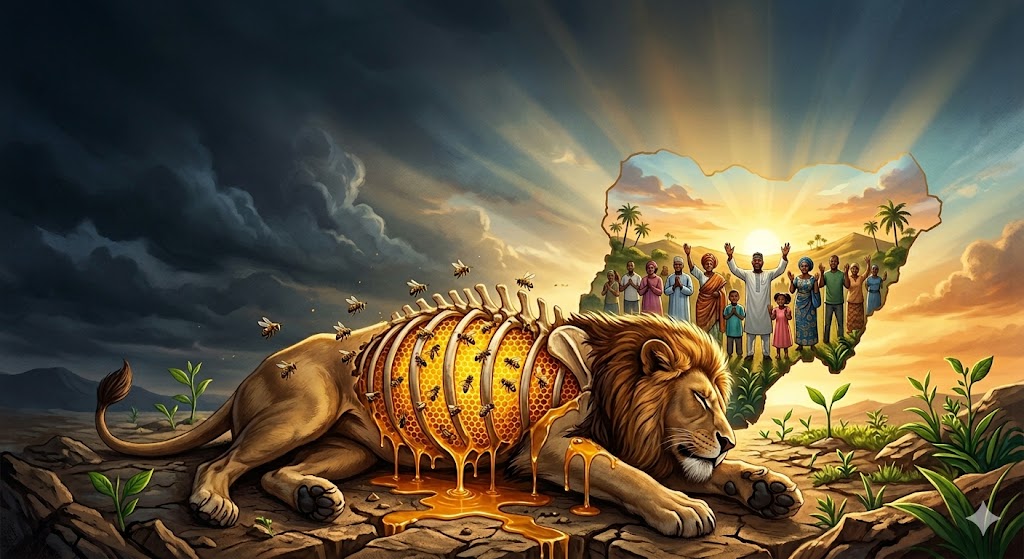
“And after a time he returned to take her, and he turned aside to see the carcass of the lion: and, behold, there was a swarm of bees and honey in the carcass of the lion” (Judges 14:8).
Nigeria stands today like a wounded giant. We are blessed with vast resources, intelligent people, fertile land, energetic youth and a vibrant church. Yet insecurity, corruption, ethnic divisions, religious extremism, poor infrastructure, unemployment, disease and moral decline continue to wound the nation.
Plateau State has experienced painful seasons of violence, distrust, bloodshed, displacement and grief. Many churches continue to ask, “Where is God in all of this?”
The story of Samson and the lion offers a surprising answer. It reminds us that God can bring honey out of a carcass. He can bring sweetness out of bitterness, strength out of weakness, revival out of tragedy and hope out of situations that appear dead and beyond redemption.
The roaring lion, the God Who gives victory
As Samson journeyed, a young lion suddenly roared against him. The lion represented danger, fear, opposition and death. Throughout Scripture, lions often symbolise destructive powers that seek to intimidate and destroy.
Nigeria today faces many lions. Corruption, terrorism, banditry, kidnapping, political manipulation, tribalism, religious hatred, economic hardship, moral decay and the abuse of public trust confront citizens daily. Many Nigerians wake up every morning facing one lion or another.
Yet the Biblical narrative tells us that the Spirit of God came mightily upon Samson and enabled him to defeat the lion. The first lesson remains clear: the lion is real, but God’s power is greater. The church must neither deny reality nor surrender to fear.
Psalm 124:8 reminds us: “Our help is in the name of the Lord, who made heaven and earth.”
No matter how fierce the lions confronting Nigeria may appear, our confidence must remain in the God who rules over nations and directs the course of history.
When Samson later returned to the place where he had slain the lion, he encountered something completely unexpected. The place of death had become a place of life. The place of danger had become a source of nourishment. Inside the carcass was a swarm of bees and honey.
This remains one of the most extraordinary images in Scripture. God transformed what once threatened Samson into something that strengthened him. The same principle applies to Nigeria today. The communities that have experienced violence can become centres of reconciliation. The institutions weakened by corruption can become instruments of justice.
The Church that has known division can become united. Youth who were once recruited into violence can become ambassadors of peace. A nation that is mocked today can become a blessing to Africa tomorrow. God specialises in transforming carcasses into honeycombs.
Yet the story contains an important warning. According to the Nazirite laws recorded in Numbers 6, Samson was forbidden from touching a dead body. Nevertheless, he took honey from the lion’s carcass. The incident, therefore, reveals both blessing and compromise.
This truth carries a powerful lesson for both the church and the nation. We must never use God’s blessings to justify disobedience. Nigeria often desires prosperity without integrity, miracles without repentance, development without accountability and national transformation without personal transformation.
God can bring honey from difficult situations, but we must not become comfortable with corruption simply because some benefits appear to emerge from it. A nation cannot continually violate God’s moral laws and expect lasting peace.
The honey Nigeria needs
Throughout Scripture, honey symbolises strength, wisdom, God’s goodness, prosperity and restoration. Honey revived Samson. Nigeria today needs spiritual honey.
The nation needs the honey of integrity. We need leaders who fear God more than they fear elections. We need the honey of justice so that citizens may experience fairness in courts, institutions and governance. We need the honey of truth because falsehood ultimately destroys societies and erodes public trust.
Nigeria also needs the honey of unity. The Church must model ethnic and denominational reconciliation in a country too often divided by differences. We need the honey of hard work because no nation can sustainably consume what it does not produce. We equally need the honey of compassion, demonstrated through care for widows, orphans, displaced persons and the poor.
Political leaders must recognise that leadership is a sacred trust rather than an opportunity for personal enrichment. Public office exists for service, not exploitation. Power is stewardship. Leaders who steal from the people rob future generations, while politicians who divide communities for political gain sow seeds of future destruction. By contrast, leaders who pursue justice become blessings to their people.
As Proverbs 14:34 declares: “Righteousness exalteth a nation: but sin is a reproach to any people.”
This timeless principle remains relevant today. No nation can rise above the moral character of its leaders and citizens.
Religious leaders also carry enormous responsibility. The church must become more than a commentator on society. It must truly function as salt and light. Pastors must preach truth. Church leaders must model integrity. The gospel must not be reduced to prosperity messages alone.
Believers should be discipled to become honest teachers, judges, traders, civil servants, politicians and businesspeople. Revival begins not in government houses but in hearts transformed by God.
African wisdom, Christian hope, Nigeria’s future
African wisdom contains truths that align remarkably with Scripture. The saying that a tree does not make a forest reminds us that Nigeria’s challenges require collective responsibility. Another proverb teaches that when spider webs unite, they can tie up a lion. Unity can overcome seemingly impossible challenges.
The proverb that says a river that forgets its source will dry up carries a profound lesson. A nation that forgets God eventually loses its moral foundation.
Yet African wisdom also speaks hope. However long the night may be, dawn will surely come. God’s mercy remains available to Nigeria.
Another proverb teaches that a child who is not embraced by the village may seek warmth elsewhere. This truth carries serious implications for Nigeria’s youth. Unless we invest in young people and provide opportunities for them to flourish, hopelessness may continue to recruit them into violence, crime, and extremism.
Ultimately, Samson points beyond himself to Jesus Christ.
Jesus entered the greatest carcass of all—the grave itself. Yet from His death came eternal life. From the cross came salvation. From suffering came redemption. From the tomb came resurrection.
If God could bring resurrection from Calvary and life from an empty tomb, then He can bring renewal to Plateau State, to Nigeria and, indeed, to Africa.
Nigeria shall rise again
The lion has roared. The nation has been wounded. The Church has wept. Many families have buried loved ones. Many communities carry deep scars.
Yet God remains the God who brings honey from carcasses. The giant of Africa shall not die. Plateau shall not die. The Church shall not die.
Truth shall rise. Justice shall rise. Integrity shall rise. Hope shall rise. Young men and women shall rise. The gospel shall rise.
And, by the grace of God, Nigeria shall yet discover honey where many see only a carcass.
Closing Prayer:
O Lord God of Nigeria, heal our land. Turn our wounds into wisdom, our pain into purpose and our losses into testimonies. Raise leaders of integrity, pastors of courage and citizens of righteousness. Let peace return to Plateau State and every troubled region. Let the honey of Your grace, truth, justice and power strengthen this nation. May Nigeria fulfil her divine destiny among the nations of Africa, through Jesus Christ our Lord.
Amen.
Rev Prof John Brown Okwii, the
Serving Pastor, Assemblies of God Church, Hwolshe Branch, opposite Model Academy, near Plateau State Polytechnic, Jos Campus, along Yakubu Gowon Way, writes via johnbrownokwii@gmail.com