



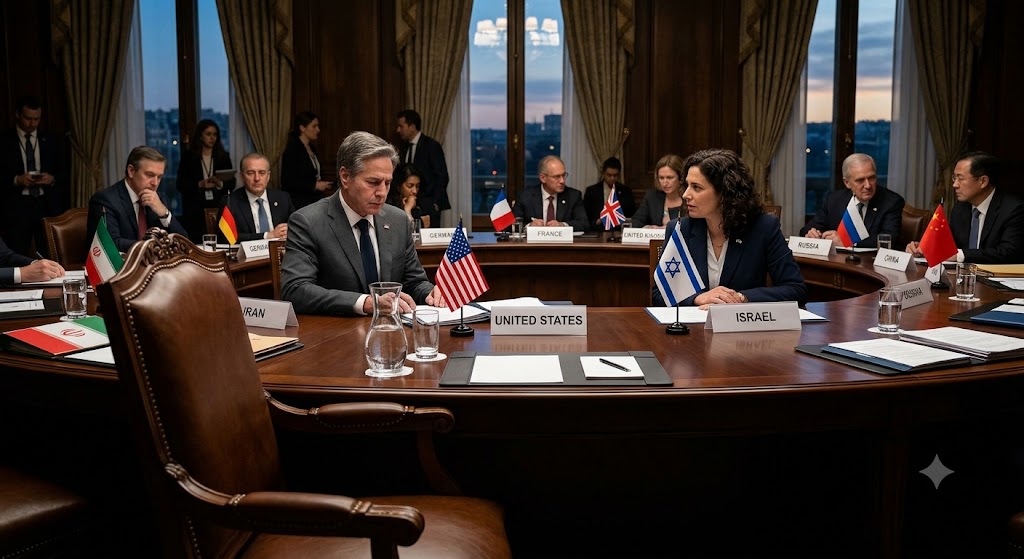
In the unfolding aftermath of the U.S.-Iran ceasefire arrangement, attention is shifting from relief over the pause in hostilities to deeper questions about the political calculations behind the agreement. In this analysis, AFOSEH HAMZA argues that while the Memorandum of Understanding may appear to signal diplomatic progress, its structure raises concerns that Iran may have entered a negotiation framework that leaves critical gaps in its strategic positioning, particularly regarding Israel’s absence from the table
The entire world breathed a collective sigh of relief upon hearing that a Memorandum of Understanding had been reached on Sunday to bring an end to the four-month-long conflict.
Interestingly, a formal agreement between the two sides is expected to be signed on Friday.
Should that happen, it would eventually lead to the reopening of the Strait of Hormuz, which has largely been under the control of the Islamic Republic of Iran since the war began on February 28.
It is hoped that such a development would help stabilise the already fragile global energy market.
In return, the United States is expected to lift the naval blockade it imposed on Iran’s southern ports, a move that has further strained the country’s already troubled economy.
A diplomatic trap?
Now to the crux of this argument: Iran may be walking into a diplomatic trap carefully laid by Israel and the United States.
Sometimes, you wonder what exactly is wrong with the Iranian leadership.
How does a country enter into a Memorandum of Understanding with America, its secondary adversary, or foe by association, without involving its primary opponent, Israel, especially in a conflict in which Israel is either directly involved or arguably the principal reason the United States became part of the equation?
By agreeing to negotiate with America without insisting that Israel be present at the table, Iran may have once again placed itself in a difficult position.
How, you may ask?
The Americans are clever.
They are clever because, while they have succeeded in bringing Iran into this agreement without Tehran demanding Israel’s participation, they have simultaneously allowed Israel to maintain a watchful eye on developments without burdening Jerusalem with any obligations arising from the agreement.
If Israel is not a party to the peace deal, then Israel cannot be bound by its provisions.
That is precisely what the principle of pacta tertiis nec nocent nec prosunt, often shortened simply to pacta tertiis, suggests.
What does this principle mean?
In international law, it refers to the rule that a treaty creates neither obligations nor rights for a third state without that state’s consent.
Since international agreements are founded upon the principle of state sovereignty, no country can be legally compelled to abide by rules it did not expressly accept or become a party to.
This long-standing principle of customary international law is formally codified in Article 34 of the 1969 Vienna Convention on the Law of Treaties (VCLT), which states, among other things: “A treaty does not create either obligations or rights for a third State without its consent.”
The Israel factor
That is why Israeli Prime Minister Benjamin Netanyahu repeatedly emphasises that President Donald Trump is the leader of the United States, while he, Netanyahu, remains the leader of the State of Israel.
And he is absolutely correct.
Indeed, Trump himself has echoed a similar position by suggesting that any agreement reached between Washington and Tehran does not automatically impose obligations on Israel, including decisions relating to military deployments in southern Lebanon or current security arrangements in Gaza and Syria.
The assumption by some Iranian policymakers that America can simply micromanage Israel and compel Jerusalem to do whatever the White House desires—as though Israel were an extension or the 51st state of the United States—may prove to be a costly miscalculation.
It is sincerely hoped that Iran does not pay dearly for what could become a major strategic oversight and diplomatic blunder.
On a more serious note, you wonder whether none of the surviving Iranian leaders recognised what appears to be a carefully concealed landmine placed before them.
If they did, why proceed?
And if they did not, the consequences may only become clear when the real test of this agreement begins.