


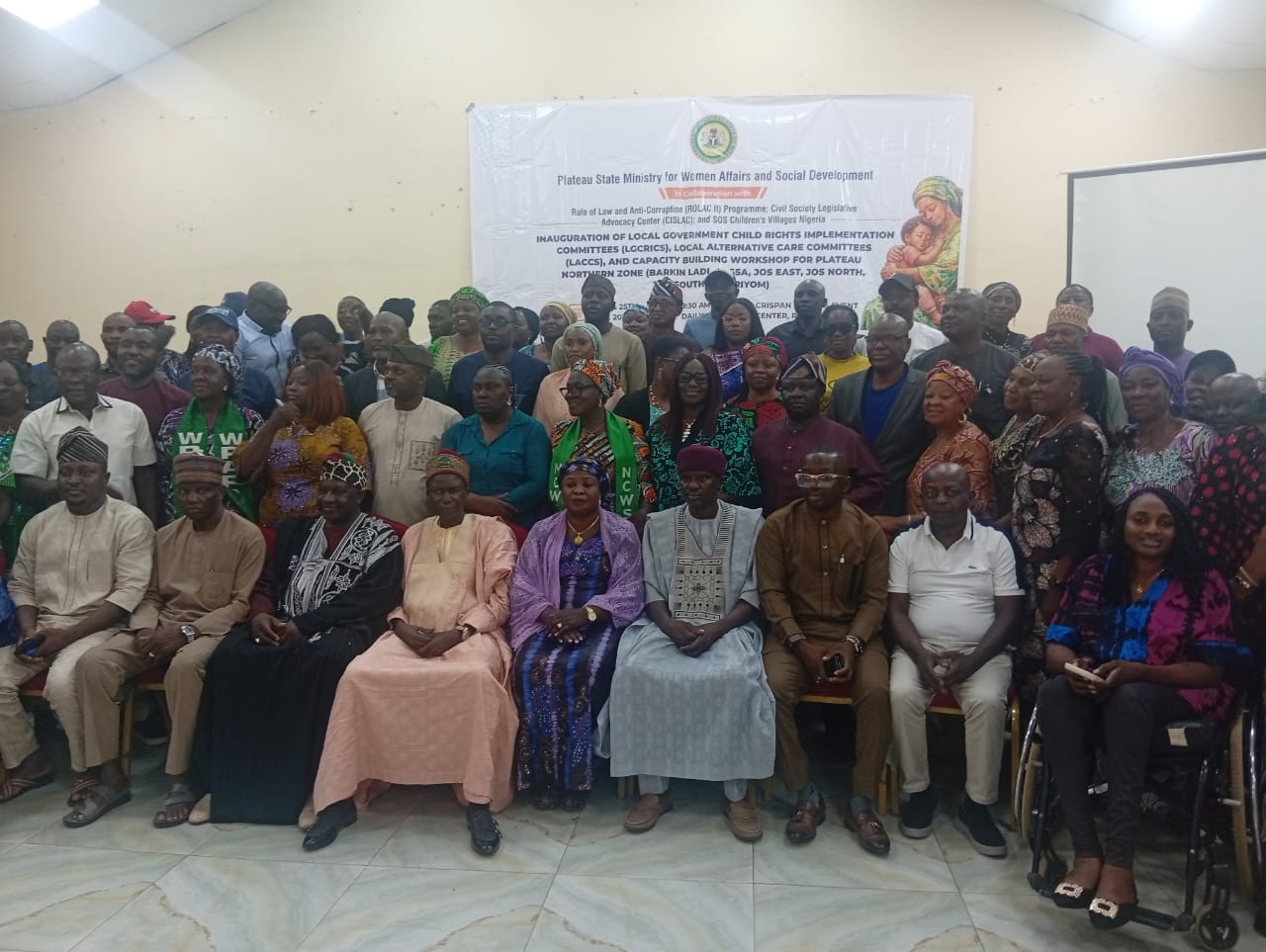

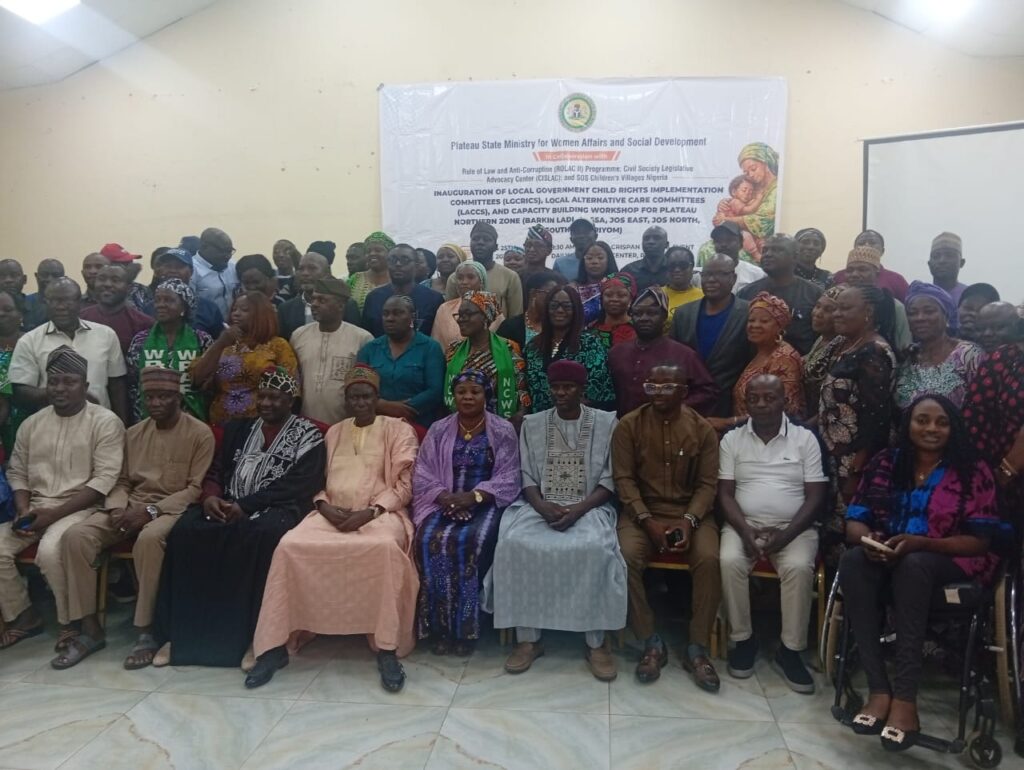
As concerns grow over child abuse, trafficking and weak enforcement of child protection laws in Plateau State, stakeholders are taking decisive steps to move child rights protection beyond government offices and into local communities. MARIE-THERESE NANLONG reports on the inauguration of Child Rights Implementation Committees across six local government areas, highlighting the determination of government, development partners, traditional institutions and community leaders to ensure that every child enjoys the protection guaranteed under the Plateau State Child Rights Law 2005
For many children in Plateau State, abuse happens in homes, in communities where ignorance of the law is widespread, and sometimes under the false promise of a better future.
Many children in the state are experiencing abuse in diverse forms. While some cry out for justice, their voices are often silenced by institutions that ought to protect them and ensure justice is served.
For instance, the case involving the alleged defilement of a four-year-old child, and the recent withdrawal of the case midway through trial, has raised questions about how effectively the Plateau State Child Rights Law 2005 is being implemented.
For child protection advocates, this case and many others occurring in communities reinforce the need for stronger institutions, greater public awareness and collective action to ensure that every child receives the protection guaranteed by law.
To secure a better future for children, the Plateau State Ministry of Women Affairs and Social Development, in collaboration with the Rule of Law and Anti-Corruption Rollout Programme, SOS Children’s Villages Nigeria and the Civil Society Legislative Advocacy Centre (CISLAC), with funding from the European Union, sought grassroots participation in implementing the law.
At a workshop organised in Jos to introduce the law to stakeholders and build their capacity for implementation, the partners also inaugurated Child Rights Implementation Committees in six local government areas of the Northern Senatorial Zone: Bassa, Barkin Ladi, Jos East, Jos North, Jos South and Riyom.
During the two-day event held on June 24 and 25, stakeholders were also sensitised on referral pathways, case management in alternative care, trauma-informed care and other child protection issues.

Building child protection from the grassroots
Speaking on the relevance of the committee at the grassroots, Victoria Kaze, a Social Welfare Officer in Jos East Local Government Area, said the realities confronting children are both painful and familiar.
Her words: “The situation is very pathetic because most people don’t know that a child has his right.”
According to her, many cases arise not necessarily because parents deliberately set out to harm their children, but because they mistake abuse for discipline or simply do not understand that children have rights protected by law.
“Some don’t even have the radio to listen to news to know that a child has his/her rights. So, we receive many of these cases of child abuse,” she explained.
For Kaze, the capacity-building workshop organised alongside the inauguration of the committees has strengthened her resolve to do more.
“It has opened my eyes to know widely issues that have to do with child protection, and by so doing I’m going to implement it when I’m working in my office.”
Beyond physical abuse, trafficking remains another major threat facing children across Plateau communities.

Pius Adaka, Supervisory Councillor for Health in Bassa Local Government Area, disclosed that insecurity and economic hardship continue to expose many families to traffickers.
“In fact, we are having a lot of challenges pertaining to trafficking,” he said.
Although awareness campaigns through village heads and community leaders have reduced the number of reported cases, he warned that traffickers still prey on struggling families.
“They will carry a child from a village saying they are taking them to give them a better job, and at the end of the day they end up being slaves in a strange land,” he observed.
He cited cases involving young girls trafficked to Ghana, adding that the newly inaugurated committee would intensify awareness campaigns through parents and traditional institutions.
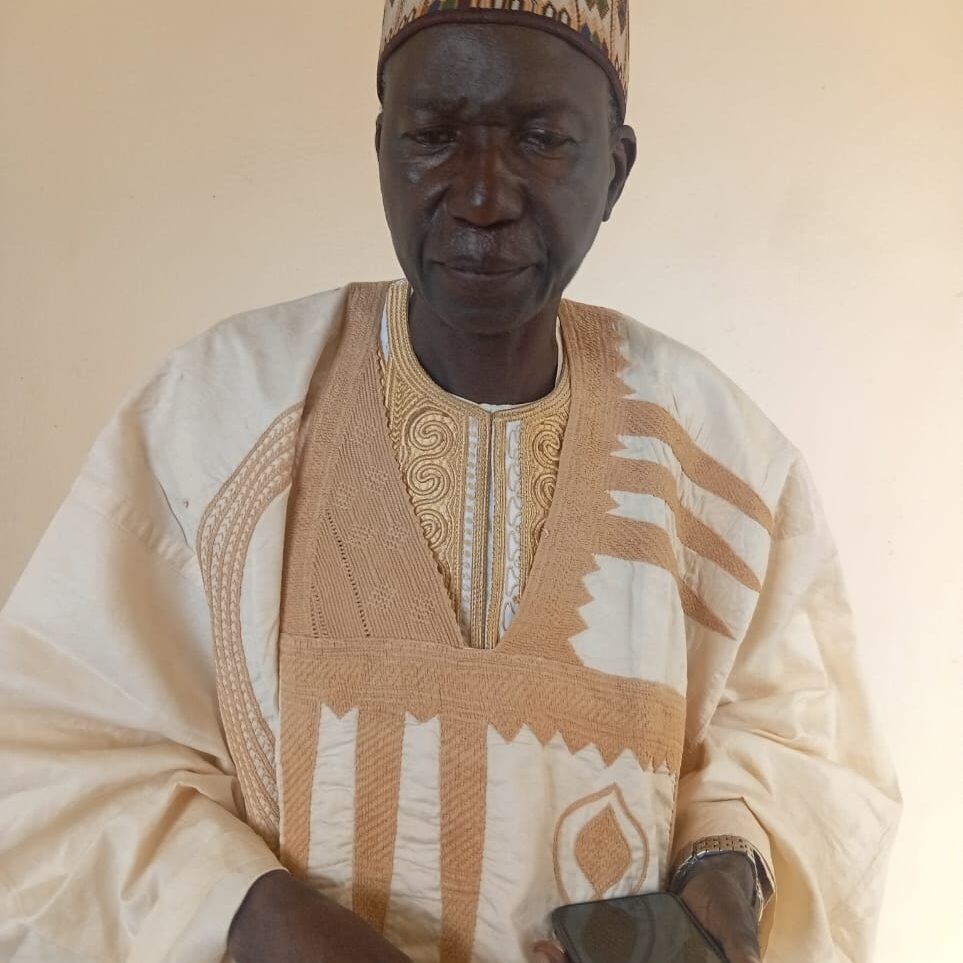
A traditional ruler, the Gwom Rwei of Barkin Ladi, Da Edward Bot, expressed similar concerns, emphasising that insecurity and economic hardship have made children even more vulnerable as desperate parents are persuaded to release their children to strangers promising employment or a better future.
According to him, “The way things are now, a lot of things are happening because of the attacks, because of the hardship. Most times, people will just come and pick children that they will get them better jobs elsewhere, and at the end of it all, they will be abused in many ways.”
He said traditional rulers continue to encourage parents to resist such temptations and instead prioritise education.
“Education is very key, and it is very important. Once one is educated, you will know your left and right,” he maintained.
Strengthening enforcement structures
The newly inaugurated committees are expected to give practical effect to Sections 265 and 266 of the Plateau State Child Rights Law 2005 by coordinating implementation at the local government level.
Their responsibilities include developing operational plans, improving coordination among stakeholders, building a database of child protection activities and strengthening enforcement of the law.
The committees comprise secretaries to local government councils, supervisory councillors for health and education, information officers, social welfare officers, members of traditional institutions, Parent-Teacher Associations and other stakeholders whose responsibilities place them close to children and families.
Addressing stakeholders, the Commissioner for Women Affairs and Social Development, Caroline Dafur, represented by the Permanent Secretary of the ministry, Rebecca Shasheet, called for collective responsibility in protecting children.
“As we inaugurate these committees today, let us renew our commitment to ensuring that no child is left behind and that the rights of every child are respected, protected and fulfilled,” she stated.
She had earlier stressed that the committees were established to tackle child abuse and trafficking while promoting the welfare of children, particularly those living in rural communities.
“This administration is committed to ensuring that every Plateau child has equal opportunity to thrive; the welfare of our children is a priority for Governor Caleb Mutfwang,” she said.
To the Plateau State Coordinator of the Rule of Law and Anti-Corruption Programme, Mantim Dala, many children affected by violence and displacement are left without adequate care.
He stressed: “Most times, the children are left without anybody to look after them. What are we going to do about that? Because two things may happen, they will either fall into good hands and become an addition to the state, or more often fall into bad hands and become more toxic to the system.”
Beyond laws, c’ttees
Speaking on behalf of the Civil Society Legislative Advocacy Centre and SOS Children’s Villages Nigeria, Solomon Adoga observed that although Plateau was among the first states to domesticate the Child Rights Act, implementation structures took years to materialise.
The inauguration of the local government committees therefore represents an important opportunity to bridge that gap through stronger coordination, improved awareness, better documentation of cases and increased access to justice for children.
However, those working most closely with affected families insist that laws and committees alone are not enough.
The lessons emerging from communities across Plateau demonstrate that protecting children requires informed parents, vigilant communities, committed traditional institutions and public officials willing to uphold the law.
As the controversy surrounding the alleged defilement case continues to fuel conversations on child protection, stakeholders maintain that every child deserves to grow up free from abuse, exploitation and neglect.
The Plateau State Child Rights Law 2005 provides the legal framework for such protection. The responsibility now rests with government, communities, institutions and every stakeholder to ensure that the law is fully enforced so that no child in Plateau is left unprotected.