



By DAN MANJANG
Public officials occupy positions that demand restraint, accuracy and fairness, particularly when addressing sensitive national issues capable of inflaming ethnic tensions. In this article, DAN MANJANG examines the controversy generated by remarks attributed to the Director-General of the National Institute for Policy and Strategic Studies (NIPSS), Professor Ayo Omotayo, arguing that branding an entire ethnic group as ‘militias’ undermines justice, national cohesion and constitutional principles, while calling for responsible leadership that promotes unity rather than division
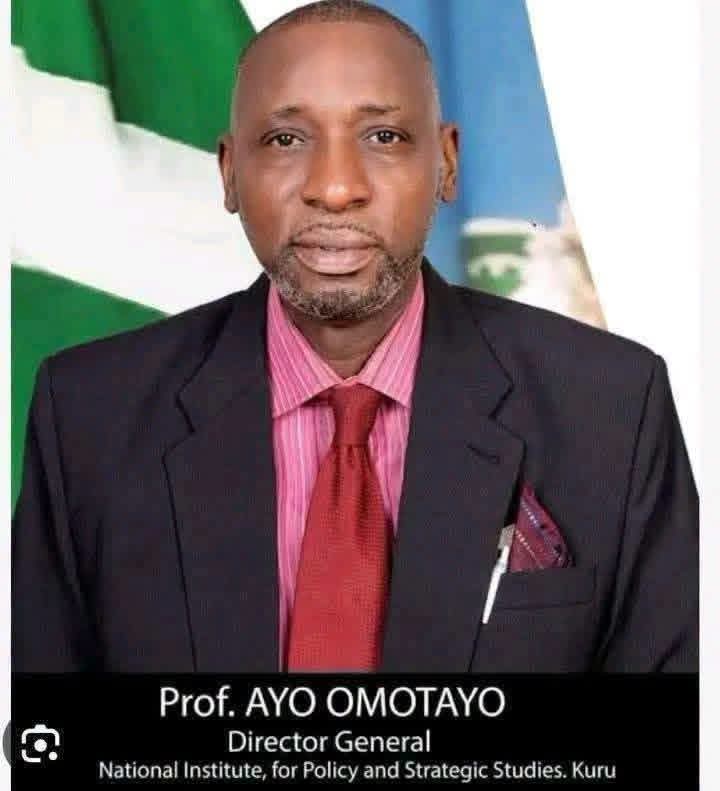
By now, many Nigerians must have watched with disbelief the television interview in which Professor Ayo Omotayo, Director-General of the National Institute for Policy and Strategic Studies (NIPSS), Kuru, reportedly referred to the Berom ethnic group of Plateau State as “militias” while discussing the prevailing security challenges in the state.
Such a sweeping characterisation has generated understandable outrage among the Berom people and other well-meaning Nigerians who appreciate the dangers of profiling entire communities.
Certainly, words matter. They matter even more when they come from the occupant of one of Nigeria’s most prestigious strategic policy institutions. The Director-General of NIPSS is not merely an academic speaking in a private capacity; he occupies a national office whose pronouncements carry significant weight.
Every public statement from such an office ought to reflect intellectual discipline, factual accuracy, impartiality and a commitment to national cohesion.
Unfortunately, the remarks attributed to Professor Omotayo fell far short of these standards.
The Berom are one of Nigeria’s constitutionally recognised ethnic nationalities with a rich history, vibrant culture and enduring contributions to the political, economic and social development of Plateau State and the nation. Like every other ethnic group in Nigeria, the Berom comprise farmers, civil servants, academics, military officers, business people, religious leaders, professionals, artisans and students.
To reduce an entire people to the label of “militias” is not only intellectually indefensible but also morally troubling. It amounts to collective condemnation without evidence and undermines the principles of fairness upon which democratic societies are built.
The security crisis on the Plateau is complex and predates the tenure of many current public officials. It has involved disputes over land, resource competition, criminality, reprisals, terrorism, banditry and communal violence affecting several ethnic and religious communities. Thousands of innocent Berom men, women and children have themselves been victims of horrific attacks over the years.
Their villages have been destroyed, lives cut short and livelihoods devastated. To ignore this painful reality while branding the entire ethnic group as militias is to disregard decades of documented suffering and sacrifice.
Justice must be individual, not ethnic
Responsible leadership demands restraint, especially when speaking on matters capable of inflaming passions. Public officials occupying sensitive offices should avoid generalisations that criminalise communities. Individuals who commit crimes should be identified and prosecuted based on credible evidence, irrespective of their ethnicity or religion.
Criminal liability is personal, not communal. Democracies are sustained by the rule of law, not by ethnic profiling or sweeping accusations against entire populations.
It is particularly disappointing that these remarks emanated from the head of NIPSS, an institution established to provide objective policy research, strategic thinking and informed national dialogue. NIPSS has earned enormous respect over the decades because it has consistently served as a platform for intellectual engagement above partisan or sectional interests.
Nigerians expect its leadership to embody the highest standards of scholarship, balance and national responsibility.
When the chief executive of such an institution appears to make categorical assertions that stereotype an entire ethnic group, the credibility of that institution inevitably comes under scrutiny.
One of the cardinal qualities of leadership is the ability to unite rather than divide. Leaders must build bridges where others erect walls. They must calm tensions rather than aggravate them.
They must inspire confidence among all citizens regardless of ethnicity, religion or political affiliation. In a plural society such as Nigeria, every public utterance by national leaders should be measured against its likely impact on peace, justice and national integration.
Statements that reinforce stereotypes or deepen existing fault lines do the exact opposite.
This is not an attempt to shield criminal elements from accountability. If any individual of Berom extraction has committed crimes, the security agencies should investigate thoroughly and prosecute in accordance with the law.
The same standard should apply to offenders from every other ethnic group. Justice is served when guilt is established individually through due process—not when an entire people are placed under suspicion because of the actions of a few.
Collective guilt has no place in a constitutional democracy.
Building unity through responsible leadership
Professor Omotayo should, therefore, reflect carefully on the consequences of his remarks.
Statesmanship requires the humility to acknowledge when words have caused unintended injury. A public clarification or apology would not diminish his stature; rather, it would demonstrate courage, integrity and respect for the values of fairness and inclusiveness that NIPSS represents.
Such a step would also reassure the Berom people and the wider Nigerian public that no ethnic group is to be profiled or criminalised from the platform of a respected national institution.
Nigeria’s diversity remains one of its greatest strengths. Every ethnic nationality deserves equal dignity, equal protection and equal respect under the Constitution. Public institutions must be seen as impartial arbiters that protect every citizen without prejudice.
The task before our leaders is not to amplify divisions but to promote understanding, reconciliation and justice. At a time when insecurity already threatens national unity, careless rhetoric can be as damaging as the violence itself.
The Berom people deserve justice, not prejudice; empathy, not stereotyping; fairness, not collective condemnation.
National discourse must be guided by evidence, reason and constitutional principles rather than broad generalisations.
As Nigerians, we must reject every attempt—whether deliberate or inadvertent—to stigmatise entire ethnic groups. Our democracy will only flourish when every citizen is judged by his or her individual conduct and not by ethnic identity.
That is the essence of justice, the hallmark of responsible leadership and the true path towards enduring peace and national unity.
Manjang, mnipr M.DiV, former Plateau State Commissioner of Information and Communication, writes via dmanjang@gmail.com
So unfortunate