



By Rev. JOHN OKWII
Text: Exodus 17:8–16
Introduction
Every generation has its own Amalek. For ancient Israel, Amalek emerged as a ruthless enemy that attacked God’s covenant people at a time when they were physically exhausted and spiritually vulnerable. Today, Plateau State, Nigeria, Africa and indeed the Church confront their own modern Amalekites in the form of killings, kidnappings, terrorism, corruption, tribal hatred, denominational rivalry, poverty, youth unemployment, drug abuse, moral decadence, leadership fatigue and spiritual complacency. These challenges threaten not only the peace and security of society but also the spiritual vitality of God’s people.
Yet the greatest danger is not simply that Amalek attacks. The greater danger is that the hands entrusted with holding the rod of God become weary.
The background to our text reveals that Israel had only recently crossed the Red Sea and possessed little or no military experience when Amalek suddenly launched an attack against them. Amalek deliberately chose to strike a people who were tired and vulnerable.
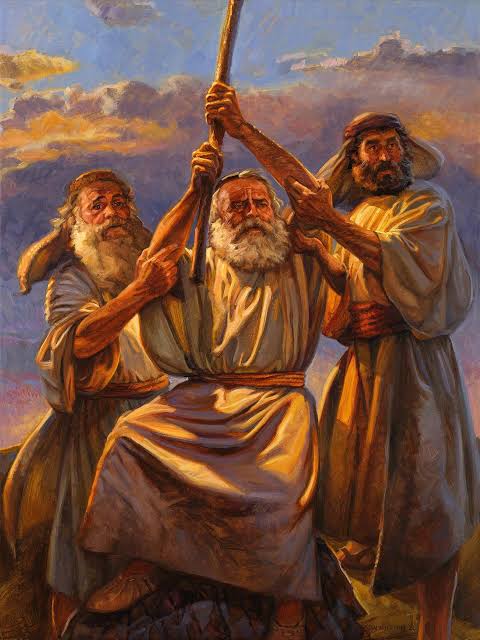
However, God’s strategy for victory was remarkable. Joshua descended into the valley to engage the enemy in battle while Moses climbed the mountain to intercede before God. Aaron and Hur remained beside Moses to support him whenever his strength began to fail. The battle, therefore, required fighters, intercessors and encouragers working together. No single ministry, no matter how gifted, could have secured victory on its own.
The rod of God, the strength found in shared responsibility
The rod Moses carried had already become a visible symbol of God’s mighty acts. Through it, God divided the Red Sea, struck the rock to provide water and demonstrated His supremacy over Pharaoh and Egypt. Yet the power never resided in the rod itself. The authority belonged entirely to God. The rod simply represented His divine authority, His covenant, His promises and His abiding presence among His people.
In the same way, Christian leadership today is sustained by God’s own resources. The Church carries God’s rod through His Word, faithful prayer, personal integrity, unwavering truth and practical righteousness. Whenever these are neglected, leadership degenerates into mere administration devoid of spiritual power.
The Scriptures tell us that Moses’ hands became heavy. The Hebrew expression literally means that his hands became weighty. This simple statement reminds us that even the greatest leaders become exhausted. Pastors become tired. Governors become tired. Presidents become tired. Parents become tired. Teachers become tired. Youth leaders become tired. Women leaders become tired, and even seasoned prayer warriors experience seasons of weakness.
No human leader possesses inexhaustible strength. Even the prophet who spoke face to face with God needed help. Leadership, therefore, should never be viewed as personal invincibility but as a shared responsibility entrusted to the entire community of faith.
One of the most sobering moments in this passage is the statement that whenever Moses lowered his hands, Amalek prevailed. The spiritual condition of one leader directly influenced the outcome of an entire nation’s battle. The lesson remains painfully relevant today.
Whenever prayer weakens, evil gains strength. Whenever righteousness declines, corruption flourishes. Whenever churches neglect earnest intercession, violence finds fertile ground. Whenever governments fail to administer justice faithfully, criminals become emboldened.
Aaron and Hur understood their assignment with remarkable humility. They neither competed with Moses nor criticised him. They did not boast that they could pray better or lead more effectively. Instead, they quietly accepted the responsibility of supporting God’s servant.
Genuine leadership is not always about standing before the crowd. Sometimes it is demonstrated by faithfully strengthening someone else’s hands.
Yet the story does not end there. Aaron and Hur themselves were human, and their own strength had limits. Recognising this, they wisely placed a stone beneath Moses so that he could sit while they continued supporting his hands until sunset. The stone therefore became another silent servant in God’s plan. It teaches us that even support systems require support.
Sometimes, God strengthens His servants through people, while at other times He provides enduring structures that preserve and sustain them.
That stone speaks powerfully to the Church and to society today. Churches require more than gifted preachers. They also need accountability, succession planning, financial transparency, welfare systems, leadership development, prayer ministries and counselling structures.
Likewise, governments cannot depend solely on charismatic individuals. They require strong institutions, independent courts, professional security agencies, effective intelligence services, credible elections and active citizen participation. No nation can endure by relying on one heroic leader alone.
Each individual in this Biblical account fulfilled a distinct calling. Moses embodied visionary leadership. Joshua represented operational leadership, reminding us that prayer alone is not sufficient when courageous action is also required. Aaron illustrated the ministry of priestly intercession, while Hur demonstrated the often-overlooked ministry of faithful support. Even the stone became a symbol of enduring systems that preserve leaders and enable them to continue serving effectively.
Applying the lessons to Plateau State, Nigeria, Africa
The lessons from Exodus 17 speak directly to the realities confronting Plateau State today. Years of killings, displacement, kidnappings, destruction of farmlands and widespread fear have become the modern Amalekites confronting the people. The solution, however, does not lie merely in organising more conferences, conducting more crusades or delivering more political speeches. The answer begins with genuine unity.
Whenever churches become divided, Amalek rejoices. Whenever ethnic communities cultivate hatred against one another, Amalek advances. Whenever politicians deliberately polarise citizens for personal gain, Amalek celebrates. Whenever security agencies fail to cooperate, Amalek benefits from their divisions.
The same principle applies across Nigeria. Our nation desperately needs pastors who support governors, governors who cooperate with traditional rulers, traditional rulers who work closely with security agencies, citizens who respect lawful government, young people who become ambassadors of peace, women who champion reconciliation and elders who intentionally mentor younger generations. Prayer and good governance must function together rather than as opposing forces.
Across Africa, the continent remains richly endowed with natural and human resources, yet many nations continue to struggle because leaders often become isolated, institutions remain weak and communities are deeply divided. Africa’s future depends upon collective responsibility.
No denomination alone can transform the continent. No government alone can solve every national challenge. No single ethnic group can build Africa’s future in isolation.
This Biblical truth also carries practical implications for every segment of society. Heads of Christian denominations must abandon unhealthy competition and instead cultivate genuine fellowship, praying together, standing together and protecting one another.
Bishops and pastors should intentionally carry one another’s burdens. Whenever a minister stumbles, the goal should be restoration rather than destruction. They must also invest deliberately in developing younger ministers while recognising the importance of periodic rest to prevent burnout.
Elders within the Church must refuse to become passive spectators. Their wisdom and experience should strengthen and stabilise younger leaders. Every church department, whether children’s ministry, women’s ministry, men’s ministry, youth ministry, choir, ushering or evangelism, contributes significantly to strengthening Moses’ hands. None should ever be regarded as insignificant.
Women have consistently sustained the Church through faithful prayer, generous giving and sacrificial service. They should continue strengthening families while mentoring younger women in faith, integrity and godly character. Men are called to lead with humility, responsibility and sacrificial love, becoming protectors of peace within their homes and communities.
Young people must channel their strength towards defending righteousness rather than promoting violence, embracing their calling as innovators, peacemakers and nation-builders. Children should be taught obedience, honesty and compassion from an early age, recognising that today’s faithful child may become tomorrow’s righteous leader.
The responsibilities of government are equally clear. Local governments must serve communities fairly, respond swiftly to local security concerns and provide meaningful support for agriculture, education and healthcare. State governments must administer justice impartially, strengthen coordination among security agencies, support victims of violence and promote sincere dialogue among communities.
At the federal level, government must guarantee equal protection for every citizen, strengthen intelligence gathering and law enforcement, combat corruption decisively and ensure that justice remains impartial. A truly secure nation is built not only with weapons but also through trust, fairness and accountable institutions.
The wisdom of Africa reinforces these biblical principles. The saying that one finger cannot lift a heavy stone reminds us that difficult burdens require many hands. The proverb that spider webs, when united, can tie up a lion teaches the extraordinary power of unity.
Likewise, the truth that a single broomstick breaks easily while a bundle remains strong illustrates the strength found in collective effort. The familiar saying that those who wish to go quickly may travel alone, but those who desire to go far must travel together, continues to speak to both the Church and society. In the same spirit, the proverb that the left hand washes the right and the right hand washes the left reminds us of mutual dependence.
Rain never falls on only one roof, a single tree can never become a forest, and wisdom resembles a great baobab tree that no individual can fully embrace alone. Together, these timeless African proverbs echo the message of Exodus 17 that lasting victory belongs to communities that embrace shared responsibility.
Holding up weary hands until victory comes
The Holy Spirit, therefore, confronts every believer with deeply personal questions. Who is your Moses today? Whose hands have become weary? Is it your pastor, your spouse, your governor, your teacher, your prayer partner, your elderly parent or your fellow church worker? More importantly, whose hands are you strengthening through your prayers, encouragement and faithful service?
The victory over Amalek did not come through Joshua’s sword alone, nor was it secured solely by Moses’ uplifted rod. Israel prevailed because Joshua courageously fought, Moses faithfully prayed, Aaron willingly supported, Hur steadfastly strengthened and even the silent stone played its part in sustaining God’s servant. Every participant fulfilled the assignment God had entrusted to him.
The Church in Plateau State, throughout Nigeria and across Africa must, therefore, reject division, discouragement and isolation. Pastors, elders, women, men, youths, children, community leaders, traditional rulers and governments must deliberately uphold one another in righteousness, justice and faithful service.
As long as God’s people continue holding up one another’s hands, the modern Amalekites of violence, hatred, corruption and fear will never have the final word.
Through God’s abundant grace, united prayer, courageous action and unwavering mutual support, righteousness shall prevail. May the Lord strengthen every weary hand, renew every discouraged heart and establish enduring peace in Plateau State, throughout Nigeria and across the African continent.
Amen.
Rev. Prof. John Brown Okwii, the
Serving Pastor, Assemblies of God Church, Hwolshe, opposite Model Academy, along Yakubu Gowon Way, Jos, writes via johnbrownokwii@gmail.com
So so great to read and listen spiritually.
Thanks a lot and always keep on sharing with me the word of God and with time I want to do bible studies