


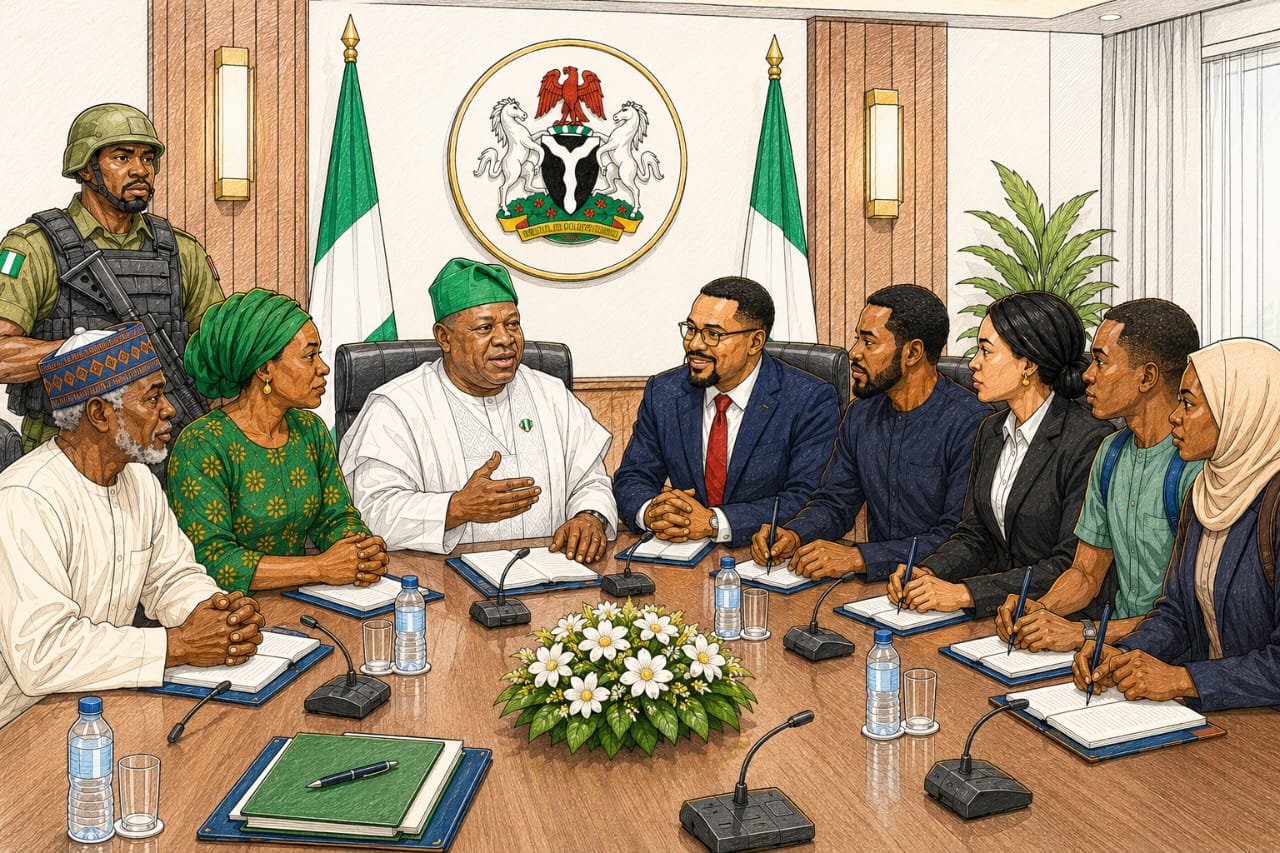

PRESIDENT Bola Ahmed Tinubu’s recent appeal to the people and leadership of Plateau State to embrace inclusion, justice, tolerance and reconciliation is both timely and commendable. No society can attain lasting peace where citizens are denied equal protection under the law or where differences of ethnicity and religion are exploited for political or sectarian ends. The president’s call reflects the ideals upon which every democratic society should stand.
HOWEVER, to elevate inclusion as the principal remedy to the prolonged bloodshed in Plateau State, as canvassed by the Daily Trust newspaper in its editorial of July 7, 2026, is to offer a prescription that does not sufficiently address the nature of the ailment. It is a diagnosis that, however well-intentioned, risks obscuring the central realities of a conflict that has consumed thousands of innocent lives and displaced entire indigenous communities over the past two decades.
THE tragedy of Plateau cannot be explained away as the inevitable consequence of exclusion or inadequate representation. Such a narrative inadvertently trivialises one of the darkest chapters in Nigeria’s recent history and diminishes the memory of countless victims whose lives were cut short in repeated attacks on villages that posed no threat to anyone.
THE facts before the nation tell a different story. Over the years, communities have been invaded under the cover of darkness. Villages have been razed. Churches, homes and farms have been destroyed. Survivors have fled ancestral lands occupied by their forebears for generations. Thousands now live as internally displaced persons, uncertain whether they will ever return home. In all honesty, this recurring pattern cannot be reduced to the absence of inclusion.
RATHER, it bears all the hallmarks of a deliberate campaign of displacement and territorial expansion carried out by heavily armed groups and other criminal interests whose objectives extend far beyond ordinary communal disagreements. To ignore this pattern is to ignore the evidence that has accumulated over many years.
NOR is Plateau standing alone. The same cycle of violence has manifested itself in Benue State, Southern Kaduna and parts of Taraba State, where indigenous communities have similarly endured repeated attacks, destruction of settlements and prolonged occupation of their lands. The geographical spread and striking similarities of these attacks demand a more dispassionate national conversation than one centred almost exclusively on inclusion.
THIS is not to argue against inclusion. Far from it. Inclusive governance strengthens democracy. Every law-abiding Nigerian deserves equal protection before the law, equal opportunity and freedom from discrimination. Governments at every level must continue to ensure fairness in appointments, development projects and access to public services. These are constitutional obligations, not favours.
BUT inclusion is not Plateau’s missing ingredient.
JOS is one of Nigeria’s oldest cosmopolitan cities. Long before Independence, its mining industry attracted Nigerians from virtually every ethnic, religious and regional background. The city became a thriving national melting pot where diversity was not merely tolerated but celebrated. If inclusiveness alone were the antidote to conflict, Jos ought to have been among Nigeria’s most peaceful cities.
THE issue has never been the presence of Nigerians from other parts of the country. Plateau has accommodated generations of migrants who have lived, worked, prospered and contributed immensely to the state’s development. The real controversy has arisen where residence has been transformed into claims of historical ownership, political supremacy and exclusive rights over ancestral homelands. That is fundamentally different from ordinary questions of inclusion.
COMMUNITIES do not abandon their ancestral villages because they were denied appointments in government. Farmers do not flee fertile lands because they were omitted from political consultations. Families are not driven into internally displaced persons’ camps because they feel underrepresented. They flee because armed men attack their communities, kill indiscriminately and destroy everything they own.
THE first responsibility of every government, as clearly stipulated by Section 14(2)(b) of the Constitution, is the security and welfare of the people. Every discussion on Plateau must, therefore, begin with that constitutional imperative. Security is not secondary to peace. It is its foundation.
EQUALLY unconvincing is the attempt to place the indigene-settler question at the centre of Plateau’s crisis. This is neither a uniquely Plateau phenomenon nor one peculiar to the Middle Belt. Questions surrounding indigeneship and residency exist in varying forms across virtually every state of the federation. They are products of Nigeria’s constitutional evolution and remain matters for constitutional reform. Not armed violence.
JUST like all other patriotic indigenous peoples of Plateau State, THE NIGERIA STANDARD has consistently maintained that citizenship and indigeneship are distinct concepts. Citizenship guarantees constitutional rights. Indigeneship, on the other hand, reflects ancestry, historical identity and the cultural continuity of indigenous communities. Confusing the two only clouds an already difficult debate.
IF the indigene-settler question alone explained Plateau’s violence, then every Nigerian state where similar disputes exist would today be engulfed in bloodshed. Clearly, that is not the case.
INDEED, if exclusion is to be presented as the principal explanation for violent conflict, consistency demands that the same argument be applied elsewhere. Parts of Northern Nigeria have long generated debate over institutional arrangements that distinguish between Muslims and non-Muslims through the application of Sharia in public life. Whether one supports or opposes those arrangements, they illustrate that questions of inclusion are neither unique to Plateau nor sufficient by themselves to explain organised violence. Therefore, selective application of the principle weakens the credibility of Daily Trust’s argument.
MORE importantly, President Tinubu’s appeal for reconciliation cannot replace the painstaking recommendations already produced by numerous commissions of inquiry into the Plateau crisis. Those reports identified concrete causes of violence and proposed practical solutions touching on security, justice, land administration, compensation, traditional institutions and conflict prevention.
THE real tragedy is not that Plateau lacks recommendations. It is that governments—both federal and state—have repeatedly failed to implement them faithfully. On matters of security, the Federal Government bears the primary constitutional responsibility. On questions of citizenship and indigeneship, constitutional reforms lie largely beyond the competence of Plateau State. It is, therefore, unfair to imply that inclusion alone can resolve issues requiring national political and constitutional action.
NOR should Plateau’s ordeal be divorced from the wider insecurity confronting Nigeria’s Middle Belt. The persistence of coordinated attacks across Plateau, Benue, Southern Kaduna and neighbouring areas suggests a broader regional security challenge that transcends local politics. Any lasting solution must, certainly, confront organised armed violence, criminal networks, impunity and extremist ideologies wherever they are found, while protecting all communities without fear or favour.
PEACE will not return to Plateau through rhetoric alone. It will return when those who organise, finance and execute these attacks are identified, arrested, prosecuted and punished. It will return when displaced communities are restored safely to their ancestral homes. It will return when impunity gives way to accountability and when governments faithfully implement the recommendations already before them.
RECONCILIATION has its place. Dialogue has its place. Inclusion has its place.
BUT truth must come first. Justice must come first. Security must come first. Only upon these foundations can reconciliation become genuine and lasting.
THE people of Plateau have buried too many loved ones, abandoned too many homes and shed too many tears for the nation to continue searching for explanations that fail to confront the central reality of their ordeal. Nigeria owes them more than comforting theories. It owes them protection, justice and the political will to ensure that never again will innocent communities be left defenceless before those who wage war against them.
THAT—and not merely the language of inclusion—is the path to lasting peace.
Gaskiya ta fi kwabo.
This is brilliant historical and constitutional narrative that is straight to the point. Inclusivity without practical implementation of the country’s constitution without any form of biasness will remain an academic exercise in futility. What is good for the goose is also good for the gander.Governments should do the needful by protecting the life of both indigene s and settlers from the hands of criminals then the battle will be lessened. Kudos to the writers 👍
Honestly this is exactly what the Plateau state problem and its solutions is and to be tackle if lasting solutions is to be achieved.