


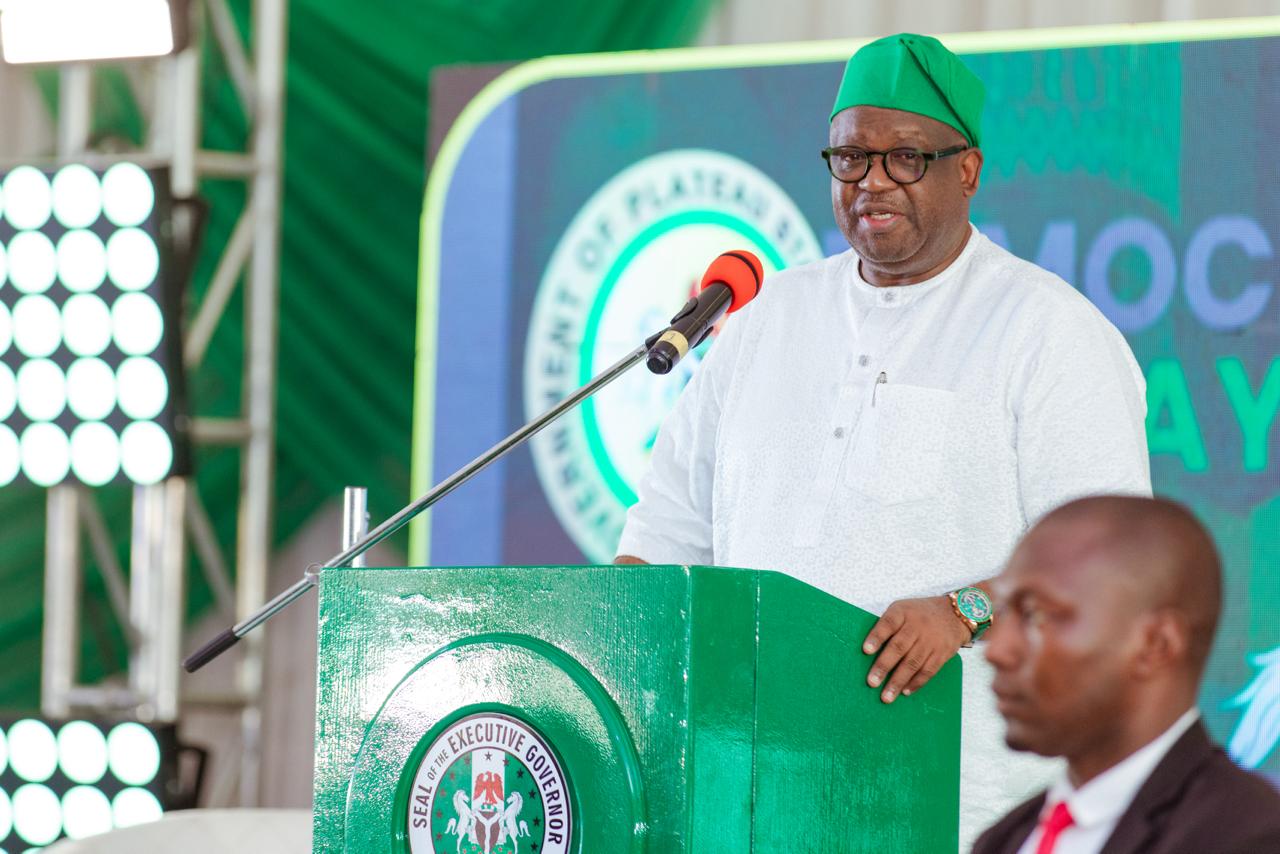

In this thought-provoking intervention, AYUBA PAM argues that Governor Caleb Mutfwang’s recent apology to the Ndi-Igbo should be viewed not through the prism of politics but as a courageous act of reconciliation that advances national healing. Drawing on history, peace studies, African traditions and Biblical teachings, the writer contends that genuine peace is sustained not by silence or denial, but by deliberate acts of forgiveness, dialogue and mutual respect
Governor Caleb Mutfwang’s recent apology to the Ndi-Igbo has generated considerable public debate, attracting both commendation and criticism. Among the critics is my long-time friend and colleague in the journalism profession, Shabul Mazadu, whose writings I have followed over the years with admiration.
Whether I agreed with his conclusions or not, I have always respected his courage in interrogating issues of public importance. On this occasion, however, I respectfully disagree with his criticism of the governor’s gesture.
My position is not informed by political loyalty or personal allegiance to Governor Mutfwang. Rather, it is rooted in my conviction that every sincere effort aimed at reconciliation deserves encouragement rather than ridicule.
The governor’s apology neither rewrites history nor diminishes the significance of General Yakubu Gowon’s famous declaration of “No Victor, No Vanquished” or the Federal Government’s post-civil war policy of Reconciliation, Reconstruction and Rehabilitation, popularly known as the Three Rs. Certainy, those initiatives remain defining milestones in Nigeria’s search for national healing after the civil war.
Yet, one honest question remains unavoidable: Has Nigeria truly healed from the scars of that conflict?
The answer, sadly, is obvious.
More than five decades after the civil war, separatist agitations continue to test the country’s unity. The activities of the Indigenous People of Biafra (IPOB), the prolonged legal proceedings involving Nnamdi Kanu and the grievances consistently expressed by groups such as the Movement for the Survival of the Ogoni People (MOSOP) all suggest that although the guns fell silent in 1970, emotional, political and social wounds remain.
Whether one agrees with these movements or condemns their methods is secondary. But their continued existence reminds us that reconciliation is not a single event concluded by government policy but an ongoing national responsibility.
Every sincere effort that promotes healing therefore deserves support.
Case for continuous reconciliation
Peace scholar, John Lederach, through his Conflict Transformation Theory, argues that lasting peace is achieved not merely by ending violence but by transforming damaged relationships through dialogue, trust, truth and reconciliation. Similarly, Norwegian sociologist, Johan Galtung, widely regarded as the father of modern peace studies, distinguishes between Negative Peace—the mere absence of war—and Positive Peace, which exists where justice, reconciliation, mutual trust and social harmony flourish.
Viewed against these enduring principles, Governor Mutfwang’s apology should not be interpreted as an admission of guilt on behalf of Plateau State. Rather, it is a symbolic contribution towards building what Galtung describes as positive peace—the kind of peace that heals hearts and strengthens national unity.
History itself validates this approach.
Following apartheid, South Africa did not heal through silence but through deliberate acts of truth, repentance and reconciliation. Archbishop Desmond Tutu wisely observed, “Without forgiveness, there is no future.”
Likewise, Nelson Mandela, after spending 27 years in prison, reminded humanity that “Resentment is like drinking poison and then hoping it will kill your enemies.”
Across the Atlantic, following the devastating American Civil War, President Abraham Lincoln appealed to his nation to act “with malice toward none, with charity for all.” Instead of prolonging bitterness, he embraced compassion as the pathway to rebuilding America.
Dr Martin Luther King Jr. also left humanity with an enduring truth when he declared: “Darkness cannot drive out darkness; only light can do that. Hate cannot drive out hate; only love can do that.”
These are not merely memorable quotations. They are enduring principles upon which stable and united nations are built.
African wisdom conveys the same message. An old proverb says: “When spider webs unite, they can tie up a lion.” Nigeria’s diversity remains its greatest strength when united. But it can equally become its greatest weakness when manipulated to foster division.
As a student of Peace and Conflict Studies, a pastor and a citizen committed to nation-building, I have come to appreciate that reconciliation is never completed within one generation. Every generation must consciously renew it through words, actions and symbols that reassure every community that it belongs.
That is precisely why leaders who extend a hand of fellowship should be encouraged rather than criticised.
The moral, national imperative
The Holy Scriptures leave no room for ambiguity on this matter.
Jesus Christ declared: “Blessed are the peacemakers, for they shall be called the children of God” (Matthew 5:9).
The Apostle Paul equally admonishes believers: “If it is possible, as far as it depends on you, live at peace with everyone” (Romans 12:18).
Again, he writes: “Make every effort to keep the unity of the Spirit through the bond of peace” (Ephesians 4:3).
These are not mere suggestions but divine imperatives.
Therefore, Governor Mutfwang’s apology should be understood as a moral gesture of solidarity and national healing, not as an attempt to rewrite history or assign collective guilt to the people of Plateau for a war prosecuted by the Nigerian state. No generation should remain imprisoned by the mistakes or tragedies of previous generations when it has the opportunity to build a better future.
As journalists, we have a sacred responsibility not only to scrutinise public actions but also to encourage those that strengthen the fabric of our nation. Constructive criticism enriches democracy. But constructive reconciliation preserves it.
Nigeria today confronts terrorism, banditry, kidnapping, communal violence, economic hardship and growing ethnic suspicion. This is hardly the time to discourage voices advocating healing. Instead, we should encourage more governors, traditional rulers, religious leaders and elder statesmen to initiate conversations that unite rather than divide.
History reminds us that wars may end with signatures on paper, but peace is sustained through continuous acts of goodwill.
Perhaps Mahatma Gandhi captured this truth best when he said: “The weak can never forgive. Forgiveness is the attribute of the strong.”
Another timeless African proverb offers an equally profound reminder: “The axe forgets, but the tree remembers.” Those who suffer often carry painful memories long after those responsible have moved on. That is why wise nations never tire of saying, “We are sorry.” They never tire of saying, “We forgive.” And they never tire of saying, “Let us build together.”
Peace is never wasted.
Every genuine apology, every sincere act of reconciliation and every bridge built across old divisions represents an investment in a stronger and more united Nigeria.
That, in my considered opinion, is what Governor Mutfwang’s apology represents, and for that reason, it deserves support rather than scorn. My humble submissions.
Dr. Pam is a veteran journalist and public affairs commentator