




By USHUKON DANIEL
THE 2027 presidential race took a sharper turn in Port Harcourt on Monday as Peter Obi, Omoyele Sowore and Rotimi Amaechi disagreed over fuel subsidy, insecurity, leadership and how Nigeria should be policed.
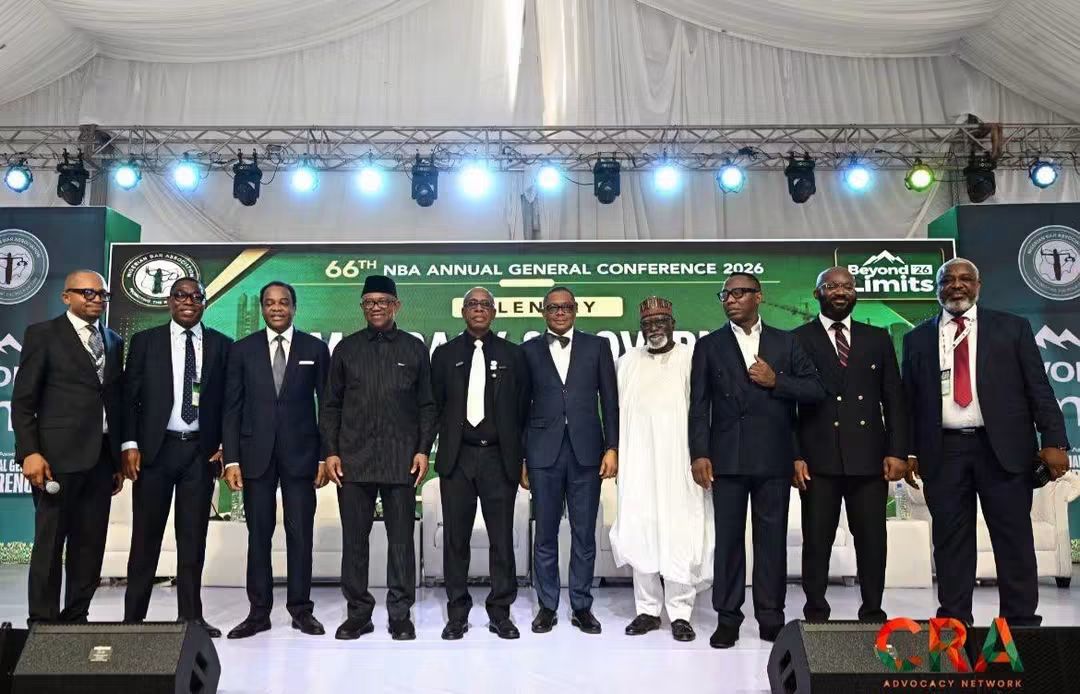
The politicians spoke at a political session of the 66th Annual General Conference of the Nigerian Bar Association (NBA), where they presented different ideas on how to tackle some of the country’s biggest challenges ahead of the 2027 election.
The session became heated when Sowore questioned the records of politicians who had previously held public office, including Obi and Amaechi.
Subsidy removal divides politicians
Sowore, the African Action Congress presidential candidate, criticised the removal of fuel subsidy, arguing that Nigerians had continued to face rising living costs while governments benefited from increased revenue.
He said the main issue was not only whether subsidy should be removed, but also who was benefiting from the policy.
Sowore also challenged politicians who had previously served in government to explain what they achieved in office before asking Nigerians to support them again.
Peter Obi, a former governor of Anambra State, disagreed with Sowore on the subsidy issue, saying its removal was necessary but argued that the money saved should have been properly managed and invested in areas that would make life easier for Nigerians.
According to him, the government should have planned ahead and provided alternatives for citizens affected by the removal of the subsidy.
On insecurity, Obi pointed out that Nigeria’s security problems were connected to poverty, unemployment, corruption and weaknesses in the country’s security system.
He called for a major review of the nation’s security strategy, saying the government must also focus on the safety and economic well-being of ordinary Nigerians.
Amaechi defends record
Rotimi Amaechi, who represented the presidential candidate of the African Democratic Congress, Atiku Abubakar, defended his record as a former Rivers State governor and former Minister of Transportation.
According to him, Nigeria needed more jobs, stronger local production and policies that would put more money in the hands of citizens.
Amaechi also highlighted projects carried out while he was in government, including roads, schools and health centres, while stressing the importance of intelligence gathering in the fight against insecurity.
His exchange with Sowore, however, became one of the major moments of the session.
After Sowore questioned the records of former office holders, Amaechi challenged him to point to his own experience in government and told him to allow those with governing experience to speak.
The exchange attracted strong reactions from the audience.
State police debate intensifies
Social Democratic Party presidential candidate, Adewale Adebayo, proposed a different model for policing, calling for police forces at the federal, state and local government levels.
While several speakers supported state police, Adebayo said each level of government should be able to enforce laws within its area of responsibility, describing the proposal as part of true federalism.
Former Cross River State Governor, Donald Duke, said many of Nigeria’s problems were linked to poor leadership and argued that getting the country’s leadership right would make it easier to solve other national problems.
He also urged Nigerians to look beyond ethnicity when choosing political leaders, saying ethnic considerations should not determine who becomes president.
Earlier, in his keynote address titled, ‘Policing in Transition’, President Bola Tinubu’s Chief of Staff, Femi Gbajabiamila, defended the Federal Government’s plan to introduce state police, saying Nigeria’s centralised policing system had limitations and that state police could improve security coverage.
He, however, warned that state police must not be used by governors to intimidate or persecute political opponents.
Gbajabiamila said the recruitment of officers should follow strict standards and proper background checks rather than political recommendations.
He also called for better training so that officers would understand the law, preserve evidence and use force only when legally justified.
Another concern he raised was the number of police officers assigned to administrative and escort duties instead of fighting crime.
A major question from the discussion was how Nigeria could prevent governors from abusing state police.
Gbajabiamila said governors should retain their legitimate executive powers but should not be allowed to use the police to order the arrest of political opponents.
He also said police officers who reject unlawful orders should be protected by strong laws and institutions.
The Federal Government is currently working on the legal framework for state police, while President Tinubu had earlier inaugurated a working group to prepare a National Policing Bill.
The Port Harcourt debate offered a glimpse of the issues likely to dominate Nigeria’s 2027 presidential election.
While Sowore focused on the impact of government policies on ordinary Nigerians, Obi stressed better management of public resources and a broader approach to security.
Amaechi defended his record and promoted job creation and local production, while Duke called for better leadership and less emphasis on ethnicity.
The debate also showed that fuel prices, insecurity, economic hardship and policing are already becoming major issues as politicians position themselves for the 2027 presidential contest.