




By MARIE-THERESE NANLONG
The Federal Government has commended Plateau State for developing the Plateau State Integrity and Accountability Strategy (PLASIAS) 2025-2029.
Victoria Ojogbane, Director, Planning, Research and Statistics and Head of the National Anti-Corruption Strategy Secretariat in the Federal Ministry of Justice, gave the commendation on Wednesday in Jos at a capacity-building programme on the implementation of the strategy.
Ojogbane, who represented the Attorney-General of the Federation and Minister of Justice, Lateef Fagbemi, said the state had demonstrated political will by developing the strategy and backing it with an action plan.
The strategy is scheduled for validation on Friday.
“What you have achieved as a state is a structural reform,” she said.
Ojogbane said PLASIAS would complement the National Anti-Corruption Strategy and its 2022-2026 Action Plan, which provides the framework for preventing and combating corruption across the country.
She identified prevention, public engagement, ethical reorientation, enforcement and sanctions, and recovery of proceeds of corruption as the five pillars of the national strategy.
She said state-level implementation was necessary for the national framework to be applied through specific governance reforms.
“The federal framework provides the architecture while implementation at the state level provides the operational reality,” she said.
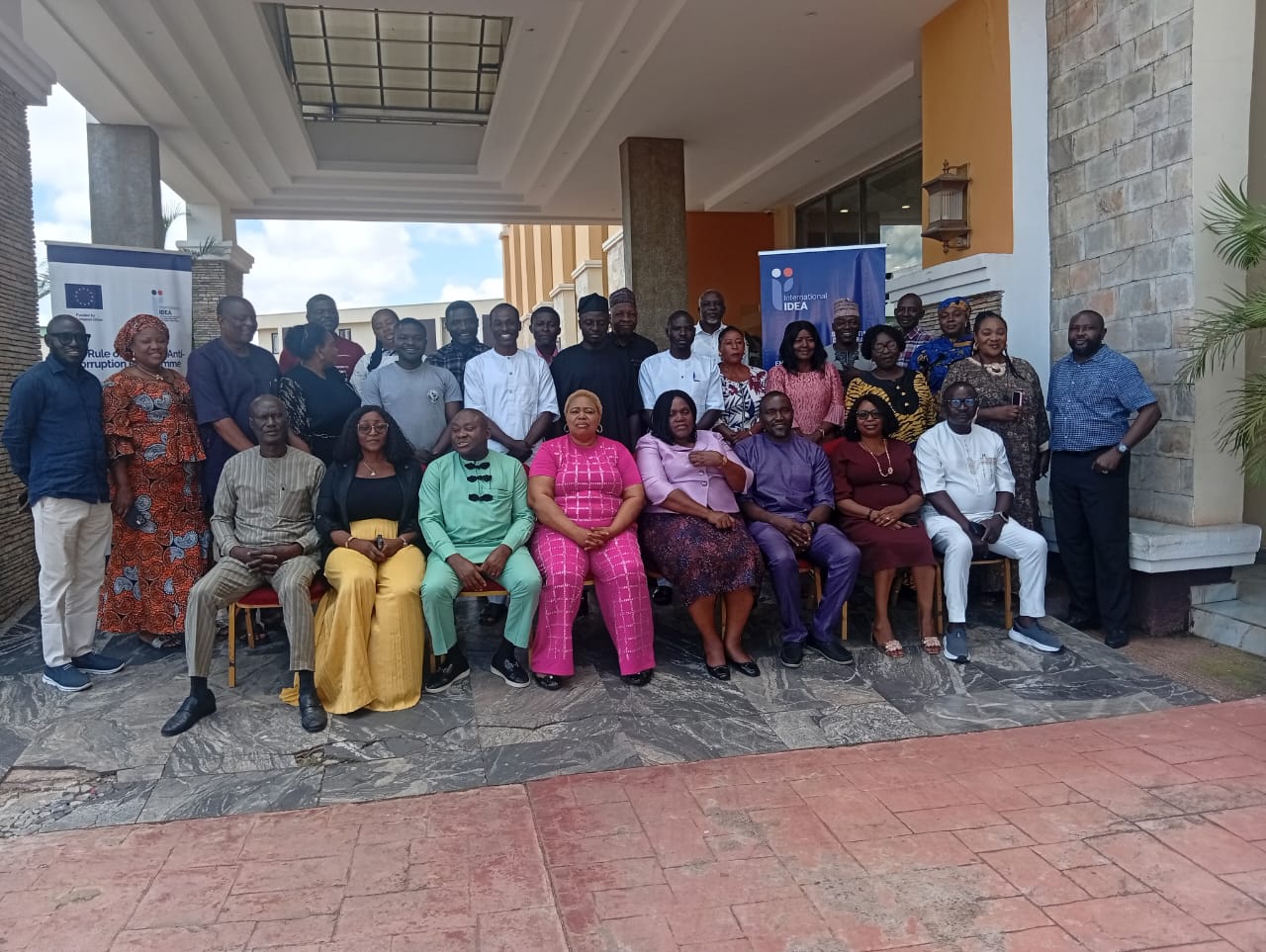
The three-day programme, which began on Wednesday, focuses on practical tools for implementing PLASIAS.
It is organised by the Office of the State Head of Service with support from the Rule of Law and Anti-Corruption Programme Phase II (RoLAC II), implemented by International IDEA and funded by the European Union.
Ojogbane said the partnership between the Federal Ministry of Justice, RoLAC II and the state government showed how technical assistance could support reforms while retaining local ownership.
She said the impact of corruption could be seen in the failure of public services when resources meant for citizens were diverted.
“Corruption is not an abstract governance challenge. It is the reason a clinic has no drugs, a school has no roof and a borehole does not produce water,” she said.
The Lead Consultant on Transparency and Accountability for RoLAC, Prof. Ada Chidi-Igbokwe, said the programme was designed to equip participating institutions with practical tools for implementing PLASIAS.
The State Project Coordinator of RoLAC, Mantim Dala, said accountability lapses had affected governance and service delivery in health, education, housing and infrastructure.
He urged participants to use the strategy to improve ethical standards in public institutions, adding that PLASIAS was intended to prevent misconduct rather than witch-hunt officials.
“The anti-corruption strategy is not actually meant to witch-hunt anyone. It aims to prevent such from happening, because when you know that you have done nothing wrong and you have followed due process, you have nothing to fear,” he said.