



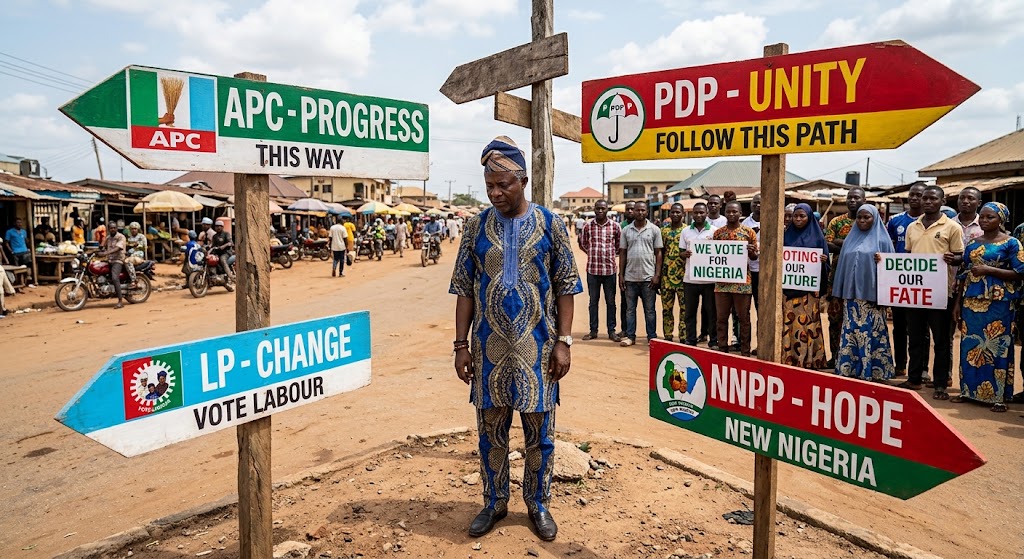
Nigeria’s democratic journey has never followed a straight ideological path; it has been shaped by the country’s diversity, political calculations, competing interests and the personalities that dominate its political space. In this analysis, DAN MANJANG examines the tension between contextual and ideological democracy, asking whether Nigeria’s peculiar circumstances justify political flexibility or whether such flexibility has become a convenient cover for opportunism
Democracy is generally understood as government of the people, by the people and for the people. In practice, however, democracy takes different forms depending on the historical, political, social and economic circumstances of a country.
Nigeria’s democratic experience since independence, and particularly since the return to civil rule in 1999, demonstrates a distinctive form of what may be described as contextual democracy — a democracy shaped less by rigid ideological commitments than by political realities, ethnic and religious diversity, personal ambitions, regional interests, electoral calculations and the search for political accommodation.
This raises an important question: should Nigeria aspire to a strictly ideological democracy, or should it continue to operate a contextual model that reflects its peculiar circumstances?
An ideological democracy is one in which political parties are principally distinguished by clearly defined philosophies and policy orientations. Voters choose not merely personalities but competing visions of governance. In such a system, party membership carries ideological obligations, and crossing from one party to another is often regarded as a serious political contradiction.
Nigeria, by contrast, has historically struggled to sustain strong ideological differences between its major political parties. Parties frequently converge around similar economic and social objectives, while politicians move between them depending on prevailing political circumstances. Consequently, Nigerian democracy has often become more personality-driven than ideology-driven.
The politics of party defection
A retrospective examination of Nigeria’s political history reveals that party switching is not a new phenomenon. Politicians have crossed political boundaries at various points in the nation’s history, sometimes because of genuine disagreements, sometimes for political survival and, at other times, because of perceived opportunities to serve their constituents more effectively.
The frequency of such defections has become particularly visible since 1999. Politicians have moved from the PDP to the APC and vice versa, while smaller parties have also gained and lost prominent members.
The central issue, therefore, is not simply whether a politician changes political parties. The more fundamental questions are why the politician defects, when the defection occurs and whether the people’s mandate is being respected.
Party supremacy is an essential principle of democratic politics. Once citizens elect a candidate under a political party, the candidate is expected to operate within the party’s constitution, manifesto, rules and disciplinary framework.
Political parties are not merely electoral vehicles; they are institutions through which citizens aggregate interests, develop policies and organise government. Without party discipline, democracy can degenerate into a collection of individual political ambitions.
However, party supremacy must not be confused with absolute political obedience. A political party is itself subject to the Constitution and the law. Where party leadership becomes arbitrary, undemocratic or disconnected from the electorate, members may have legitimate grounds for dissent.
Party supremacy should, therefore, mean supremacy of the party’s lawful constitution and democratic processes, rather than unquestionable supremacy of individual party leaders.
Party discipline is equally important. A legislature cannot function effectively when every member treats his or her personal interest as superior to collective party decisions. Yet discipline must be exercised fairly and transparently.
Selective punishment, victimisation and the imposition of decisions without consultation weaken party loyalty rather than strengthen it. A disciplined party should be one in which members understand the rules, participate in decision-making and accept legitimate collective outcomes.
Defection, principle, the people’s mandate
The question of “jumping ship” is therefore complicated. Not every defection should automatically be interpreted as betrayal. A politician may leave a party because of ideological disagreement, exclusion, injustice, factional conflict, persecution or a fundamental departure by the party from its promises to the electorate.
In such circumstances, defection may be presented as a principled political decision.
But sincerity must be tested against conduct. If a politician defects only after losing a party primary, failing to secure an appointment or when another party offers a better platform for personal political survival, the claim of principle becomes questionable.
Similarly, if a politician moves to a party whose policies and leadership he or she previously condemned without adequately explaining the reasons for the change, the electorate has a legitimate right to demand an explanation.
The issue of the people’s mandate makes the debate even more significant. When voters elect an individual on a party platform, what exactly have they elected — the person, the party or both?
In Nigeria, the answer is not always straightforward. Elections involve both personal popularity and party identity. A candidate may win because voters trust the individual, because they support the party, or because of a combination of both.
This creates a moral and constitutional dilemma when an elected representative defects. If the mandate substantially belongs to the party, retaining the seat after abandoning the party may appear to undermine the voters’ decision.
Conversely, if the mandate belongs primarily to the individual elected by the people, forcing that person to resign merely for changing parties could also be viewed as restricting political freedom.
The Nigerian Constitution and judicial interpretation have attempted to regulate defections, particularly within legislative institutions. Yet the continuing political controversy demonstrates that legal provisions alone cannot resolve the deeper democratic question.
Nigeria needs a stronger political culture in which elected officials recognise that a mandate is a sacred trust rather than personal property.
Building a principled, contextual democracy
The way forward begins with strengthening political parties as genuine democratic institutions. Parties must develop clear manifestoes and identifiable policy positions. Nigerians should be able to distinguish parties not merely by their candidates but by their approaches to economic development, education, healthcare, security, federalism, social welfare and institutional reform.
Second, internal party democracy must be strengthened. Party primaries should be transparent, credible and participatory. Party leadership should not arbitrarily manipulate nomination processes to favour particular individuals.
When members believe that their parties are fair, defections motivated by internal injustice are likely to reduce.
Third, party discipline should be based on clearly established rules rather than personal loyalty to party leaders. Disciplinary mechanisms must be transparent, consistent and subject to appeal. The same offence should not attract punishment for one politician and reward for another.
Fourth, Nigerian politicians who defect should be required to explain their reasons openly to their constituents. Such explanations should address whether the defection is based on principle, policy, injustice, political survival or the perceived interest of the electorate.
The electorate should then have the opportunity to judge the sincerity of the decision at the next election.
Finally, Nigerian democracy must gradually move from personality politics to issue-based politics. Contextual democracy may be necessary because Nigeria is a complex, plural society, but context should not become an excuse for abandoning democratic principles.
Flexibility is useful. But opportunism is not. Political accommodation is necessary. But political prostitution is destructive.
Nigeria does not necessarily need to choose between contextual and ideological democracy as if one must completely replace the other. What the country needs is a context-sensitive democracy anchored in enduring democratic principles.
Our diversity requires political flexibility, negotiation and accommodation, but these must operate within the boundaries of integrity, accountability, party discipline, constitutionalism and respect for the electorate.
Defection should neither automatically be celebrated as courage nor condemned automatically as betrayal. Its legitimacy should be judged by the circumstances, motives, timing and consequences for the people whose mandate the politician carries.
Ultimately, Nigerian democracy will mature when politicians understand that parties are institutions, mandates are trusts and political power is temporary. The true supremacy in a democracy is not the supremacy of the individual politician or even that of party leadership; it is the supremacy of the people, expressed through lawful, credible and accountable democratic processes.
Manjang, mnipr, M.Div., former Plateau State Commissioner of Information and Communication, writes via dmanjang@gmail.com