



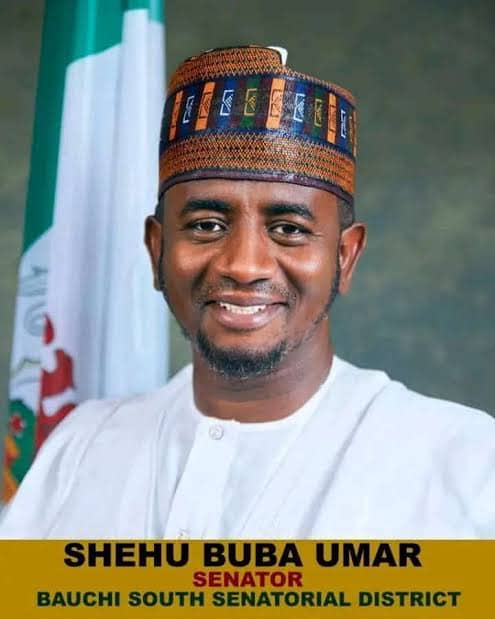
Nigeria’s deepening security crisis has created an atmosphere in which every allegation involving a public official can quickly become a political storm, but the controversy surrounding Senator Shehu Buba Umar demands something more valuable than outrage or partisan loyalty. JAMES TITSE examines the allegations against the Bauchi South senator, his defence, his reported contacts with bandit leaders, questions surrounding an earlier DSS investigation and the urgent need for security agencies to establish what is fact, what is false and what remains unresolved
Nigeria’s worsening insecurity has made allegations involving political office holders a matter of serious national concern. Therefore, the latest controversy surrounding Senator Shehu Buba Umar, representing Bauchi South Senatorial District, deserves more than political propaganda, social-media outrage or partisan defence.
It deserves evidence, investigation and accountability.
Recent allegations made publicly by a man identified as Hassan have linked Senator Buba to individuals allegedly associated with notorious bandit leader Dogo Gide.
Hassan claimed that persons connected with the bandit network were brought to Abuja for specialised training and alleged that one of the individuals had served as an aide to Senator Buba at the National Assembly. These are extremely serious claims. But they remain allegations, not established facts.
The allegations, the senator’s defence
The controversy is not entirely new.
In October 2024, THISDAY reported that the Department of State Services (DSS) was investigating an allegation concerning Senator Buba’s alleged link to a suspected bandit, Abubakar Idris.
According to the report, a purported security report had been forwarded to President Tinubu and alleged that the senator, through an aide, facilitated the registration of Idris as a pilgrim for the 2024 Hajj.
The report said DSS personnel subsequently sought the individual’s e-passport from the Bauchi State Muslim Pilgrims Welfare Board.
That allegation raises fundamental questions: What did the DSS investigation eventually establish? Was Senator Buba cleared? Was Abubakar Idris established to be a wanted bandit? Was anyone prosecuted? Was the alleged connection between the senator, his aide and the pilgrim established or disproved? Most importantly, where is the final security report?
The latest development has now brought the matter back into the public arena.
Hassan publicly identified Senator Shehu Buba as the senator he had previously accused of involvement in activities connected with banditry.
He alleged that people associated with Dogo Gide’s network were brought to Abuja and received specialised training, and also claimed to possess voice recordings and other materials which, according to him, support his allegations. But possessing a recording, photograph or video is not automatically proof of the criminal allegation being made from it.
Every piece of purported evidence must be authenticated, properly examined and placed within its full context before any responsible conclusion can be reached. Senator Buba has strongly rejected the allegations.
In his response, he explained that Hassan was someone he had previously assisted after being introduced to him as an orphan seeking educational support.
According to Buba, he helped connect Hassan with a cleric who assisted him in gaining admission to Islamic and conventional schools and also provided him with a bicycle.
Buba said Hassan later abandoned his education for a car-dealing business. The senator further alleged that Hassan exploited access to his residence to record visitors and subsequently used the materials for political propaganda.
Buba says he has petitioned the Inspector-General of Police over the matter and that arrests have been made in connection with the allegations against him.
There is, however, another important dimension to the controversy. Senator Buba has previously been involved in efforts described as part of Nigeria’s non-kinetic approach to tackling banditry.
Reports say he and associates, including cleric Musa Asadussunnah, had contact with bandit leaders, including Bello Turji, in efforts aimed at negotiating peace. Such contact with criminal actors does not, by itself, establish criminal complicity.
In conflict resolution, government officials, community leaders and intermediaries sometimes communicate with armed groups precisely because they are attempting to secure peace or negotiate releases.
The critical questions are therefore: What was the purpose of each contact? Who authorised it? What was discussed? And what followed?
The viral videos circulating around the controversy also require caution.
A recent PRNigeria fact-check examined viral footage purportedly showing bandits and passports connected to Senator Buba. Its conclusion was that two unrelated video clips had been combined, creating a misleading impression.
The first showed people described as businessmen and pilgrims visiting Senator Buba in 2023, while the second involved different individuals and passports.
PRNigeria therefore rated the combined narrative false and misleading. This demonstrates precisely why security allegations must be investigated professionally rather than prosecuted through social media.
The unanswered questions surrounding the DSS
Former Minister, Solomon Dalung, has now called on the DSS to clarify what happened with the earlier investigation involving Abubakar Idris.
Importantly, Dalung reportedly stated that he was not declaring Senator Buba guilty. His argument was essentially that Nigerians deserve to know whether the investigation was conducted and what it established.
That is a legitimate public-interest question.
If an investigation cleared the senator, the authorities should say so. If the evidence was insufficient, that should also be made known.
If the investigation established wrongdoing, those responsible should be prosecuted where appropriate. And if the matter remains open, Nigerians should be told that it remains open.
Silence creates suspicion. The controversy is particularly sensitive because of Senator Buba’s former position as Chairman of the Senate Committee on National Security and Intelligence.
Someone occupying such a position naturally has extensive interactions with security officials, intelligence officers, military personnel, traditional rulers and individuals involved in conflict-resolution efforts.
Such proximity can be legitimate. But it also makes transparency even more important.
The public must be able to distinguish between security engagement and criminal collaboration. They are not the same thing. The DSS and the police therefore have several questions to answer.
Did the DSS investigate the 2024 allegation involving Senator Shehu Buba and Abubakar Idris? What was the conclusion of that investigation? Was Abubakar Idris actually identified as a wanted bandit or terrorist?
Was any relationship between Senator Buba, his aide and the alleged criminal established? Have the latest allegations made by Hassan been formally investigated, and have the materials he claims to possess been authenticated?
These questions should be answered with documents and evidence, not political statements.
Allegation is not conviction
This is perhaps the most important principle in the entire controversy. Based on the publicly available information cited in the article, there is no publicly known court judgment establishing that Senator Shehu Buba Umar sponsored terrorism or banditry. A recent fact-check likewise found allegations, petitions and demands for investigation. But no known conviction establishing such sponsorship.
Therefore, describing Senator Buba as a “terrorist sponsor” as an established fact would go beyond the evidence currently available. At the same time, dismissing every allegation as “political propaganda” without an independent examination would also be irresponsible.
Nigeria does not need political persecution. Nigeria does not need political protection. Nigeria needs the truth.
If Senator Shehu Buba is innocent, a transparent investigation can help clear his name. If the allegations are fabricated, those responsible should face the law.
If credible evidence establishes criminal conduct, the law must take its course, regardless of the suspect’s political position. National security must never become a political weapon, but neither should political status become a shield against legitimate investigation.
The question before Nigerians should therefore not simply be: “Is Senator Shehu Buba a bandit sponsor?”
The more responsible question is: “What do the security agencies know, what did they investigate, what evidence exists, and what did they conclude?”
Until those questions are answered, Nigerians should resist both extremes: blind condemnation and blind defence.
In matters involving terrorism, banditry and national security, the truth must be established by evidence, not political loyalty.
The public deserves answers. Senator Buba deserves due process. And Nigeria deserves the truth.
Rev. Titse writes from Gboko,
Benue State, via revjamestitse@gmail.com