



For Plateau’s poultry and fish farmers, a creature most people instinctively avoid could become an unlikely answer to soaring feed costs. As SAMSON ILIYA discovers, maggot farming is turning market refuse, rotten vegetables and poultry waste into protein-rich animal feed, creating a low-cost opportunity for farmers while tackling the growing problem of agricultural waste
Behind a block fence off the road that drops from the Jos Plateau, the air is thick with the sour smell of rotting fruit.
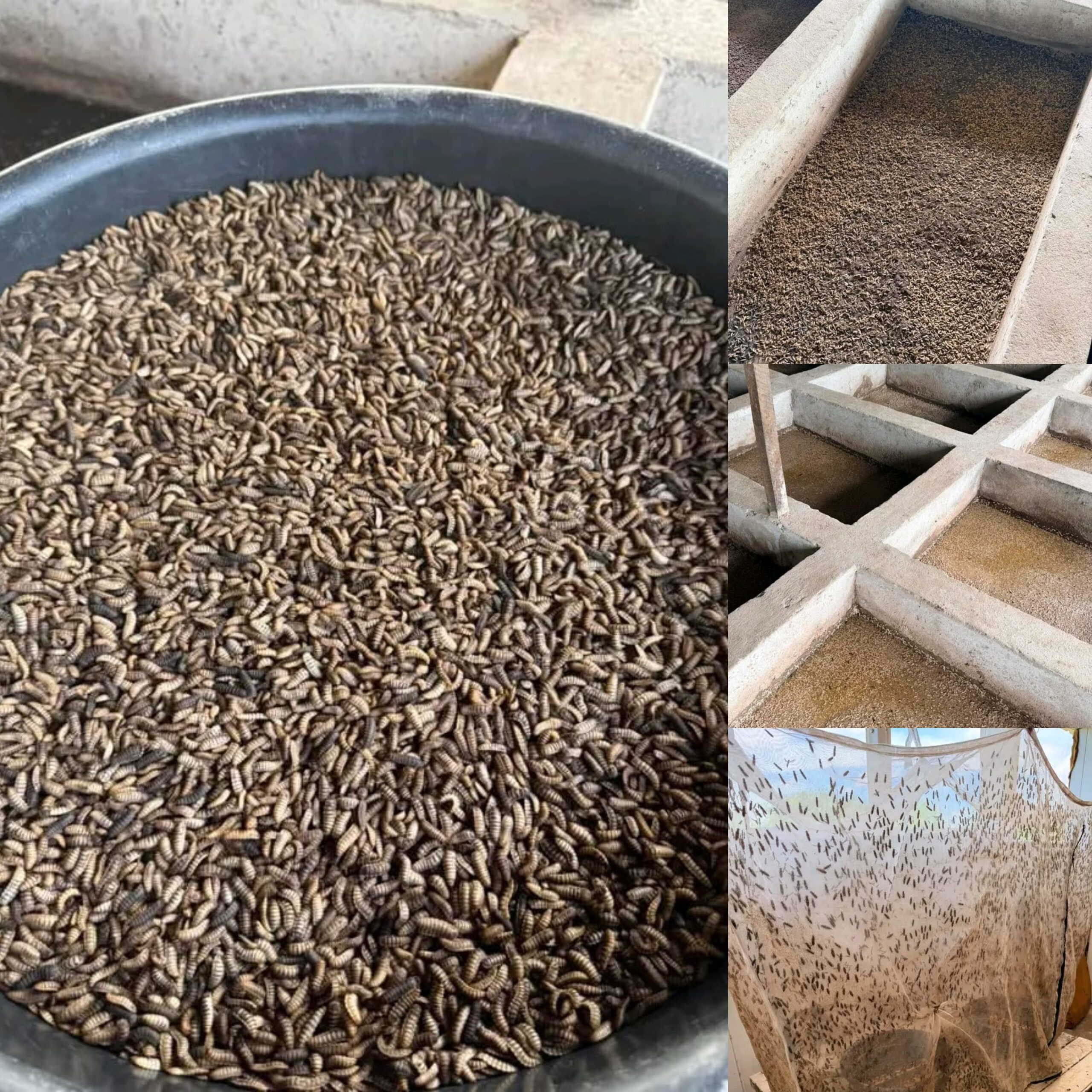
A hand lifts a blue tarpaulin off a row of shallow trays and the ground appears to move. Thousands of plump, cream-white worms squirm over each other, devouring a pile of tomato waste, chicken droppings and leftover swill from yesterday’s market.
Naturally, it is not a beautiful sight. But in Plateau State today, it is business.
Plateau is the poultry capital of the Middle Belt and the northern states as a whole. Jos South and Jos North local government areas alone feed Jos with broilers, eggs and catfish.
The cold climate, hatcheries clustered around Vom and Bukuru and the endless demand from Farin Gada Market to Terminus have all helped make the area a major centre for raising birds.
But for two years, farmers have been living on the edge.
This is because soya, maize and fishmeal – the protein heart of animal feed – have doubled in price. Fishmeal, an ingredient farmers cannot easily skip if they want chicks to grow and layers to produce eggs, now sells for N1,800 per kilogramme.
For a smallholder mixing 100kg of feed daily, the profit has disappeared. Many have cut their flocks by half. Some have locked their pens.
And yet, the solution to one of the most expensive problems in Nigerian livestock farming is rotting right beside them.
Enter the maggot
For a state like Plateau, which throws away tonnes of tomatoes during periods of glut, cabbage waste from Farin Gada every morning and chicken manure from thousands of poultry pens, maggot farming could be a perfect solution.
Maggot farming is the rearing of fly larvae – mainly Black Soldier Fly Larvae, Hermetia illucens (BSFL), and common housefly larvae – to feed fish, poultry and pigs. It is gaining popularity in Nigeria because it addresses one of the biggest problems confronting livestock farmers: expensive feed.
Unlike Lagos, where companies such as Bempet and Panacea Farms have commercialised maggot production into a full value chain involving dried larvae, oil and organic fertiliser, maggot farming on the Plateau remains largely informal. Farmers mostly produce for personal consumption and in small quantities.
Efforts to contact a commercial-scale maggot farmer in Plateau for this report proved abortive. However, that silence itself tells a story: the practice is thriving in backyards, but has yet to make a significant transition into boardrooms.
Turning waste into feed
At the National Veterinary Research Institute (NVRI), Vom, Dr Bala Akawu has watched the shift closely.
Dr Akawu, a veterinarian and Director of NVRI Consultancy Services, described maggot farming to THE NIGERIA STANDARD as a powerful way of producing affordable, organic animal feed.
According to him, “Maggots can be produced through two methods: Black Soldier Fly Larvae and the common housefly larvae. Both can be harvested and used to compound feeds, providing a rich, natural source of protein.”
For the housefly method, organic waste is allowed to ferment and decay, creating a breeding ground where maggots develop before being harvested.
For Black Soldier Flies, the process is more controlled. The flies are lured to lay eggs on corrugated cardboard placed over waste. The cardboard is then moved to a moist bucket, where the larvae hatch in about two days.
Akawu also advocates integrated farming as a smart, zero-waste system. In this model, a poultry pen is built directly above a fish pond.
As chickens feed, leftover particles and their droppings fall into the pond below, serving as natural feed for the fish. Adding maggots to that loop further reduces waste and feeding costs.
“We know this is the future of feed in Nigeria,” he enthused.
However, he is blunt about why it matters now.
“The economics are what keep them going. One kilo of fresh maggot replaces half a kilo of fishmeal. Fishmeal today is N1,800 per kg. Maggot is almost free – your raw material is only waste,” Akawu pointed out.
In fact, some farmers now make more money selling maggots than selling chicken, he revealed.
Why the business pays
Maggot farming is a relatively new but growing business, and it can pay more than expected. This is largely because the larvae can be produced more cheaply than conventional feed ingredients and contain about 40–45 per cent protein on average.
There are several factors driving its appeal.
Free raw material: Maggots feed on market waste, rotten fruits and chicken droppings – materials that Plateau already has in abundance.
Fast returns: Maggots can be ready for harvest within 10–14 days. This allows farmers to complete multiple production cycles before their broilers reach market weight.
High demand: Demand is growing as catfish and poultry farmers increasingly recognise the potential of larvae as a protein source.
Easy preservation: The larvae can be smoked or dried and ground into meal that can be stored for months.
For a young farmer, the entry point is almost laughably low.
Starting with N25,000
Starting this method of farming is relatively cheap and affordable compared with many other forms of farming.
For the fly house, a small box is constructed, covered with mosquito netting and kept under shade.
Next, farmers provide conditions for the flies to lay eggs by placing chicken dung and rotten waste inside the cage, with pieces of cardboard positioned on top.
The flies lay their eggs in the folds of the cardboard. The cardboard is then moved to a bucket containing moist waste, where the maggots hatch within about two days.
The maggots are fed daily with vegetable waste and kept in a moist environment, but the material should not be waterlogged.
They are ready for harvest after about 12 days. They are sieved out and sold fresh for N1,200 per kilogramme, sun-dried and ground into meal, or fed alive to fish.
Catfish are particularly responsive to live larvae.
The leftover waste, known as frass, is an excellent organic fertiliser. Nothing is wasted.
On a small scale, 10 basins can produce 20–30kg every two weeks. At N1,200 per kilogramme, that translates to between N24,000 and N36,000, with relatively little recurring cost after the initial set-up.
For a household struggling with feed costs, that could make the difference between closing a farm and keeping it in business.
The challenge is that a poorly managed maggot farm can produce an unpleasant and unwanted smell. Farmers, therefore, need to keep the farm shaded and ensure that water is properly drained.
The science behind the larvae
From a nutrition and feed-science standpoint, Mr Dafom Christopher says the enthusiasm surrounding Black Soldier Fly Larvae is justified, although there are important qualifications.
“Black soldier fly larvae represent a promising alternative protein source, although their nutritional composition and functional role differ substantially from those of soybean meal and fishmeal,” he told THE NIGERIA STANDARD.
BSFL composition varies according to the substrate on which the larvae are reared, the larval stage, processing methods and whether the larvae are defatted. Reviews report roughly 30–53 per cent crude protein and 20–41 per cent fat on a dry-matter basis for full-fat larvae, while defatting can raise protein concentration to above 60 per cent.
A 2025 systematic review and meta-analysis of 78 studies pooled BSFL at 42.7 per cent protein, 31.2 per cent lipid and 12.4 per cent ash, although there was very high variation because of differences in rearing conditions.
For comparison, soybean meal typically contains 44–48 per cent protein and about one per cent fat, while fishmeal contains 53–56 per cent protein and 8–10 per cent fat.
On a dry-matter basis, crude protein is highest in fishmeal, while BSFL can match soybean meal. Fat is considerably higher in BSFL, giving it greater energy content. Fibre, in the form of chitin, accounts for about 2–9 per cent in BSFL. Calcium is high, while phosphorus is moderately high.
In terms of amino acids, BSFL is high in lysine, leucine and valine – all important for growth – but lower in methionine.
“Nigeria imports over $1bn of fishmeal and soybean annually. BSFL converts waste we already have into protein locally. One tonne of organic waste can produce 150–200kg of fresh larvae. For low-income communities, this is protein that doesn’t need farmland, irrigation or forex,” Christopher added.
On health-related benefits, he stated: “If included at 5–10 per cent in poultry feed and 25–50 per cent in fish feed, we see better feed conversion, less diarrhoea and better survival.”
For humans, the future is even more intriguing. BSFL flour – defatted and de-chitinised – could serve as a fortificant for complementary foods because it is high in protein, fat, iron and zinc. However, more human trials are needed to determine chitin tolerance.
Dr Akawu agrees on the safety of maggot-based feed. He noted that maggots are even more protein-rich than many conventional feeds, while being entirely organic.
Unlike some conventional feeds that may contain chemical additives and blood meal derived from dead animals, he said, maggot-based feed contains no chemical substances and poses no health risk to animals or humans who consume the animals.
Closing the loop
The real benefit, Christopher argues, is not replacing meat but filling gaps in the feed chain that help make meat affordable.
“Cheaper feed equals cheaper eggs, chicken and catfish – the proteins low-income families actually eat daily. The frass also becomes organic fertiliser, closing the loop: waste – feed – food – fertiliser – more food.”
If scaled with proper regulation of substrates – including clear rules on what types of waste are safe to use – Nigeria could gain three major benefits: less vegetable waste in markets, cheaper animal protein, and local jobs for young people and women that do not require large tracts of land.
Back behind that block fence, the farmer covers the trays again. In 12 days, the sour pile will be clean. The waste will be gone. The worms will be fat enough to feed 200 broilers for a week.
Plateau does not need to import all its protein. It is already throwing some of it away.
What it needs is to stop seeing a maggot simply as a source of disgust and start seeing it as a tiny, wriggling feed mill.