


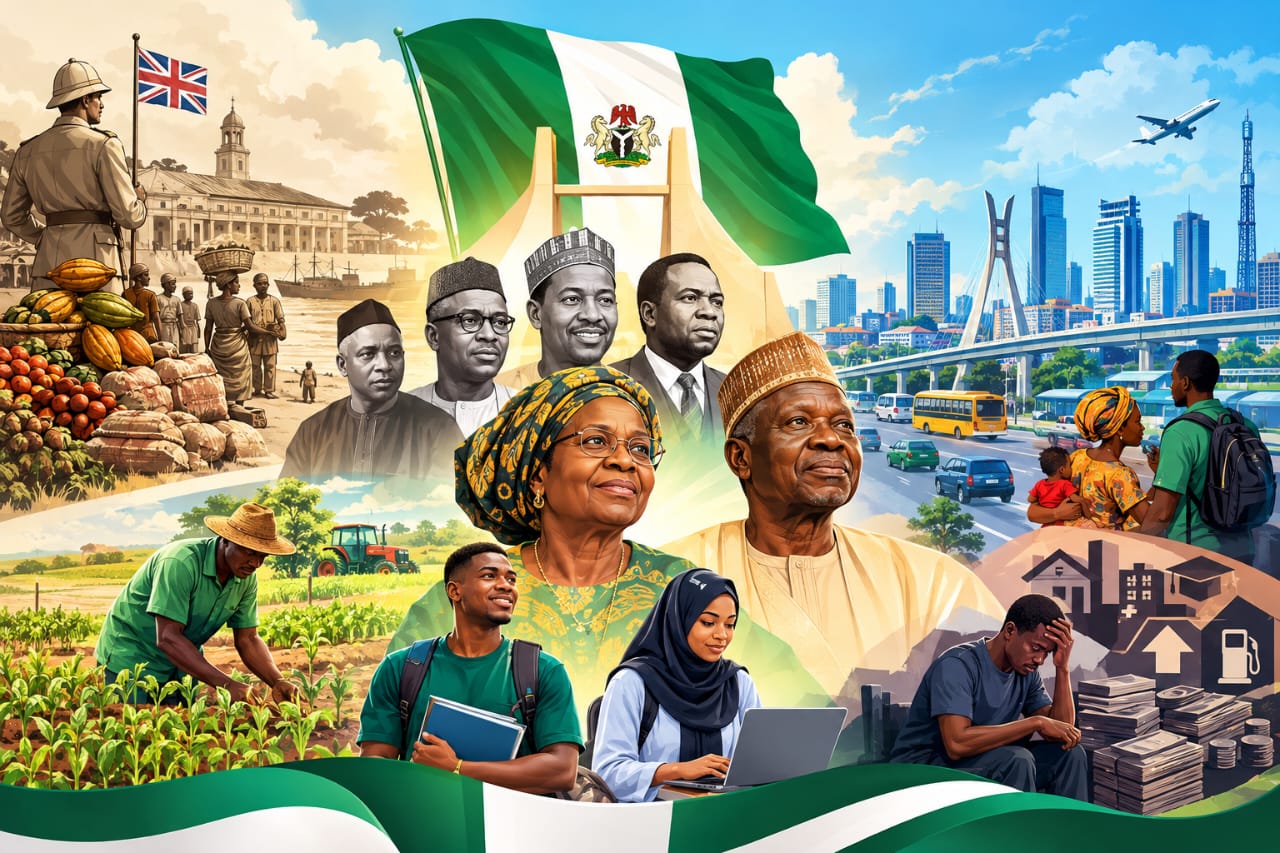

Sixty-six years after independence, Nigeria stands between the promise of its beginnings and the realities of a rapidly changing nation. In this reflective journey through the country’s past and present, SEKYEN WALSHAK revisits the experiences of Nigerians who witnessed the transition from colonial rule to self-government and examines what has changed, what has endured and what today’s generation has inherited
The history of Nigeria did not begin with independence.
Long before October 1, 1960, the territory that would become Nigeria had attracted foreign interests because of its abundant natural resources and expanding trade opportunities.
The British gradually established colonial control, shaping the country’s administration, economy and social institutions. Agricultural commodities such as palm oil, palm kernel, cocoa, groundnuts and cotton became important exports, while minerals such as tin also attracted commercial interest.
Nigeria’s journey towards self-government gained momentum in the years leading to independence. In 1953, Anthony Enahoro moved a motion for self-government in the British-led parliament, joining a growing nationalist movement that included figures such as Obafemi Awolowo, Nnamdi Azikiwe and Tafawa Balewa.
These nationalists argued that Nigerians were capable of governing themselves and pushed for greater political control.
Seven years later, Nigeria became independent on October 1, 1960.
For a generation that had lived under colonial rule, independence represented more than the lowering of one flag and the raising of another. It carried hopes of self-government, prosperity, unity, better infrastructure and a future in which Nigerians would determine the direction of their own country.
Sixty-six years later, those hopes are being measured against a very different Nigeria.
The country has grown enormously. Its population has expanded, cities have spread, universities and businesses have multiplied, transportation has improved and technology has transformed how Nigerians communicate and work.
Yet, alongside these changes are rising living costs, insufficient jobs and public services, declining purchasing power and continuing questions about how effectively the country’s abundant resources are being converted into better lives.
For Nigerians who lived through the transition from colonial rule to independence and beyond, the difference is not simply a matter of history. It is personal.
The Nigeria they knew
For 79-year-old Dora Lot, a retired civil servant with the Federal Ministry of Defence, memories of Nigeria before and around independence are memories of a country with fewer people, fewer opportunities and serious health challenges.
She remembers there was a time when diseases claimed the lives of many children as a result of limited awareness and knowledge.
“When I was young, there were many crises and sicknesses affecting people generally in Nigeria. I remember that there were serious illnesses that affected children and caused many deaths,” she recalls.
She remembers hearing about injections brought by the British to her area to help control some of those diseases.
“Those sicknesses were real killers of children. That was part of what life was like before and around independence,” Lot said.
But if illness and hardship were part of the reality of the time, so was hope.
For Lot, independence was expected to bring Nigerians closer together.
“People hoped that independence would bring us closer to one another. They believed there would be better roads and work for everybody, and that there would be more love and unity among Nigerians.”
There was also a strong sense of possibility for different regions in the country and their inhabitants.
“Those of us in the South believed that we would be able to reach people in the North more easily, and those in the North would also be able to reach the South. At that time, there was a feeling that the country was very free and that Nigerians were like brothers and sisters,” she pointed out.
But as Nigeria developed, Lot says some changes also came with unintended consequences and repercussions.
One of them was language.
“Some languages and the people who spoke them were made to feel inferior, while other languages were given more recognition,” she says.
For her, language became connected to opportunity and social acceptance.
“If you were clever or talented but came from a local community and spoke your local language, you could feel that you could not go far unless you adopted another language or way of speaking.”
Yet, Lot’s memories are not entirely nostalgic. She acknowledges that Nigeria gained in mobility and exposure.
“People could move around more and see things for themselves. When you travel and see how other people live, you learn.”
For her, exposure gave people opportunities to learn from others and improve their own lives.
But one change stands above others when she compares her childhood with Nigeria today: population.
“The biggest difference is the population. There were not as many people then as there are now. Today, there are too many people.”
With fewer hands now having to provide for many more people, the population has grown so much that it has made everything more difficult.
That population growth has placed greater pressure on virtually every aspect of national life — from housing and healthcare to education, employment and food.
From pounds and shillings to naira and kobo
For 70-year-old Yakon Posat, a retired civil servant with the Plateau State Government, the transformation is particularly visible in governance, administration and the economy.
He recalls a Nigeria where political and administrative authority rested with the colonial government.
“Before independence, certainly in terms of governance, administration was by the colonial masters. In areas of resource control, it was also by the colonial masters.”
Even ordinary economic transactions reflected colonial control.
Buying and selling, as well as the payment of salaries, were done with the currency of the colonial masters — pounds and shillings.
With independence, that arrangement changed, as Nigerians began handling their own payments in their own currency.
“Having had our independence in 1960, Nigerians were then governed and ruled by Nigerians, and most other aspects of administration were handled by Nigerians,” he explained.
The transition was also reflected in the country’s currency.
“Our currency was changed to reflect the name of our country, Nigeria — naira and kobo — whereas during the colonial masters’ rule, it was pounds and shillings.”
For Posat, however, the more significant difference lies in the purchasing power of money.
He remembers a period when the currency could buy more goods and services.
“During the colonial masters’ rule, the pound and shilling had a very high value. One could buy many things with a small amount and still be contented.”
He also remembers the early post-independence period as one in which civil servants could live more comfortably on their salaries.
His recollection is that revenues from natural resources supported government spending on public infrastructure and other services.
“That was how Nigeria used to have so much money in its treasury, and staff were equally comfortable with their salaries, with no complaints about low payment,” Posat said.
Today, the experience is different for many Nigerians.
The question is no longer simply how much a person earns, but what that income can buy.
Food, transportation, housing, education and other necessities have become major concerns for households, while workers and businesses contend with changing economic conditions.
Posat believes policymakers need to pay attention to the gap between income and purchasing power.
“Today, we are witnesses to most of these developments. Aside from the present developments which are ongoing, with so much money being spent on infrastructure from the revenue being generated, compared to where we were coming from, civil servant salaries and the cost of commodities in the market have changed.”
“Where one pays much money to receive a small quantity, our leaders need to consider this disparity and think of going back to where we started.”
For him, the ultimate goal should be economic stability.
What has changed? Sixty-six years after independence, Nigeria cannot be described simply as the country of 1960.
It is now larger, more urbanised, more connected and more complex.
Nigerians today can travel by road and air across the country and beyond. There are more universities, hospitals, businesses and technological opportunities than the generation that witnessed independence could have imagined.
Mobile phones and the internet have transformed communication. Nigerian businesses operate across borders. Young people work remotely for organisations they may never physically visit. A Nigerian can sell a product to someone thousands of kilometres away from a mobile phone.
But progress has not erased hardship.
For many Nigerians, the expansion of the economy has not always translated into an equally significant improvement in everyday living conditions.
The expectations of citizens have also changed.
A generation that once celebrated the availability of basic roads and government services now asks different questions: Can I afford transport? Can I pay rent? Can I find a job? Can my children receive quality education? Can I afford healthcare? Can my salary survive the month?
This is the Nigeria the younger generation inherited.
The Nigeria we inherited
The Nigeria inherited by today’s generation is, therefore, a mixture of enormous possibility and persistent difficulty.
It is a country with vast human and natural resources, but where questions about resource management, governance, productivity and equitable distribution remain central to the national conversation.
For Lot, agriculture must play a greater role in determining Nigeria’s future.
“I also think we need to pay more attention to agriculture. Farming is one of the important works of our land. If we can properly support farmers and help them produce enough food, the country will gain from it.”
She believes the country’s size, rather than being viewed only as a challenge, should also be seen as an opportunity.
“The country is trying. They are trying seriously. But the population is too large, and that is one of the most important challenges we face.”
Her hope for the next generation is simple. She hopes Nigeria becomes a country where people can work, feed themselves and live better lives by supporting agriculture and creating opportunities for people to work and provide for themselves.
“Nigeria has many people and many resources. If we are able to put those resources to good use and support the people who are working, especially farmers, the country can become better for the next generation,” Lot noted.
Posat’s concerns about purchasing power and economic stability point in the same direction: the resources of the country must ultimately translate into opportunities and a decent standard of living for its people.
Beyond the celebration
Every October 1, Nigeria’s independence is marked with speeches, ceremonies, flags, cutting of cakes, prayers and reminders of the struggle for self-rule.
But 66 years after independence, the anniversary also provides an opportunity to look beyond celebration.
The Nigeria Dora Lot knew is not the Nigeria today’s young people inherited.
The roads are different. The cities are different. The population is different. The economy is different. Technology has changed the way Nigerians work, communicate and live.
Yet some of the hopes remain remarkably familiar. People still want jobs. They still want affordable food. They still want good roads, functioning hospitals and quality education.
They still want security. They still want a country where hard work can provide a decent life.
Perhaps that is the most enduring thread connecting the Nigeria of 1960 with the Nigeria of 2026: the country has changed, but the desire for a better life has remained.
The generation that witnessed independence carried one Nigeria into the future.
The generation that inherited it now has the responsibility of deciding what kind of Nigeria it will leave behind.
At 66, the story is very far from finished.