



By Rev JOHN BROWN
Beloved brothers and sisters in Christ, consider this important question: If God granted everything you have been praying for but you failed to receive eternal life, what exactly would you have gained? What is the value of acquiring wealth, property and earthly influence while remaining spiritually bankrupt? What is the benefit of escaping one danger while remaining enslaved to corruption, hatred, ignorance and injustice?
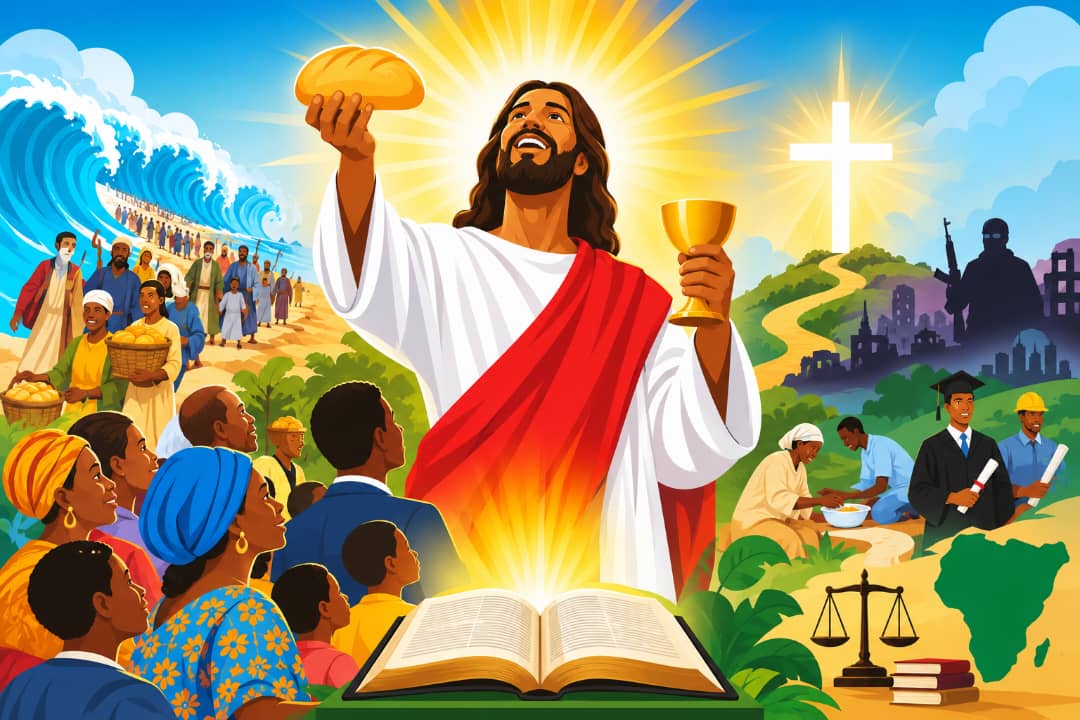
The encounter between Jesus and the people who followed Him after the feeding of the five thousand provides an important answer. Having witnessed the miracle of five loaves and two fish feeding thousands, the people searched for Jesus and crossed the sea to find Him. However, Jesus understood their motivation.
In John 6:26, He told them: “You seek me, not because you saw the signs, but because you ate of the loaves and were filled.” They were interested in the bread but had failed to understand the significance of the person who provided it.
Jesus, therefore, redirected their attention in John 6:27: “Do not labour for the food which perishes, but for the food which endures to everlasting life.”
This exposes a major challenge facing Christianity when material provision becomes more important than spiritual transformation. We have people praying for wealth without embracing integrity, seeking powerful positions without learning responsible leadership and praying against enemies without practising forgiveness, justice and reconciliation.
We ask for miracles but sometimes neglect the transformation of our minds and character. We ask God to change our circumstances while resisting His demand that we change our lives.
There is nothing wrong with praying for daily bread. Jesus Himself taught His disciples to make that request. The problem arises when Christianity is reduced to the continuous pursuit of material benefits while the gift of eternal life is neglected. God provides bread to sustain physical existence, but through Jesus Christ, he offers something greater: eternal life.
When the Israelites escaped slavery in Egypt, they entered a wilderness where survival presented enormous challenges. They had gained freedom but had not reached the Promised Land. Faced with hunger, they complained, and God responded by providing manna from heaven.
Manna was a demonstration of God’s faithfulness, compassion and sustaining power. However, it was intended for a particular historical circumstance. It had to be gathered regularly, could not provide permanent physical security and could not prevent death. Although the Israelites received this miraculous provision, many eventually died in the wilderness.
Jesus therefore reminded his listeners in John 6:49, “Your fathers did eat manna in the wilderness, and are dead.” He was not dismissing the miracle performed during Moses’ leadership. Rather, he was explaining that although manna was important, it was not the ultimate provision God had prepared for humanity.
The Israelites needed more than physical food. They needed redemption, spiritual maturity and a lasting relationship with God. Similarly, a church that continually prays for material provision but neglects knowledge, discipline, productive work, responsibility and spiritual growth risks producing religiously dependent people rather than mature disciples.
Jesus takes this teaching further when he declares in John 6:35, “I am the bread of life.” Unlike manna, which was something God provided, Jesus presents himself as God’s ultimate gift to humanity. In John 6:51, he declares, “I am the living bread which came down from heaven: if any man eat of this bread, he shall live for ever.”
The distinction is fundamental. Manna sustained physical life temporarily, but Christ offers eternal life. He does not merely promise to give us something that sustains existence. He offers himself as the foundation of our salvation.
Eating the Bread of Life means believing in Christ, accepting his sacrifice, living according to his teachings and remaining in fellowship with him. It means allowing his character to influence our decisions, relationships and conduct rather than merely admiring him from a distance.
A person can attend church every Sunday, carry a Bible and sing Christian songs without allowing the teachings of Jesus to govern his or her life. Christianity is not simply about obtaining things from Jesus. It is about receiving him, following him and allowing his life to transform ours.
Danger of Manna-centred Christianity, the cost of ignorance
Let me make an important clarification. There is nothing wrong with praying for employment, healing, financial breakthroughs, protection or success. God is concerned about our material needs, and Jesus taught his disciples to pray for daily bread.
The danger begins when material provision becomes the centre of our theology, preaching and understanding of God’s purpose. When Christians measure God’s presence primarily by the material benefits they receive, they risk misunderstanding the Gospel.
We cannot pray for prosperity while neglecting integrity, celebrate wealth acquired through corruption or seek positions of authority without accepting the responsibility that comes with leadership. Similarly, we cannot continually pray against enemies while refusing to practise reconciliation and love our neighbours.
Prayer must also be accompanied by responsible action. A student who prays for academic success must study, a farmer who seeks a good harvest must embrace productive agricultural practices, and someone seeking healing should not reject appropriate medical attention. Faith is not an excuse for irresponsibility.
The Church must, therefore, move beyond prayer without transformation, knowledge, obedience and accountability. Jesus did not call people merely to become consumers of miracles. He called them to become disciples.
This brings us to another serious problem confronting Christianity in Nigeria and Africa: ignorance. Hosea 4:6 declares, “My people are destroyed for lack of knowledge.”
Ignorance can manifest in different ways. Spiritual death occurs when humanity becomes alienated from God through sin, while intellectual death develops when people surrender their capacity to think, investigate, question and learn. Christians who accept every religious claim without examination become vulnerable to manipulation and deception.
We must reject the false assumption that education and spirituality are enemies. African Christianity needs prayerful people who can also think, study, understand history, appreciate science and engage responsibly with economics, agriculture, technology and public administration.
There is also moral death, which occurs when corruption, exploitation, dishonesty and violence become normalised. A church may be crowded but morally weak, just as a society may have impressive religious institutions while continuing to suffer injustice.
Social and institutional death follow when people abandon their responsibilities towards one another and institutions become instruments of personal enrichment rather than public service. A church loses its purpose when leaders prioritise personal wealth above the Gospel, while government institutions lose credibility when public resources are treated as private property.
Jesus offers more than the preservation of biological existence. He offers a life that transforms our relationship with God, ourselves and society. We must therefore stop measuring life exclusively by our possessions, positions and years on earth and begin asking whether we are genuinely alive in Christ.
The Bread of Life in a country experiencing suffering, insecurity
What does this message mean for Christians living in Nigeria and other African countries? How can we preach eternal life when innocent people are being murdered, communities are displaced, farmers cannot safely access their fields and young people struggle to find opportunities?
The Gospel must never become an escape from the realities of human suffering. Jesus fed the hungry, healed the sick, confronted hypocrisy, defended the vulnerable and wept at the grave of Lazarus. His ministry demonstrated that concern for eternal life must go hand in hand with compassion for people experiencing earthly difficulties.
When terrorism, kidnapping and violence destroy communities, the church must do more than tell survivors to pray and move on. We must pray, but we must also support displaced families, provide assistance to vulnerable people, comfort grieving families and promote peaceful coexistence.
We must refuse to justify violence in the name of religion, ethnicity or political ambition. We must encourage responsible reporting of threats and cooperation with lawful security institutions. If Christ is the Bread of Life, the church must become a community that protects, nourishes and serves humanity.
The same message must challenge bad leadership and governance. The church cannot remain silent about corruption, the misuse of public resources, exploitation of poor people and the manipulation of citizens through ethnic and religious divisions. Public office is a responsibility, not an opportunity for personal enrichment.
Christians must demonstrate responsible citizenship by rejecting bribery, demanding transparency, supporting accountable institutions and participating constructively in society. We cannot pray for a better country while participating in the very practices that undermine its development.
Similarly, unemployment and poverty require more than repeated prayer meetings. We must encourage education, vocational training, entrepreneurship, agricultural development, innovation and productive work. Churches should become centres where young people acquire skills, develop their abilities and receive support to become economically productive.
A Church that preaches the Bread of Life must also demonstrate practical concern for hungry people, widows, orphans and vulnerable families.
Religious manipulation must equally be confronted through sound biblical teaching and accountability. Not every prophecy is genuine, not every financial appeal represents divine instruction and not every successful ministry necessarily reflects faithfulness to the Gospel. Christians must return to Scripture and examine religious claims in the light of Christ’s teachings and character.
However, we must also understand that Jesus does not promise that believers will never experience physical death. John 11:25–26 declares, “I am the resurrection, and the life: he that believeth in me, though he were dead, yet shall he live.”
The apostles died, Christian martyrs died, and faithful pastors, missionaries and believers have experienced physical death. The promise of Christ is not permanent biological existence on earth but victory over death through resurrection.
Our hope is, therefore, founded on the risen Christ. We may experience suffering, bereavement and persecution, but none of these can cancel God’s promise of eternal life. As Paul explains in 1 Corinthians 15:51–57, death will ultimately be defeated through the resurrection.
Christianity does not deny suffering or death. It declares that neither has the final authority over those who belong to Christ.
Our response, call to action
What would the church look like if it genuinely understood the teaching of Jesus in John 6? It would become a community that produces mature disciples rather than people who depend exclusively on the next miracle.
Such a Church would encourage prayer alongside personal responsibility, celebrate miracles without replacing Christ-centred discipleship, promote biblical and intellectual maturity and teach that prosperity must be accompanied by integrity.
It would challenge tribal hostility, religious intolerance and discrimination while encouraging servant leadership, transparency and accountability among pastors and other church leaders. Above all, it would prepare believers not merely to succeed in this world but to live faithfully before God.
The Church must become a place where people discover Christ, develop their gifts, acquire knowledge, support one another and contribute positively to society. This is the kind of fellowship reflected in Acts 2:42–47 and Acts 4:32–35.
Every Christian must examine his or her life. Are we following Jesus because of who he is or merely because of what we expect him to give us? Has our faith made us more knowledgeable, responsible, truthful and compassionate? Are we asking God to change our circumstances while refusing to change our behaviour?
Does our church produce mature disciples or merely people who continually depend on miracles? If we were to face physical death today, would our confidence rest in our possessions, achievements and religious activities or in Jesus Christ, the resurrection and the life?
These questions are intended to awaken us to the true meaning of Christianity.
Beloved, there is nothing wrong with asking God for bread, employment, healing, protection and deliverance from insecurity. But we must not stop there. We must move from asking for bread to knowing the Bread of Life, from seeking miracles to becoming disciples, from ignorance to knowledge, from corruption to integrity, from hatred to love and from selfishness to service.
The Israelites received manna, but they eventually died. Jesus offers something greater because he offers himself as the source of eternal life. Our earthly possessions may disappear, political systems may disappoint us, economic circumstances may change and our bodies may become weak, but the life Christ gives cannot be destroyed by the grave.